
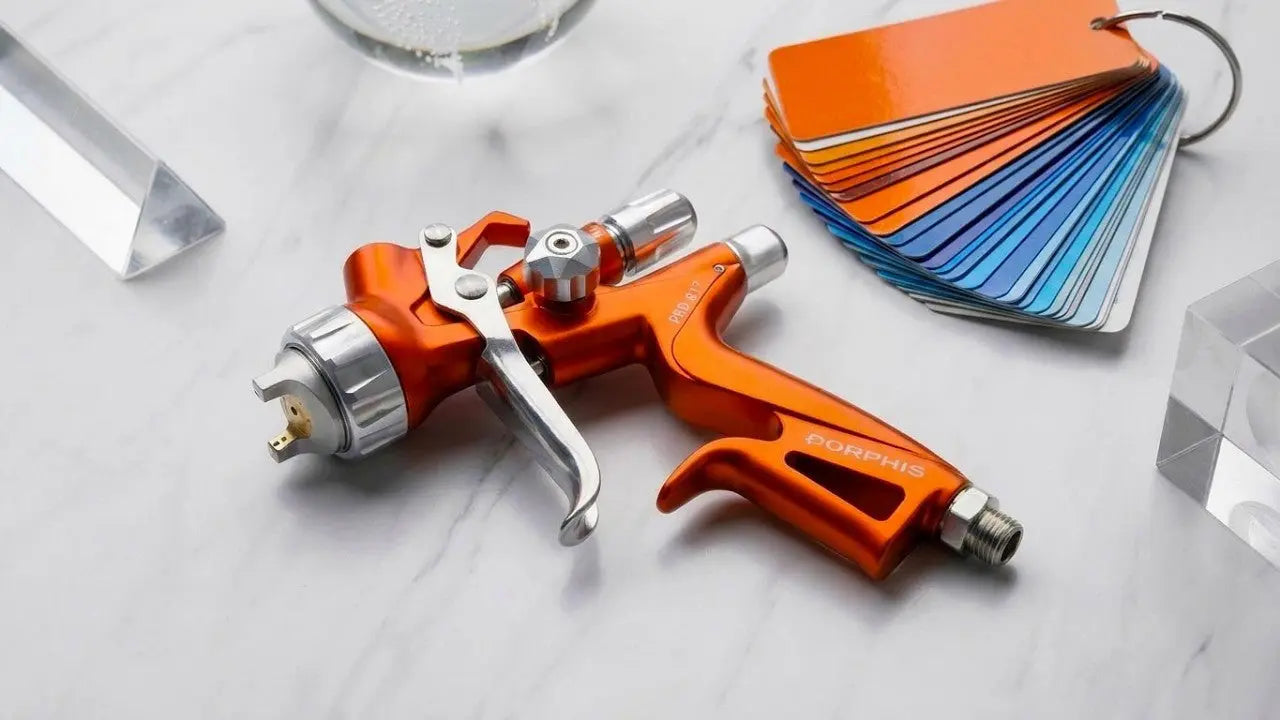
The PRD-817 is easy to oversell. It has a wide published fan, a split-nozzle design and a product page full of finish claims. But the first thing a buyer should know is less exciting: this gun needs air.
PORPHIS lists the PRD-817 at 15.2 CFM with a 1.3 mm nozzle. If your compressor and air line cannot sustain that demand, the rest of the specifications do not matter. If they can, the 817 becomes a much more interesting option for painters who prioritize controlled atomization and clear-coat work.
This review separates the published specifications from what should be verified on a real spray-out. Add your own pattern cards, panel photos and recorded test conditions to this page before calling any finish result “proven.”
PRD-817 Specifications That Matter
|
Specification |
Published PRD-817 data |
Why it matters |
|
Nozzle |
1.3 mm |
Works with many automotive topcoat systems, but the coating TDS still decides whether it is appropriate. |
|
Operating pressure |
1.3–1.8 bar |
Set and verify pressure dynamically with the trigger pulled. |
|
Air consumption |
15.2 CFM / 430 L/min |
The biggest setup requirement; small compressors are a poor match. |
|
Fluid consumption |
175 ml/min |
Useful baseline when comparing material delivery. |
|
Recommended spray distance |
150 mm |
A reference point for pattern testing, not a universal distance for every coating. |
|
Published spray pattern |
260–350 mm |
A wide range that should be verified on your own pattern card and material. |
 |
 |
The First Question: Can Your Air System Run It?
Do not choose a compressor by tank size alone. A 60-gallon tank can buy reserve time, but the pump still has to replace the air the gun consumes. What matters is sustained delivered airflow at pressure, duty cycle and pressure loss through the hose, regulator, filters and fittings.
For a repeatable setup, use our spray gun air pressure guide and set the gun under flow with the trigger pulled.
If the pressure falls during a long pass, the fan and atomization can change even if the gun itself is functioning perfectly.
What the Split-Nozzle Design Is Trying to Do
PORPHIS positions the PRD-817 as a split-nozzle gun intended to improve atomization and coating distribution. That design is the real reason to consider it—not a promise that every panel will come out “glass” automatically.
The useful test is a spray-out card: does the fan stay balanced top to bottom, are the edges overly dry, and does the pattern remain stable through a continuous pass? Those are things a painter can see and record.
If you are choosing within the same family, our PRD-817 vs. PRD-717 comparison focuses on how the two designs differ rather than treating one as universally better.
Where the PRD-817 Makes the Most Sense
|
Use case |
Fit |
Reason |
|
Clear coat / topcoat where 1.3 mm is approved |
Strong fit |
Fine-control, full-size automotive setup; verify film build and flow-out with your clear. |
|
Basecoat requiring controlled atomization |
Potentially strong fit |
Depends on paint system, reducer, pressure and painter preference. |
|
Small-compressor garage setup |
Poor fit |
15.2 CFM demand is the limiting factor. |
|
High-build primer requiring large fluid tip |
Poor fit |
Current PRD-817 configuration is 1.3 mm only. |
PRD-817 vs. PRD-815: Do Not Turn This Into a Fake “Winner”
The more useful comparison is specialization versus flexibility. The PRD-817 is a 1.3 mm, high-air-demand precision-oriented option. The PRD-815 uses a different MP setup and is positioned more as a versatile multi-stage gun.
We keep the detailed trade-offs in the PRD-817 vs. PRD-815 comparison so this review does not repeat a second keyword-heavy comparison article inside itself.
If you are considering the more versatile option, see the PRD-815 spray gun review.
What I Would Remove From the Old Review
- “90% of premium-brand performance at one-third the price” — not meaningful without a defined test and current price comparison.
- “~1% overspray” as a proven fact — keep only as a clearly labeled manufacturer claim unless you have a test method and measurement.
- “Glass finish with minimal orange peel” as a guarantee — finish depends on clear viscosity, reducer, film build, distance, overlap, booth conditions and painter technique.
- Untraceable customer quotes — use only reviews that can be linked to the exact PRD-817 version.
- “30–60 gallon / 3+ HP is enough” — replace with sustained airflow requirement.
Real Limitations
- 15.2 CFM is a meaningful air demand. This is not a small-compressor gun.
- The current fluid setup is 1.3 mm only, so it is not a universal primer-to-clear solution.
- A wide fan is not automatically better. On smaller parts, a painter may prefer a narrower, lower-demand setup.
- A precision-oriented gun still needs correct viscosity, reducer, pressure, distance and overlap.
How to Evaluate It Properly in Your Shop
- Use the coating TDS to choose material reduction and confirm that a 1.3 mm setup is acceptable.
- Set dynamic pressure with the trigger pulled.
- Make a spray pattern at a recorded distance and photograph it.
- Record compressor pressure recovery during a long pass.
- Spray a test panel and photograph the cured finish under side lighting.
- Record what you would change on the next panel instead of calling the first result “perfect.”
For clear-coat technique problems that can be mistaken for a gun problem, see our overlap-line troubleshooting guide.
Who Should Buy It — and Who Should Skip It?
|
Consider the PRD-817 if… |
Skip or compare another gun if… |
|
You have a compressor/air system that can comfortably sustain 15.2 CFM. |
Your compressor is small or pressure drops during full-panel passes. |
|
Your topcoat/basecoat system supports a 1.3 mm fluid setup. |
You need a 1.4–1.8 mm or primer-oriented setup. |
|
You value controlled atomization and are willing to test/record settings. |
You want a “magic setting” that works with every coating. |
|
You are deciding between dedicated higher-end PORPHIS 81-series setups. |
You need one lower-air-demand gun for many unrelated tasks. |
Final Verdict
The PRD-817 is not compelling because of a headline like “1% overspray” or because someone says it sprays like a gun that costs three times more. It is compelling if its actual design matches your booth: 1.3 mm, 15.2 CFM, a wide published pattern and a split-nozzle architecture aimed at controlled atomization.
Its biggest strength and biggest limitation are connected. The gun is designed around a full professional air supply. Give it stable air and a coating that suits the 1.3 mm setup, then judge it with a pattern card and a real panel. Starve it for air and no review can make the result meaningful.
That is the standard this page should follow too: evidence first, claims second.
Udostępnij:
Recenzja pistoletu natryskowego PORPHIS PRD-725: Specyfikacje, konfiguracja, najlepsze zastosowania i ograniczenia