
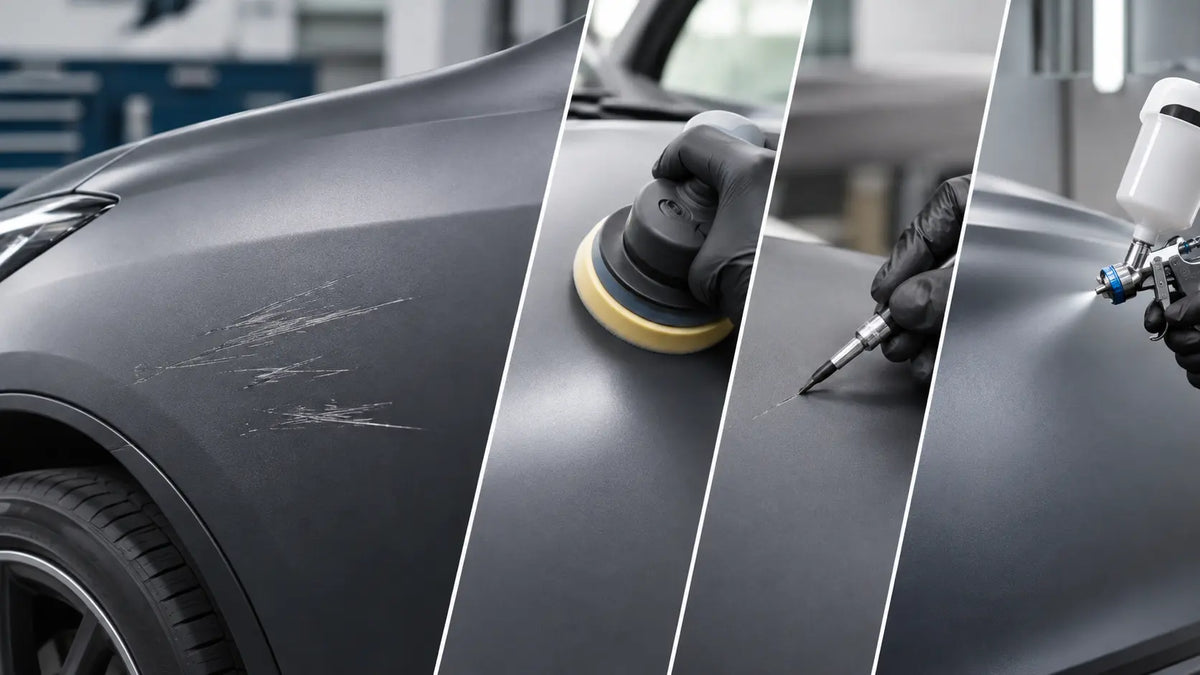
Matte paint is unforgiving in a way glossy paint is not. On a normal clear coat, a light scratch may disappear after careful compounding and polishing. On a matte finish, the same polishing step can leave a shiny patch that attracts more attention than the scratch did in the first place.
That is why matte paint scratch repair starts with diagnosis, not correction. Before you sand, buff or order paint, you need to know whether you are looking at surface contamination, damage inside the matte clear, damage through the color layer, or a substrate problem underneath.
Can Matte Paint Scratches Be Repaired Without Respraying the Whole Panel?
|
What you find |
Likely repair path |
|
Dirt, rubber transfer or surface contamination |
Clean with a product approved for the matte system; do not jump straight to abrasives. |
|
Very light mark in the outer surface |
Follow the coating manufacturer’s matte-care/repair procedure; conventional polishing may change gloss. |
|
Scratch through matte clear |
Refinishing is often required. Whether a local repair is allowed depends on the exact system. |
|
Basecoat damage |
Color repair plus a compatible matte clear system may be required. |
|
Primer / metal / plastic exposed |
Repair the substrate first, then rebuild the approved coating system. |
Why Can’t You Buff or Polish Matte Car Paint Like Gloss Paint?
The issue is not that matte clear is physically impossible to polish. The issue is what polishing does to the surface. Gloss clear is designed to look smoother and more reflective as defects are leveled. Matte clear relies on a controlled texture and flattening system to scatter light. Smoothing one small area can raise the local gloss and create a visible halo.
That is also why a dust nib in matte clear is much harder to ‘fix later.’ In its Matt Clear System guidance, Standox warns that dust inclusions cannot simply be removed from the dry film by sanding and polishing, and that clearcoat fading/blending is not possible in that system.
Matte Paint Blending Problems: Color Match Is Only Half the Job
A matte repair can match the color code and still look wrong. The eye also sees gloss level, texture and the way light rolls across the panel. Those are influenced by film build, mix ratio, hardener/thinner choice, gun distance, pressure, overlap, flash time and drying conditions.
For that reason, a spray-out card is more useful than guessing on the vehicle. Make the card with the same material, mix, gun setup and drying method you intend to use, then compare it with the vehicle under natural light before committing to the repair.
If the panel needs to be refinished, review the surface sequence in our paint prep before base coat guide.
How to Approach Matte Paint Scratch Repair
1. Identify the exact paint system: OEM matte clear, satin clear, single-stage matte, wrap, or another specialty finish.
2. Clean the damage with products approved for that finish. Do not use a polishing compound as a diagnostic tool.
3. Determine how deep the scratch goes and whether the surrounding coating is stable.
4. Check the coating manufacturer’s repair procedure before deciding on a spot repair or full-panel refinish.
5. If refinishing is needed, make spray-out cards to verify color and gloss before painting the vehicle.
6. Reproduce the approved film build, pressure, distance, overlap, flash and drying process as consistently as possible.
Satin Paint Repair Cost: Why There Is No Useful Flat Price
Satin paint repair cost depends less on the length of the scratch than on how far the repair has to go. A superficial mark may need only careful cleaning. A scratch through the clear may require an entire panel refinish if the system does not permit blending. Damage into primer, metal or plastic adds substrate repair before the color and matte clear are even considered.
Matte Finish Respray vs Wrap
|
Option |
Makes sense when |
Does not solve |
|
Respray |
The original coating or substrate is damaged and needs a true repair. |
Nothing—the repair still depends on correct prep and system compatibility. |
|
Wrap |
The existing paint is sound and the goal is mainly appearance change or broad visual coverage. |
Rust, peeling paint, unstable filler, deep scratches or adhesion failure underneath. |
Where the PRD-817 Fits In
If the repair procedure calls for refinishing, application consistency matters because changes in film build can shift the final gloss level. The PRD-817 is a 1.3 mm VS spray gun published at 1.3–1.8 bar, 15.2 CFM, a 150 mm recommended distance and a 260–350 mm spray pattern.
Those numbers do not make it a ‘matte repair gun.’ They simply define an application tool that can be set up repeatably when the coating TDS supports a 1.3 mm gun and the air system can supply it.
For model-specific setup context, see our PRD-817 spray gun review.
Before any 2K matte-clear work, review the 2K clear coat safety guide.
Final Takeaway
Matte paint scratch repair is difficult because the finish is judged by color, gloss and texture at the same time. Do not treat matte clear like a glossy clear that can always be sanded and polished back to shape. Identify the system, determine the depth of the damage, follow the paint maker’s repair procedure and verify the gloss on a spray-out card before you touch the vehicle.
If the system does not permit blending, a full-panel refinish may be the cleanest way to make the repair disappear.
Udostępnij:
Spray Painting in High Humidity: How Heat, Humidity & Panel Temperature Change the Finish
Base Coat Cracking After Spraying: How to Find the Layer That Failed