
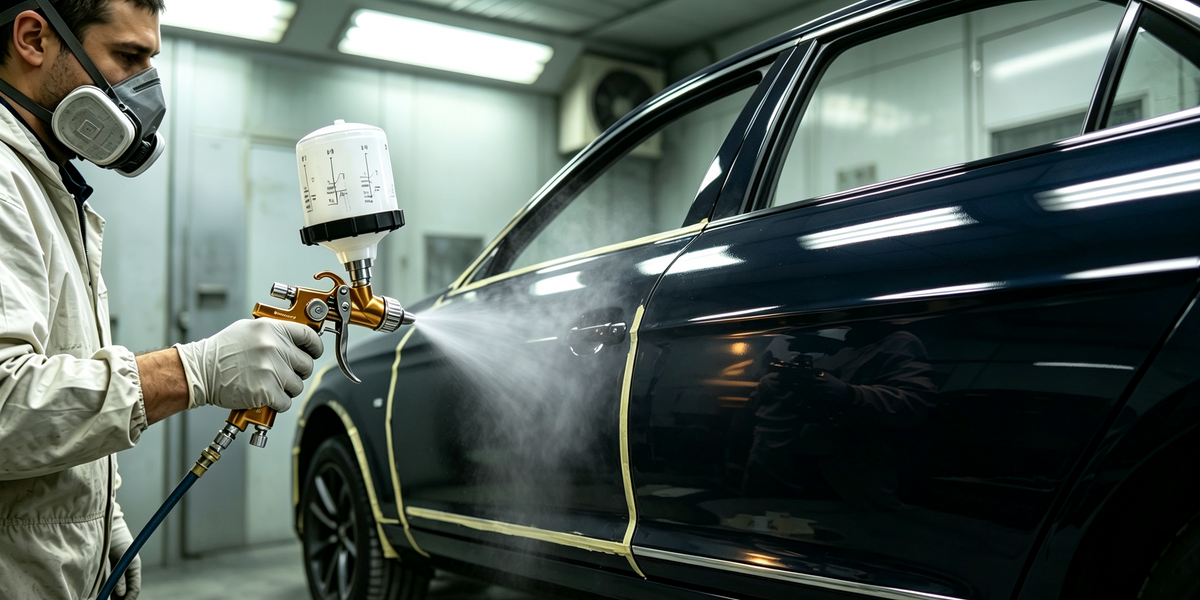
When painters say a 2K clear job is making “too many fumes,” they are often describing three different things at once: visible overspray mist, solvent vapor and odor. Those are related, but they are not the same problem.
You can reduce unnecessary overspray with a better spray setup. You cannot tune away the chemical hazard of spraying 2K material. That distinction matters before you touch the regulator.
First: Overspray Control Is Not Respiratory Protection
Many 2K automotive clear coats use isocyanate-containing hardeners. Spray application creates a fine mist that can be hazardous even when you cannot see or strongly smell it. A gun with good transfer efficiency can waste less material, but it does not replace a properly extracted spray booth/room, air-fed respiratory protection, PPE, clearance time, or the coating SDS.
Before adjusting the gun, read our 2K clear coat safety guide. For the home-garage question specifically, see can you spray 2K clear coat at home?.
What Can Actually Reduce 2K Clear Coat Fumes and Mist?
|
You can improve |
You cannot replace |
|
Unnecessary overspray from excess pressure or poor distance |
Proper spray booth / extracted spray room |
|
Fan size that is too wide for the job |
Air-fed breathing apparatus where required |
|
Inconsistent dynamic pressure |
SDS/TDS and exposure controls |
|
Excess material from poor overlap or technique |
Keeping unprotected people out until the area has cleared |
|
Air-supply instability that changes the fan |
Professional safety procedures for 2K spraying |
Why Does My 2K Clear Coat Produce More Mist Than Primer?
Do not assume every clear coat inherently produces more mist than every primer. The amount you see depends on the exact product, solids content, viscosity, reducer/hardener, gun setup, nozzle, film build, pressure, booth airflow and lighting.
A clear job may look “mistier” because it is often sprayed as a fine automotive topcoat across broad panels and because booth lighting makes the cloud easier to see. If the cloud seems excessive, diagnose the setup rather than assuming the chemistry is the only reason.
How to Reduce 2K Clear Coat Fumes When Spraying
1. Set Dynamic Pressure at the Gun
Set pressure with the trigger fully pulled. Start inside the spray-gun manufacturer’s range and the coating TDS guidance, then evaluate the pattern card. Too much pressure can create unnecessary fine overspray; too little can produce poor atomization, coarse droplets and texture.
For the full setup method, use our spray gun air pressure regulation guide.
2. Match the Fan to the Panel
A full-width fan is not automatically the most efficient setting. Use enough fan to cover the panel consistently without throwing material far beyond the target. On small parts, a smaller pattern can reduce waste when the gun is designed to work that way.
3. Keep Distance, Angle and Travel Speed Consistent
Moving too far away gives droplets more time to miss the panel or dry in the air. Tilting the gun sends one side of the fan away from the target. Keep the gun square to the surface and work inside the manufacturer’s recommended distance range.
4. Do Not Chase Gloss With Extra Film Build
Follow the clear-coat TDS for coat count, target film build and flash time. Extra-wet passes do not “solve” atomization; they increase material use and can add runs, solvent retention and cure problems.
If the clear remains soft or rubbery after the stated cure window, use our guide to clear coat not curing instead of adding more material.
5. Make Sure the Compressor Can Feed the Gun
If the compressor cannot sustain the gun’s airflow demand, dynamic pressure falls during the pass and the spray pattern changes. That can lead to dry areas, inconsistent film build and wasted material.
Check your air supply with our guide to match spray gun CFM to air compressor.
Low Overspray Spray Gun Settings: A Better Way to Think About It
There is no universal “low overspray” pressure or fluid setting. A useful setup is the lowest pressure inside the approved range that still gives complete, repeatable atomization for that coating and nozzle—while the fan, fluid delivery, distance and travel speed remain balanced.
|
Adjustment |
What you are looking for |
|
Dynamic pressure |
Stable pressure through a full pass |
|
Fan width |
Even pattern sized to the work area |
|
Fluid delivery |
Enough for target film build without flooding |
|
Distance |
Inside gun/coating guidance; square to the panel |
|
Overlap |
Consistent wet edge according to the coating system |
What PSI Should I Spray 2K Clear Coat At?
There is no single PSI that is correct for every 2K clear coat. Gun design, nozzle size, clear viscosity, inlet restrictions and the coating manufacturer’s process all matter. Use the gun’s recommended operating range as the starting point, measure dynamically at the gun, and adjust from a spray pattern—not from a universal internet number.
How to Stop Paint Smell Reaching Neighbors
The safe answer is not “spray when fewer people are outside” or “open the garage door.” Odor control is not exposure control, and wind can carry spray mist away from the work area.
For isocyanate-containing 2K products, professional guidance calls for a dedicated extracted spray booth or spray room, keeping unprotected people out of the spray area, and using air-fed breathing apparatus while spray mist is present. If your location cannot contain and exhaust the spray safely, the correct solution is to use a suitable spray facility—not to rely on timing, wind direction, or a different gun setting.
Where the MPH-338 Fits In
For small-area work, a mini gun can help keep the spray pattern proportional to the part. The current PORPHIS MPH-338 is an LVLP mini spray gun with 0.8/1.0/1.2 mm nozzle options, a 1–1.5 bar operating range, 5.7 CFM air consumption, a 150 mm recommended distance and a 120–200 mm published spray pattern.
That makes it more logical for spot repair, trim, mirrors, wheel areas and other small sections than for a full hood or complete vehicle. It may reduce unnecessary material around a small target when correctly set up, but it is not respiratory protection and does not make a garage safe for 2K spraying.
VIEW MPH-338 LVLP MINI SPRAY GUN
Do Not Forget Air Quality
Water or oil contamination in compressed air creates a different set of finish problems. Drain the compressor, maintain filters and separators, and keep the air system clean.
If you are seeing pinholes, bubbles or random craters, read our guide to moisture in compressed air and solvent pop.
Final Takeaway
To reduce 2K clear coat fumes in the way painters usually mean it, focus on avoiding unnecessary overspray: correct dynamic pressure, the right fan size, stable distance, controlled fluid delivery and an air supply that can keep up. Those changes improve transfer and waste.
But the invisible part of the hazard does not disappear because the cloud looks smaller. Treat spray settings as application control and treat 2K safety as a separate requirement involving the product SDS, extracted spray area, respiratory protection and clearance procedures.
FAQ
How to reduce 2K clear coat fumes when spraying?
Reduce unnecessary overspray with correct dynamic pressure, fan size, distance, fluid delivery and stable airflow—but use proper spray-area extraction and respiratory protection for the chemical hazard.
Why does my 2K clear coat produce more mist than primer?
It may be the product, gun setup, film build, booth airflow or simply visibility under booth lighting. Do not assume all clears inherently produce more mist than all primers.
What PSI should I spray 2K clear coat at?
Use the gun manufacturer’s operating range and the coating TDS. Set pressure dynamically with the trigger pulled and confirm the result on a spray pattern card.
How to stop paint smell reaching neighbors?
Use a spray facility that contains and exhausts the mist safely. Do not rely on open doors, outdoor spraying, wind direction or times when fewer people are nearby.
Best spray gun setting to reduce clear coat overspray?
There is no universal number. Balance dynamic pressure, fan, fluid, distance and travel speed so the pattern is fully atomized and sized to the work without excess material outside the target.
Udostępnij:
Basecoat Wrinkling Over Bodywork: Why It Lifts and How to Respray Correctly
Spray Painting in High Humidity: How Heat, Humidity & Panel Temperature Change the Finish