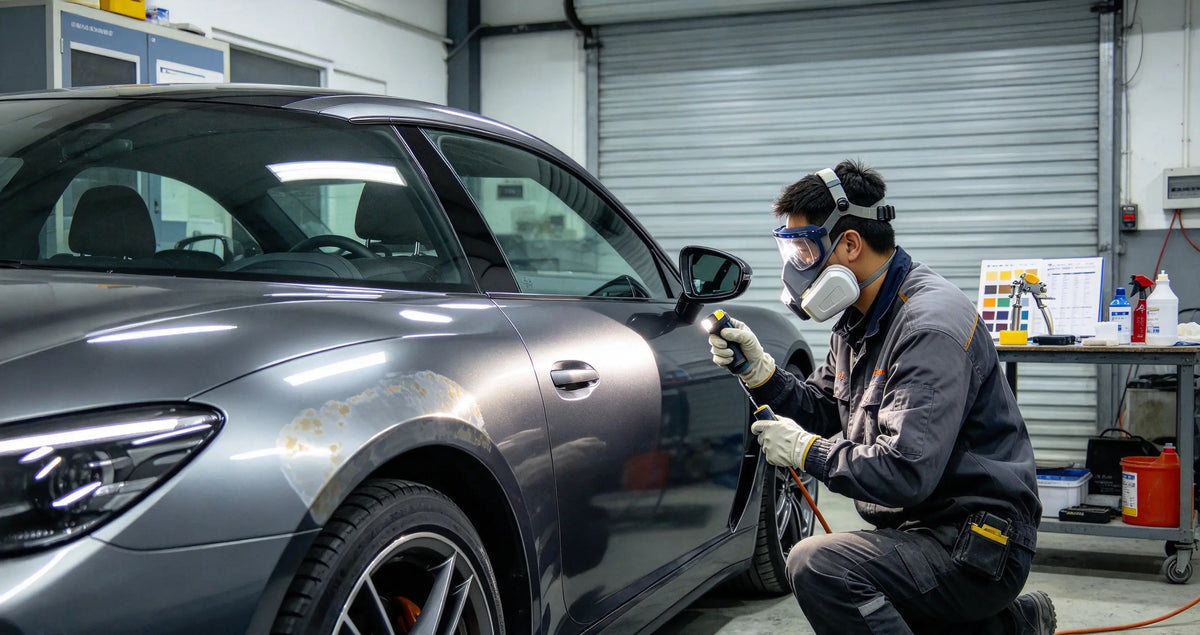
Metallic paint is unforgiving because aluminum flakes and other effect pigments reflect light differently as their position changes. A panel can feel smooth and still look patchy, striped, or darker from one angle than another.
The reliable approach is to control the whole process: prepare the surface, mix the material accurately, test the gun, keep the fan and travel consistent, respect flash time, and inspect the basecoat before clear. No single spray-gun setting can replace that sequence.
Start With a Balanced Spray Pattern
Keep the gun perpendicular to the panel and maintain the same working distance throughout each pass. Tilting the gun changes how much material reaches each side of the fan. Too little overlap can leave bands; too much can create locally heavy deposits.
Test the fan on a suitable surface before spraying the vehicle. Look for even material distribution, clean air-cap openings, and stable pressure. If the pattern is uneven, service the gun before changing your technique.
Avoid Excessively Wet Metallic Basecoat
A heavy basecoat can stay wet long enough for metallic particles to move before the film stabilizes. Controlled, even coats are usually more predictable than trying to achieve full coverage in one wet pass.
Some paint systems specify a final orientation or control coat. Use it only when the product instructions call for it, and inspect the appearance before applying clear. Clear coat adds gloss and depth; it does not correct uneven metallic distribution underneath.
Metallic Paint Flash Time Is a Process Window
Flash time is the interval needed for enough carrier to evaporate and for the coating to reach the condition specified for the next application. It is not a universal stopwatch value. The correct interval depends on the paint, reducer or activator, temperature, humidity, airflow, film thickness, and application technique.
|
Variable |
What it changes |
What to do |
|
Temperature |
Cooler conditions can slow evaporation; heat can shorten the working window. |
Use the reducer and flash guidance approved for the conditions. |
|
Humidity |
Can affect drying, especially in waterborne systems. |
Keep the work area within the product’s stated range. |
|
Air movement |
Appropriate airflow removes evaporated carrier; poor airflow can disturb the spray. |
Use the booth or ventilation setup designed for the coating. |
|
Film thickness |
Heavy coats generally need more time to reach the next-stage condition. |
Build coverage in controlled coats. |
|
Reducer choice |
Evaporation rate affects flow, flash, and metallic movement. |
Use the exact approved reducer and ratio. |
How Long Should You Wait Between Coats of Metallic Paint?
Follow the technical data sheet for the exact basecoat and the actual conditions. A five-minute interval may be correct for one product in one booth, but it is not a universal rule. Visual cues such as a uniform matte appearance can help, but they do not override the manufacturer’s time and recoat instructions.
Can You Take Longer Than a Five-Minute Flash Time?
Yes, when the paint manufacturer permits a longer interval and the basecoat remains inside its application window. Waiting longer is not automatically safer: an excessive delay can affect intercoat adhesion, blending, or metallic appearance depending on the system. If the film has gone beyond the approved window, follow the manufacturer’s recoat procedure instead of simply adding another wet coat.
For repeatability, record the product code, reducer, temperature, humidity, flash interval, and gun settings on the test panel. That record is more useful than a generic “five minutes” note.
Choosing a Slow Reducer for Metallic Basecoat
A slow reducer can help when the approved process calls for a longer evaporation rate, such as warmer conditions or a large panel that needs wet-edge control. It is not a universal fix for striping or mottling.
|
Question |
Why it matters |
|
What is the exact basecoat product? |
Different products under the same brand can use different reducer families. |
|
What temperature range is approved? |
Reducer speed is selected for conditions, not just the painter’s preference. |
|
What is the mixing ratio? |
An unapproved ratio changes film behavior and coverage. |
|
What flash time is specified? |
A slower reducer can extend the interval as well as the wet time. |
|
What does the test panel show? |
The panel reveals whether the metallic settles evenly before the vehicle is committed. |
For a product-specific question such as PPG Paraglaze Metallic, use the reducer named in the technical documentation for that exact product code and region. Do not substitute a generic slow reducer because the shop feels warm.
How to Prevent Dust Nibs When Painting a Car at Home
Dust nibs are particles trapped in wet coating. They can come from sanding residue, clothing, dirty air lines, contaminated equipment, or airflow that disturbs the work area at the wrong moment.
|
Source |
Practical control |
|
Vehicle and panel gaps |
Complete sanding first, then clean panel gaps, wheel arches, trim edges, and seams. |
|
Work area |
Remove loose dust before final preparation; avoid sweeping or blowing dust immediately before spraying. |
|
Compressed air |
Maintain filtration and moisture separation; check hoses, fittings, regulators, and compressor maintenance. |
|
Clothing and movement |
Wear clean garments and limit movement after the area is prepared. |
|
Between-coat inspection |
Check the surface under good light and follow the coating procedure if contamination is found. |
If the surface is not ready for paint, start with the paint prep before base coat guide before troubleshooting the gun.
Grounding a Car to Reduce Static Dust
A vehicle can accumulate static charge through movement, cleaning, airflow, and contact with clothing or other materials. A charged surface may attract lightweight dust while the coating is wet. Static control can be part of the solution, but it is not a replacement for housekeeping, clean air, or safe ventilation.
|
Do |
Do not |
|
Use a purpose-designed grounding or antistatic method suitable for the spray environment. |
Do not attach a random wire to the car and connect it to a building outlet or improvised ground point. |
|
Verify continuity with appropriate equipment where the system requires it. |
Do not assume static grounding replaces the electrical and fire controls for the booth. |
|
Keep the vehicle, clothing, and work area clean after grounding. |
Do not treat grounding as a guarantee that dust nibs will disappear. |
Does Wetting the Floor Prevent Dust?
A purpose-built wet-floor or water-wash booth can help manage airborne overspray because the floor system is engineered with the booth’s airflow, filtration, drainage, and fire controls. Wetting an ordinary garage floor is not the same thing.
Standing water can create slip hazards, affect electrical equipment, and add moisture to the work area. It also does nothing for dust coming from walls, clothing, compressed air, or the panel itself. Use a controlled, purpose-designed spray environment and follow the coating manufacturer’s safety requirements.
Choosing a Spray Gun for Metallic Basecoat
A suitable gun helps deliver a consistent fan and controlled material flow. It cannot compensate for the wrong reducer, poor flash control, dirty air, or a contaminated panel, but it supports a process that can be repeated from one panel to the next.
The PHS-155 car paint sprayer is one option to evaluate when its nozzle, air demand, and application characteristics match the selected basecoat. Test the complete setup on a sample panel first.
For pressure setup, see spray gun air pressure regulation and then verify every value against the paint TDS.
A Practical Checklist Before Spraying Metallic Paint
|
Stage |
Checks |
|
Paint preparation |
Exact basecoat and reducer confirmed; ratio measured; surface clean; panel ready. |
|
Gun setup |
Air cap, nozzle, and needle clean; fan checked; fluid delivery and pressure stable. |
|
Environment |
Dust-generating work complete; ventilation and filtration suitable; static-control plan in place. |
|
Application |
Gun angle, distance, travel speed, overlap, film build, and flash time controlled. |
|
Inspection |
Metallic coverage checked from multiple angles before clear; settings recorded from the test panel. |
For two-component clear systems, review the 2K clear coat safety guide before starting.
Frequently Asked Questions
How long should I wait between coats of metallic paint?
Use the interval in the technical data sheet for the exact product and conditions. Temperature, humidity, airflow, film thickness, and reducer choice all affect flash time.
Can I take longer than a five-minute flash time?
Yes, when the product instructions allow it and the basecoat remains within its application window. Five minutes is not a universal maximum.
How do I prevent dust nibs when painting a car at home?
Control dust before spraying, keep the air system clean and dry, wear clean clothing, limit movement, and inspect between coats in a suitable spray environment.
What reducer should I use for PPG Paraglaze Metallic?
Use the reducer approved for the exact Paraglaze product code and conditions. Confirm the ratio, temperature range, and flash requirements in the TDS or with the paint supplier.
How do I ground a car to reduce static dust?
Use a grounding and antistatic arrangement designed for the spray environment and verify that it meets the applicable electrical and fire-safety requirements. Do not improvise a connection.
Does wetting the floor help prevent dust?
A properly engineered wet-floor booth can help manage certain airborne particles. Wetting a domestic garage floor does not provide the same dust control or safety design.
Final Thoughts
A consistent metallic finish comes from controlling several small variables together. Use the approved reducer and flash window, keep the fan and travel repeatable, control dust and static, and inspect the basecoat before clear.
A suitable gun can support that process, but it cannot replace a correct paint system, clean air, a prepared surface, or a safe spray environment. Test first, change one variable at a time, and record what produced the even result.
Compartilhar:
Can I Apply Epoxy Primer Over Old Paint?
Why Does Silver Metallic Paint Have Stripes?