
1. Strategic Context and Evaluation Framework
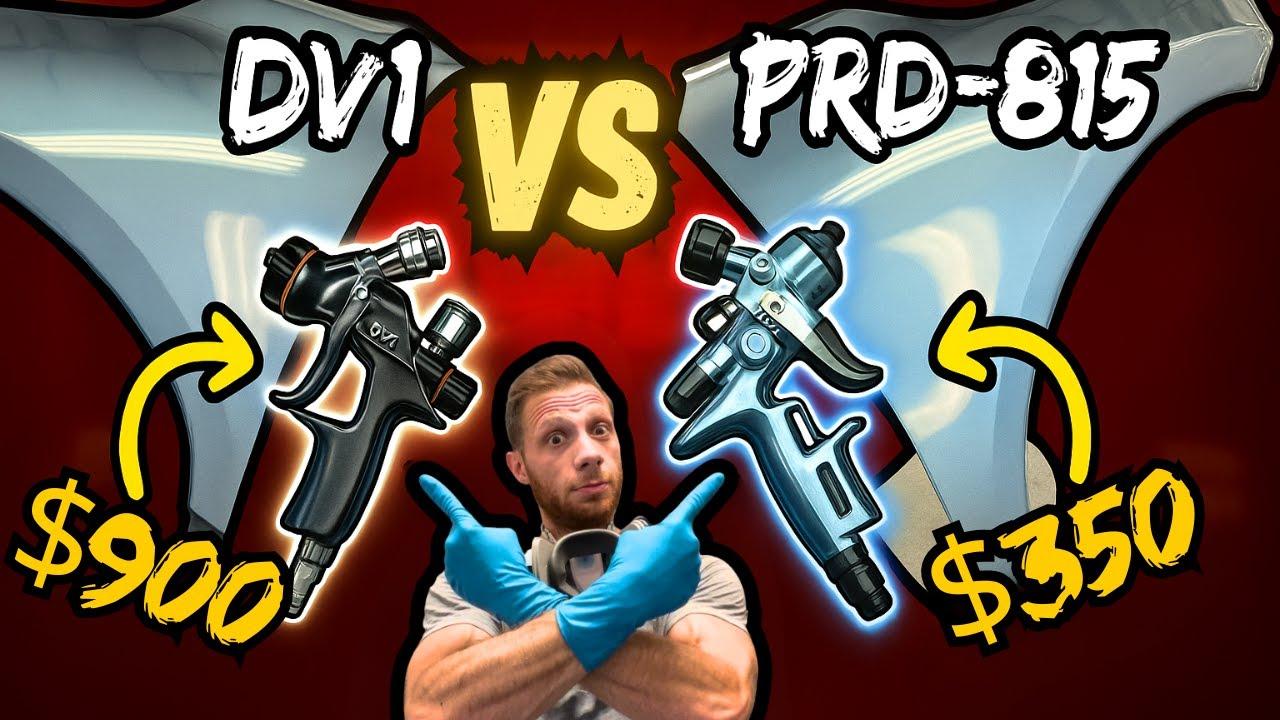
In the high-stakes environment of professional automotive refinishing, the selection of fluid delivery systems is a strategic pivot point that dictates shop throughput, finish quality, and long-term profitability. The choice between established flagship equipment, such as the DeVilbiss DV1, and high-value disruptors like the PRD-815 involves more than a simple comparison of price tags; it is an assessment of how capital equipment aligns with specific production goals. While the DV1 is positioned as a premium standard-bearer, the PRD-815 aims to provide a professional-grade alternative that challenges the ROI traditional shops expect from their primary investments.
The following table establishes the baseline for this technical evaluation:
|
Feature
|
DV1 (High-End)
|
PRD-815 (High-Value)
|
|---|---|---|
|
Capital Expenditure
|
~$900.00
|
~$350.00
|
|
Industrial Design/Aesthetics
|
Professional Polished Chrome
|
Superior Aesthetics (High-Value Finish)
|
|
Nozzle Configuration
|
1.3 mm
|
1.3 mm
|
|
Material Specification
|
Omni MC161 Clear Coat
|
Omni MC161 Clear Coat
|
To ensure an objective technical assessment, a "fairness protocol" was strictly enforced. This involved utilizing a shared material source distributed evenly between both units and standardizing hardware to 1.3 mm tips. Critically, to equalize the mechanical playing field, the DV1’s integrated regulator was bypassed—standardizing the test to the PRD-815's configuration. This methodology is essential for isolating the performance of the air cap and internal fluid dynamics, ensuring that results are based on material delivery rather than mechanical advantages.
This foundation allows for a precise analysis of how these tools perform during active material delivery.
 |
2. Analysis of Spray Pattern and Material Atomization
Fan width and atomization fineness are the primary drivers of application efficiency and film uniformity. A broader fan allows for reduced cycle times on large panels, while finer atomization dictates the smoothness of the final clear coat.
Fan Width and Application Speed The PRD-815 possesses a significantly larger fan width than the DV1. From a strategic perspective, this translates directly to increased application speed. By covering more surface area per pass, the PRD-815 functions as a production powerhouse, enabling technicians to "walk" panels more quickly and reducing the time spent in the booth—a key metric for high-volume shop profitability.
Atomization Quality and Delivery Style Technical observation of the spray patterns reveals a distinct contrast in delivery styles. The DV1 demonstrates its premium engineering at the periphery, where atomization at the edge or the top of the pattern is noticeably finer than its competitor. This leads to a more refined, mist-like application.
The PRD-815, however, utilizes a "thick" delivery style that bridges the gap between major industry players. It behaves as a "SATA/IATA mix"; it delivers the high volume of material characteristic of a SATA gun but atomizes that material significantly finer than traditional high-volume models. For technicians, this means the PRD-815 offers a shorter learning curve for those accustomed to high-output guns, while still providing the refined breakup necessary for modern clear coats. These characteristics directly influence the resulting surface topography.
 PRD-815 Spraying Process |
 PRD-815 Spraying Effect |
 DV1 Spraying Process |
 DV1 Spraying Effect |
3. Surface Topography and Finish Quality Assessment
The automotive industry demands a dual-track approach to finish quality: "Flawless Flatness" for custom, show-car projects and "OEM Matching" for the daily realities of collision repair and orange peel replication.
Flatness Performance:
The DV1 The DV1 remains the reigning champ for achieving a smooth, minimal-texture finish. Its fluid dynamics are engineered for maximum flatness, making it the superior tool for high-end boutique work where a "glass-like" surface is the primary objective. Achieving this level of flatness with the DV1 requires less post-paint correction, saving labor hours on premium jobs.
OEM Matching:
The PRD-815 In contrast, the PRD-815 provides a distinct "plug-and-play" advantage for standard collision repair. The gun naturally produces a texture that aligns perfectly with factory finishes, such as those found on Toyota vehicles. While the DV1 might require technician intervention—adjusting pressure or distance to manually "add" texture back in—the PRD-815 produces this industry-standard texture with high consistency, facilitating faster panel blending and metallic orientation.
Comparative Texture Summary
-
DV1: Premium Smoothness – Engineered for maximum flatness and minimal texture; the specialist for high-end show-car finishes.
- PRD-815: Industrial Accuracy – Delivers a consistent, professional texture that mimics modern OEM standards without excessive adjustment.
While visual results are paramount, the operational feel of the gun determines its long-term viability in a professional setting.
4. Operational Efficiency and User Experience (UX)
Tool ergonomics and "sprayability" are critical to reducing technician fatigue and maintaining high job satisfaction in high-volume environments.
Subjective Preference and Production Reliability Despite the prestige associated with the $900 price point, the PRD-815 emerged as the preferred tool for overall enjoyment of use. Following initial panel tests, the PRD-815 was utilized for a full-vehicle respray and performed phenomenally. This indicates that the gun is not just a test-panel novelty but a durable production tool capable of maintaining high performance throughout an entire shift.
-
Standard Procedure:
Lower the air pressure significantly and decrease pass speed to allow metallics to lay down evenly. -
Pro-Tip (Speed-Only Adjustment):
Observations confirm that a perfect finish can also be achieved by maintaining application pressure but significantly slowing the walking speed. This alternative allows the technician to adjust on the fly without returning to the regulator.
The transition from visual performance to the economic bottom line defines the ultimate value of these tools.
5. Economic Verdict and Professional Recommendation
The tension between capital expenditure (CapEx) and specialized performance outcomes requires a nuanced procurement strategy.
-
Scenario A:
The Specialist Pursuit – Choose the DV1for projects requiring absolute "show-car" flatness, ultra-fine edge atomization, and the branding prestige associated with DeVilbiss. It remains the tool of choice for the highest-tier custom work.
-
Scenario B:
The Production Powerhouse – Choose the PRD-815
for high-volume OEM collision repair. Its superior fan width, "plug-and-play" Toyota-style texture matching, and operational enjoyment make it the strategic choice for throughput-focused shops.
Share:
Spray Gun Comparison: MPH-338 vs. Meiji F55、ANI R160 、Devilbiss DV1S
Spray Gun Comparison: PRD-717 vs. wata Wider4L