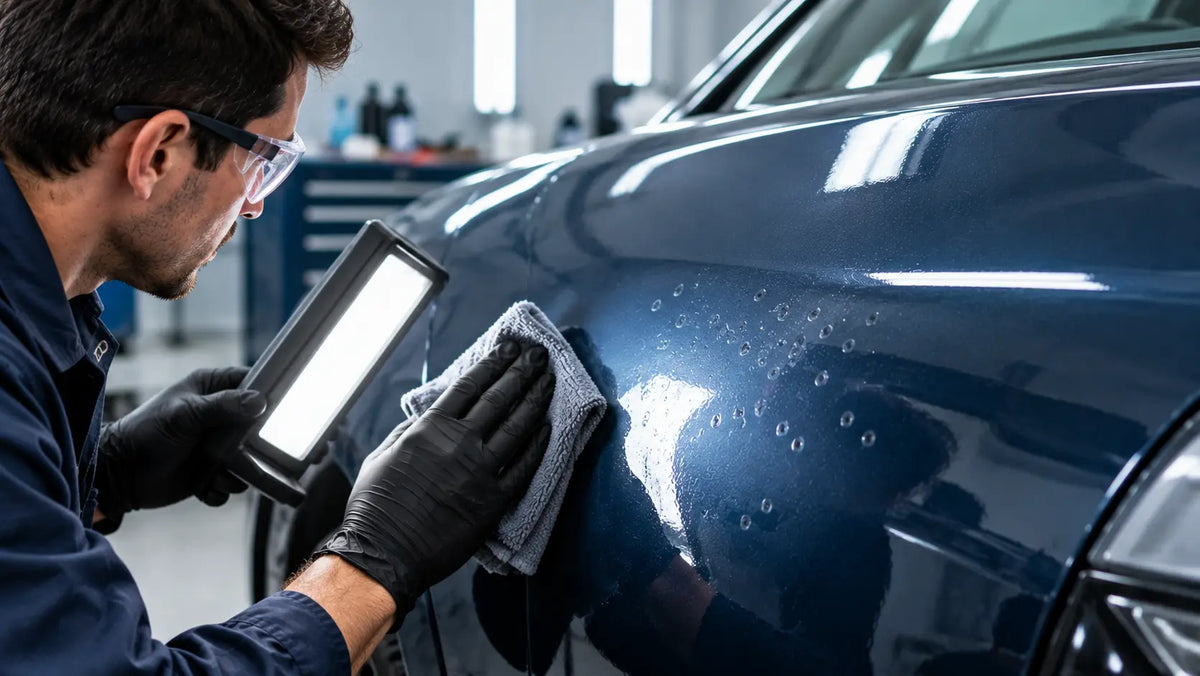
Fisheyes in clear coat need two decisions: where the contamination came from, and how much of the damaged coating must be repaired. Adding clear over a crater can leave the same defect in the next coat if the surface still will not wet properly.
Pause the application when craters appear. Note whether the problem began on the first pass, after changing a cup or gun, or only on one part of the panel. Those details help narrow the investigation before sanding removes the evidence.
Check That the Defect Is a Fisheye
Fisheyes are small depressions where wet paint pulls back, sometimes far enough to reveal the layer underneath. They commonly appear during or shortly after spraying. Their shape gives a useful clue, but similar-looking defects can require different repairs.
|
What you see |
Useful clue |
What to investigate |
|
Round craters opening in wet clear |
The film pulls away from isolated points |
Surface or application-system contamination |
|
Small openings appearing as the film dries |
Bubbles or pinholes develop after application |
Solvent release and the coating schedule |
|
Raised particles with a surrounding texture |
The defect sits above the film |
Dirt, fibres or airborne debris |
|
Broad sandy roughness |
No distinct circular withdrawal |
Dry spray, overspray or atomization |
Inspect the panel under good lighting and record when the marks appeared. Do not choose a repair from crater size alone.
Trace the Contamination Before Repainting
Silicone-containing dressings and polishes are familiar suspects, along with oil, grease and residue from handling or cleaning. A contaminated cloth can spread a small problem across a much larger area. Use the coating system's approved cleaning process, with fresh cloths and clean gloves. Our paint prep before basecoat guide covers the wider preparation sequence; the cleaner and timing still need to suit the actual products.
A cluster in one area suggests checking what touched that spot. Defects across several panels make shared materials, equipment and air supply worth investigating. Neither pattern proves the source on its own.
When fisheyes start after changing the gun
A new gun can introduce contamination if it was not prepared for first use, but the change does not establish that the gun itself is defective. Check the cup, fluid passages, cleaning materials and any lubricant used during assembly or maintenance. Clean the equipment as its manufacturer directs with a compatible cleaner. Avoid soaking seals or the entire gun unless the instructions specifically allow it.
Check the air hose and fittings too. Draining a compressor does not establish that every downstream component is clean. Maintain the filters and dryers required for the air system; a simple water separator should not be assumed to remove every form of oil contamination. Use the spray gun air supply checks to verify delivery as well as the regulator setting.
Choose the Repair for the Coating State
If the clear is still wet
Use the paint maker's correction instructions for that clear. Some defect guides describe additional coats or approved additives as options, but that does not authorize flooding every crater or adding an arbitrary fisheye eliminator. Unapproved changes can affect the coating and complicate the repair.
If the system calls for removal of wet material, follow its specified method. An improvised solvent wipe can disturb the basecoat or spread contamination. Preserve the repair boundary and the underlying layers required by the approved process.
If the clear has cured
Let the coating reach its specified repair condition. Clean it, inspect crater depth and assess whether enough sound clear remains for leveling. Shallow defects may stay within the clear; deeper craters or adhesion problems can require a broader refinish.
|
Condition after assessment |
Repair direction |
|
Shallow craters confined to sound clear |
Level only if sufficient film remains, then use the approved finishing or recoat process |
|
Craters too deep for safe leveling |
Prepare and refinish rather than repeatedly thinning the surrounding clear |
|
Sanding damages or exposes the colour layer |
Restore the basecoat as required before clearcoating |
|
Repeated craters or unsound coating |
Resolve contamination and remove failed material to a sound foundation |
There is no universal sanding grade or safe number of passes. Match the abrasive and preparation to the clearcoat and repair system. Pay attention to edges and body lines, where further removal may quickly create a breakthrough.
Decide Whether Basecoat Must Be Renewed
Removing a fisheye does not automatically require stripping to bare metal. The repair should go far enough to remove the defect and leave a suitable substrate for the next layer.
If sanding alters the colour, exposes an irregular basecoat patch or leaves contamination below the clear, a clear-only repair is no longer the default. Check the basecoat's repair and recoat instructions. Sanded metallic colour may need renewed basecoat even when the patch feels smooth. Clear will add gloss to that patch; it will not restore the original pigment arrangement.
Verify the Cause Has Been Removed
Before returning to the vehicle, prepare a clean test panel and use the intended material, cup, gun and air supply. Inspect the application and its drying behaviour. If craters return, investigate before adding more material to the repair. A successful test reduces uncertainty, although it cannot certify that the vehicle surface is free of contamination.
For the subsequent clearcoat application, the PRD-627 has a listed 1.3 mm nozzle configuration. Check its suitability against the clearcoat's technical data sheet and the air supply available. Equipment selection comes after contamination control.
If the repair involves spraying 2K material, review the 2K clear coat safety guide and the product SDS before work. Use the specified spray environment and respiratory protection.
Frequently Asked Questions
Can fisheyes be polished out
Polishing is not a dependable repair for deep craters. Minor defects may be correctable only when their depth and the remaining clear allow it. Polishing also leaves the original contamination source unresolved.
Can I dab clear into individual fisheyes
A dot of clear may crater again or leave a visible repair. Use the coating maker's defect procedure rather than treating spot filling as a general solution.
Should I add fisheye eliminator
Only if the coating manufacturer approves the additive, dose and application. It does not replace cleaning the contamination source.
Why do fisheyes return after sanding and repainting
Contamination can remain on the panel or re-enter through cloths, materials, equipment or air. Recheck those paths before another refinish.
Udostępnij:
How Wet Should Base Coat Be Before Clearcoat
Clear Coat Too Thin and When to Recoat