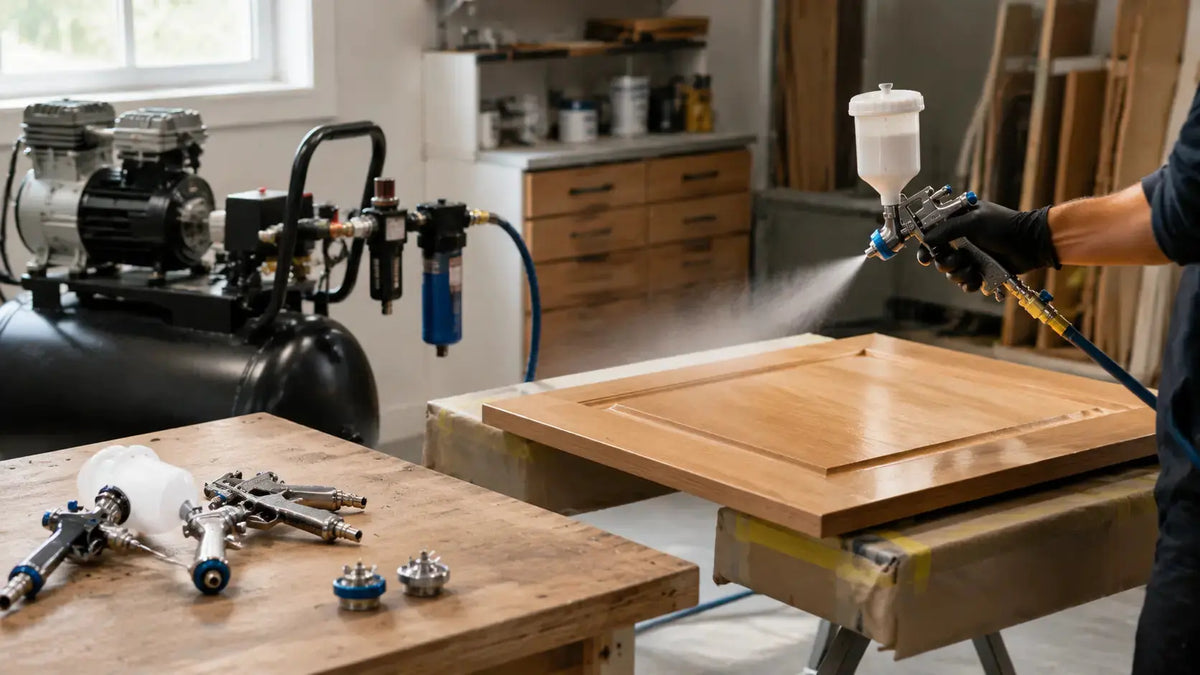
If your lacquer or clear finish looks good on one pass and rough on the next, the spray gun may not be the first thing to blame. In a small wood shop, inconsistent airflow, moisture in the line, the wrong fluid setup, dust, and an improvised spray area can all show up in the finish long before a more expensive gun makes a difference.
A better upgrade plan starts by finding the bottleneck. Then you spend money where it actually changes the result.
Quick Diagnosis: What Is Holding the Setup Back?
|
Symptom |
Likely area to check first |
Why |
|
Fan gets weaker during a long pass |
Air supply / pressure drop |
The compressor or hose may not sustain the gun’s airflow demand. |
|
Water spots, fisheyes or random contamination |
Compressed-air quality / surface contamination |
Liquid water, oil aerosol or dirty lines can reach the gun. |
|
Finish is dry and rough even with stable air |
Material setup / distance / pressure |
Viscosity, reducer, nozzle and technique may not match the finish. |
|
Dust lands in every coat |
Spray environment |
A clean gun cannot compensate for a dusty or unsafe spray area. |
1. Match the Compressor to the Gun — Not to a Magic CFM Number
There is no universal “16 CFM woodworking compressor.” The right compressor is the one that can sustain the spray gun’s required airflow at the relevant pressure, with enough reserve that pressure does not collapse during a long pass.
Look for the compressor’s delivered SCFM/CFM rating at pressure, not just horsepower or tank size. A large tank can give you more reserve time, but it does not create airflow the pump cannot supply.
If you are unsure where to measure pressure or why static pressure is misleading, see our spray gun air pressure guide. Set pressure with the trigger pulled so you are looking at the gun under flow, not at a resting gauge.
What That Means for the PRD-817
PORPHIS lists the PRD-817 at 15.2 CFM with a 1.3 mm setup and a 1.3–1.8 bar operating range. If you plan to use this gun, your air system needs to maintain that demand through the hose, fittings, filters and regulator while you are spraying.
A compressor that looks large on paper can still struggle if the pump delivery is marginal, the duty cycle is low, the hose is restrictive or several tools share the line.
2. Clean Air Is More Than a Moisture Trap
Compressed air can carry liquid water, oil aerosol, particles and water vapor. Those are not all solved by the same filter.
|
Problem |
Typical control |
What it does not replace |
|
Bulk liquid water |
Drain, aftercooling, water separator |
Does not guarantee low dew point. |
|
Oil aerosol / fine particles |
Coalescing filtration |
Does not remove all water vapor. |
|
High humidity / vapor moisture |
Proper air dryer selected for the system |
Does not replace tank/line drainage and maintenance. |
|
Final debris near the gun |
Clean final-stage filtration when appropriate |
Should not be used to hide a dirty upstream system. |
For a deeper explanation of why moisture can ruin a finish, read how moisture in compressed air causes paint defects.
3. Do Not Use a Wood Dust Collector as a Spray Exhaust System
This is the part of a workshop upgrade that matters more than finish quality: safety. Opening a roller door and turning on a woodworking dust extractor is not a substitute for a spray-finishing ventilation system.
Solvent-based lacquers and other finishes can create flammable vapors and hazardous mists. In the United States, OSHA requires mechanical ventilation for spray areas using flammable or combustible materials and controls for ignition hazards. Other countries have their own requirements.
Use a spray booth or spray area, exhaust system, electrical equipment and respiratory/PPE controls that are appropriate for the exact coating and local rules. Follow the finish manufacturer’s SDS. Do not improvise a solvent-vapor exhaust with equipment designed only for wood dust.
4. Pick the Spray Gun After You Know the Finish
The coating decides a lot of the gun setup. Nitrocellulose lacquer, waterborne furniture finish, conversion varnish and 2K polyurethane do not all want the same nozzle, airflow or safety controls.
|
Question |
Why it matters |
|
What nozzle range does the coating TDS recommend? |
A 1.3 mm setup can work for many thin topcoats, but it is not a universal wood-finishing size. |
|
How much air can your compressor sustain? |
A gun that needs 15.2 CFM is a poor match for an air system that can only maintain 8 CFM. |
|
How large are the parts? |
A wide automotive-style fan can be useful on doors and tabletops but may be awkward for small trim. |
|
How flammable / hazardous is the coating? |
The material drives ventilation, ignition control and PPE requirements. |
Where the PRD-817 Fits
The PRD-817 is a 1.3 mm, high-air-demand split-nozzle gun. It makes more sense for a woodworker who already has a full-size air system and regularly sprays clear topcoats on larger furniture parts than for someone trying to run from a small portable compressor.
If you want the product-side explanation of the nozzle and airflow design, see the PRD-817 split-nozzle technology guide.
For a small compressor, do not upgrade the gun first and hope the compressor catches up. Either choose a lower-air-demand gun that fits your material, or upgrade the air system before moving to the PRD-817.
5. Test the Whole System Before the Project
Confirm the finish manufacturer’s nozzle, reduction, pressure and flash recommendations.
- Set gun pressure dynamically with the trigger pulled.
- Spray a pattern card and check top-to-bottom material distribution.
- Run a long enough test pass to see whether the pressure or fan changes as the compressor cycles.
- Check the air line for water/oil contamination before material goes into the gun.
- Spray a scrap panel of the same wood/finish system before the actual furniture piece.
If the fan still changes with a stable compressor, use our finish inconsistency troubleshooting guide to work through cap cleanliness, restrictions and gun setup.
A Smarter Upgrade Order
|
Priority |
Upgrade |
Why |
|
1 |
Safe, suitable spray area and ventilation |
A cleaner finish is irrelevant if the spray process is unsafe. |
|
2 |
Air supply that can sustain the chosen gun |
Stops pressure/fan collapse during long passes. |
|
3 |
Moisture/oil control matched to shop conditions |
Protects the finish from compressed-air contamination. |
|
4 |
Gun/nozzle matched to the coating |
Improves atomization and repeatability once the system is stable. |
|
5 |
Technique and job records |
Lets you repeat good results instead of rediscovering settings every project. |
Final Takeaway
The best woodworking spray upgrade is not a shopping list. It is a matched system.
Start with the finish you spray, verify what airflow and nozzle it needs, make sure the compressor can actually sustain the gun, control moisture and contamination, and use a spray area designed for the material. Only then does a higher-end gun become the final piece instead of an expensive way to expose the same old bottleneck.
The PRD-817 can be a strong option for larger clear-finish work when you have the air to run it. If you do not, choosing a lower-demand gun is the more professional decision.
Udostępnij:
Zmarszczenia podkładu na krawędzi pióra: Dlaczego się podnosi i jak to naprawić
Can You Spray 2K Clear Coat at Home? PPE, Isocyanates and When a Garage Is Not Enough