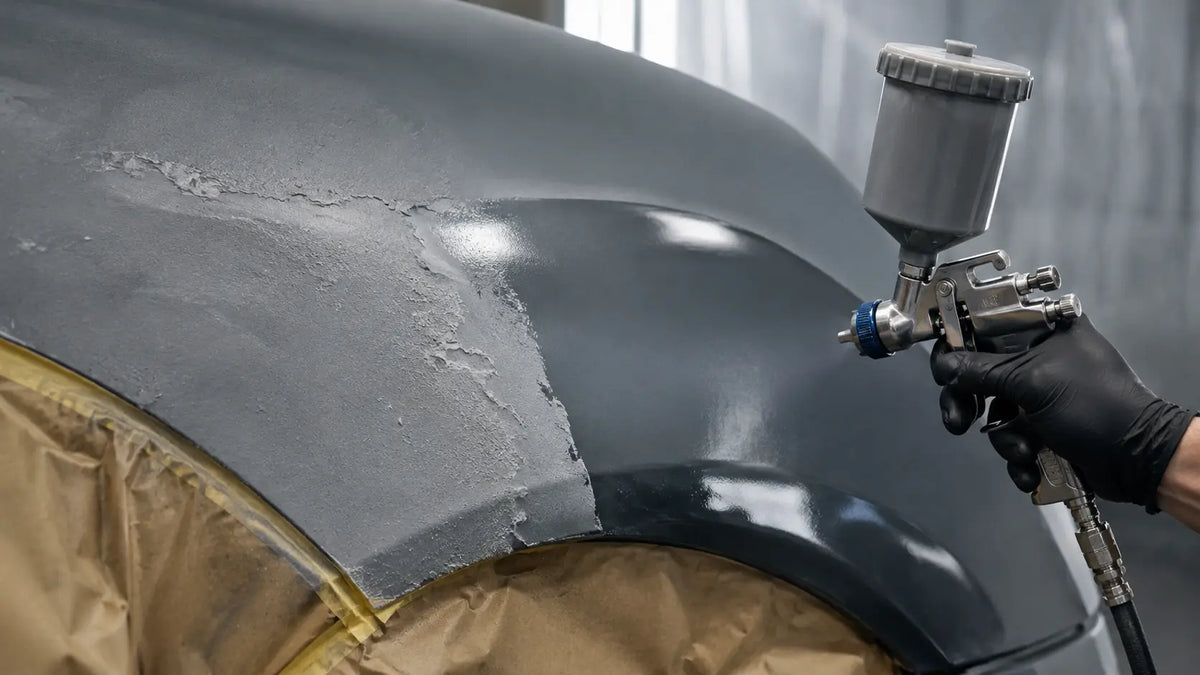
A 2K paint over 1K primer reaction often shows up as wrinkles, swollen edges or lifting shortly after the next coat lands. Stop spraying if that happens. More wet material can deepen the damage and make the failed layers harder to remove.
The label alone does not explain the failure. Some 1K primers are approved under suitable 2K topcoats. Others are sensitive to the solvents in the proposed finish. Product identity, drying, film thickness and the older layers beneath the primer all matter.
Can You Spray 2K Paint Over 1K Primer
Yes, in a documented compatible system. Before spraying, check the primer's approved topcoats, drying and sanding requirements, recoat window and substrate limitations. Confirm that the proposed topcoat is approved for that prepared primer as well.
In common refinish use, a 1K product is supplied as a single-component coating, while a 2K product uses a specified second component to cure. That distinction is useful, but it does not identify every resin or solvent in the can.
A real example is SprayMax 1K UNI PRIME 680600. Its TDS permits conventional 1K and 2K topcoats within the stated preparation instructions. It also excludes thermoplastic paintwork and 2K polyester putties. Permission for one product and coat sequence is not permission for every 1K primer.
Why Does Paint Wrinkle or Lift Over Primer
A solvent-sensitive lower layer
The new material may soften or swell an older primer or finish. Sand-throughs and exposed repair edges can be especially revealing because they give the coating stack a different contact condition from the intact surface.
PPG's lifting and wrinkling guide identifies old non-catalyzed lacquer or enamel layers, excessive film build, reducer selection, sand-throughs and incorrect flash timing as possible contributors. The affected layer needs assessment before refinishing.
Primer that has not reached its recoat condition
Touch-dry is not the same as ready for the next coat. A heavy primer film can retain solvent even when its surface seems dry. Follow the specified drying conditions, coat count and preparation process for the product.
Heavy application over a questionable foundation
A wet first topcoat exposes the lower layers to more material at once. Heavy coats and short flashes can make a sensitive stack harder to control. Apply the specified film build; do not invent a universal “dust coat” solution to make an unapproved combination usable.
|
Symptom |
Possible explanation |
What to check |
|
Wrinkles or swollen edges during application |
Solvent attack or an unstable lower film |
Product compatibility and the exposed repair edges |
|
Peeling without wrinkling |
Adhesion or surface-preparation failure |
The interface where the layers separate |
|
Small fisheyes |
Contamination can be involved |
Surface, materials and air supply |
|
Pinholes or solvent pop |
Film build and drying can be involved |
Coat thickness and flash procedure |
|
Persistent soft areas |
Drying, mixing or lower-layer instability |
Which layer has failed to become sound |
These observations guide the inspection. They do not identify the chemistry by themselves.
Why Did My 2K Paint React Over Rust-Oleum Primer
Find the exact product name and code first. Rust-Oleum sells several automotive and general-purpose primers. They do not all have the same approved use.
The manufacturer's page for 2 in 1 Filler and Sandable Primer describes use under suitable automotive lacquers and enamels. That description does not establish approval beneath every catalyzed refinish topcoat. Read the product's current instructions and obtain confirmation for the combination you plan to use.
Also check what happened before the topcoat. Was the primer applied heavily? Did it reach its drying stage? Was the surface clean and prepared? Was there an unidentified old finish underneath? A brand-level answer cannot resolve those details.
How to Fix Paint Reaction from Incompatible Primer
Stop adding material
End the spray application when wrinkling or lifting appears. Let the film reach a workable repair condition under the manufacturer's instructions. Avoid force-drying a reacting coating by an improvised heat method.
Find the depth of the failure
Inspect the topcoat, primer and any older finish beneath them. A local defect may need only a local repair, but a widespread unstable primer may need broader removal. Do not decide the removal depth from the visible wrinkle alone.
Soft material can smear and clog abrasives. Work it only by the approved repair method and remove enough to expose a reliable layer.
Remove every unstable layer in the repair
Feather the surrounding sound finish and check for remaining soft islands or lifting edges. Leaving a failed primer beneath a smooth new surface can repeat the same problem later.
If the repair exposes steel, aluminum, filler or plastic, use the preparation and primer appropriate for that substrate. The paint prep before basecoat guide covers the general cleaning and preparation sequence.
Rebuild a documented coating stack
Choose the primer, any sealer, color and topcoat together. A sealer is not an automatic barrier that makes unstable or incompatible paint safe. Use an isolation step only when the system specifically supports it over a stable prepared layer.
|
Repair stage |
Required check |
|
Remaining foundation |
Firmly adhered, free of soft or failed coating |
|
Exposed substrate |
Correct preparation and approved primer |
|
Primer and sealer |
Documented compatibility and recoat procedure |
|
Color and topcoat |
Correct components, film build and flash timing |
|
Representative test panel |
Same proposed layers and application sequence |
Test the complete process
A representative test panel should use the same substrate preparation, undercoat and finishing products as the repair. Follow the real drying schedule and inspect for movement, lifting or other defects.
A successful small test reduces uncertainty; it does not override a prohibited combination or prove that unidentified layers across a vehicle are stable.
Should I Use 2K Primer Instead of Rattle Can Primer
Choose a primer with a documented route to your intended automotive finish. An approved 2K surfacer can be a practical choice for sanding and leveling, but the correct substrate protection and coating compatibility still need to be checked.
“Rattle can” describes packaging. Aerosols can contain different coating types, including activated 2K products. A spray can is not automatically a general-purpose 1K primer, and a 2K label does not make a product suitable for every surface.
For a small repair, an approved 1K product may be appropriate. For an unknown existing primer, identify or remove the uncertainty rather than assuming a new 2K layer will stabilize it.
Spray Gun Setup After the Compatibility Problem Is Resolved
Once the surface and materials are sound, check the pattern and working pressure. Maintain the distance, overlap and film build required by the coating. The spray gun air pressure regulation guide explains the pressure check at the application stage.
The PRD-725 offers 1.3 and 1.4 mm setups. Match its specifications to the selected basecoat or clearcoat before use. A controlled fan can help with uniform application, but it cannot stop a chemical reaction in an incompatible lower layer.
Read the safety data sheet for every component. Some 2K spray products contain isocyanates and require specialist ventilation and respiratory protection. Review the 2K coating safety guide before spraying.
Frequently Asked Questions
Will every 1K primer react under 2K paint
No. Some automotive 1K primers allow suitable 2K topcoats. Use the exact product documentation and follow its restrictions, drying and preparation instructions.
Can sealer stop paint lifting
Only in a system that permits that isolation process over a stable layer. Sealer cannot make soft, peeling or unidentified failed coating into a reliable foundation.
Should I sand wrinkled paint immediately
Follow the product's repair guidance. Sanding a soft reacting film can smear material and enlarge the problem. Determine the failure depth before rebuilding.
Can thinner coats make incompatible products work
Thinner coats within the application instructions can reduce excess film build. They do not establish compatibility for a combination the manufacturers have not approved.
Before the Next Application
Record the product names, layer sequence and required drying conditions. A replacement coating is ready to spray when the remaining foundation is sound and the proposed system has a documented path from substrate to topcoat.
Compartilhar:
High Build Primer Spraying Problems and Practical Fixes
How to Remove Uncured Clear Coat and Repair the Finish