
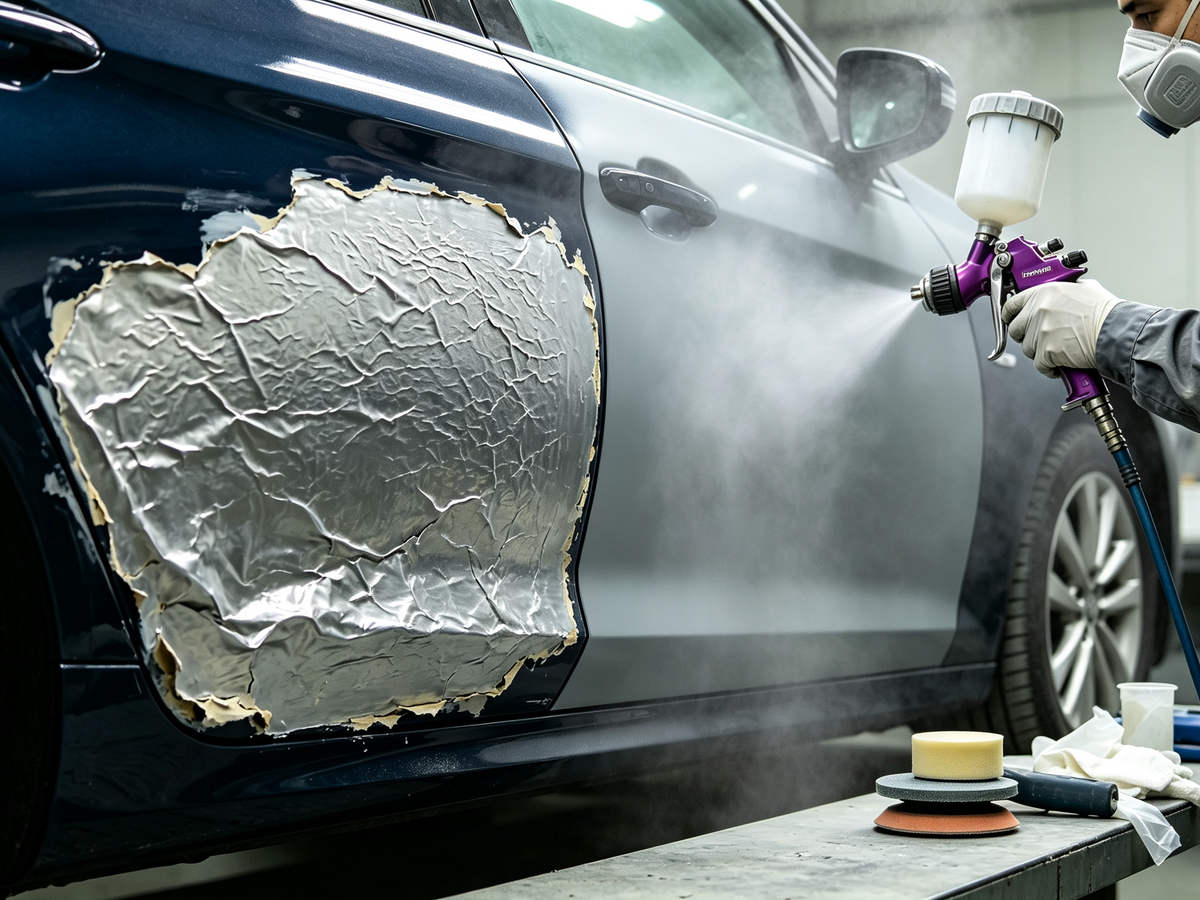
You finish the bodywork, prime the repair, lay down the basecoat—and the repaired area suddenly ripples, lifts, or wrinkles. At that point, another coat of color is usually the last thing the panel needs.
Basecoat wrinkling over bodywork is normally a warning that something underneath the color layer is still vulnerable to solvent. The hard part is figuring out which layer is unstable before you bury the problem under more material.
Quick Diagnosis: What the Wrinkle Is Telling You
|
What you see |
Check first |
Why |
|
Wrinkle follows the bodywork or primer repair |
Old repair layer / primer / sealer stability |
Fresh solvent is finding a weak layer underneath. |
|
Reaction starts around the feathered edge |
Transition between old finish and repair materials |
Multiple coatings with different solvent resistance meet at the edge. |
|
Large area wrinkles after a wet coat |
Film build, flash time, recoat window |
A heavy solvent load can attack a marginal underlayer. |
|
Problem returns after repriming |
Unknown or unstable material remains below |
The repair may not have been taken back far enough. |
What Basecoat Wrinkling Over Bodywork Actually Is
Wrinkling—often described in paint-defect manuals as lifting, rippling, or raising—happens when solvents from a new coat attack a layer underneath and distort it. That lower layer might be fresh primer, sealer, an older refinish coating, or an unknown repair material.
If the failure is concentrated specifically along the repair transition, use our more focused guide to basecoat wrinkling at a feather edge.
Why Does My Basecoat Wrinkle Over Bodywork Areas?
There is no single cause, and it is better to think in terms of “which layer is still solvent-sensitive?” than to blame the basecoat itself.
1. The Underlying Repair Is Not Stable Yet
Primer, sealer, or an older repair may be outside its approved recoat window, still releasing solvent, or not compatible with the next coating. “Dry to the touch” is not the same thing as “ready for this topcoat.”
2. The New Coat Loads the Surface With Solvent
Heavy application, short flash times, or repeated wet coats can give fresh solvent more time to attack a marginal lower layer.
3. Materials Are Not Compatible
Mixing unknown primers, sealers, reducers, old enamels, lacquer repairs, or products from unrelated systems increases the chance that the new basecoat will soften something below.
4. The Bodywork Edge Was Not Prepared Far Enough
A hard repair edge, sand-through, coarse scratch, or poorly bonded old coating can become the weak point where the reaction starts.
5. The Reducer / Temperature / Application Setup Is Wrong
Reducer speed and shop temperature can change how the basecoat flashes and levels. That can worsen a marginal repair, but the root problem is still the interaction between the new solvent load and the lower coating stack.
Solvent Reaction Basecoat: What Is Really Happening?
The phrase solvent reaction basecoat is useful because it describes the mechanism: solvent from the fresh color coat penetrates a coating underneath that is not resistant enough at that moment. The surface swells or distorts, and the wrinkle appears through the new paint.
That does not always mean the primer “wasn’t cured.” It may be partially cured, outside its recoat window, incompatible, contaminated, or sitting over another weak repair layer.
For a broader look at compatibility between coating layers, see our guide to 2K clear over 1K base compatibility.
Sealer Curing Time Before Basecoat: Use the TDS, Not a Universal Clock
Painters often search for sealer curing time before basecoat, but “curing” is not always the best word for this step. Many automotive sealers are designed to receive basecoat after a specified flash period and within a defined topcoat window—not after the sealer reaches full final cure.
The correct interval depends on the exact product, film build, temperature, airflow, reducer/activator, and paint system. Follow the sealer technical data sheet for minimum flash and maximum topcoat time. If you miss that window, the system may require sanding or another preparation step before color.
Basecoat Lifting Over Primer
Basecoat lifting over primer can start for several different reasons: the primer is not ready for topcoat, the old coating below it is still sensitive, the surface was contaminated, the primer was applied too heavily, or the basecoat solvent package is attacking an incompatible layer.
Before respraying, make sure the whole repair area follows a controlled paint prep before base coat process rather than treating the wrinkle as a gun-setting problem.
Can a Turbine Sprayer Cause Solvent Reaction in Basecoat?
Not by itself. A turbine changes how the coating is atomized and often delivers warmer air than a conventional compressed-air setup. That can change evaporation, perceived wetness, and the way a painter compensates with distance or material flow.
So turbine sprayer paint problems can contribute indirectly if the painter floods the panel, uses the wrong reducer for the temperature, or ignores the coating manufacturer’s setup instructions. But a turbine does not create chemical incompatibility on its own.
What Causes Basecoat to Lift at Bodywork Edges?
|
Possible cause |
What to verify |
|
Unstable old repair |
Sand farther back until the remaining coating is sound. |
|
Primer / sealer timing |
Check the actual recoat and topcoat window in the TDS. |
|
Incompatible materials |
Confirm the primer, sealer, reducer and base are approved together. |
|
Heavy film build |
Rebuild the repair without flooding the transition. |
|
Contamination / sand-through |
Clean and re-establish the substrate according to the paint system. |
How to Fix Wrinkling Basecoat and Respray Correctly
- Stop spraying as soon as the wrinkling starts.
- Let the affected coating reach a condition where it can be removed safely according to the product guidance; do not keep adding solvent-rich coats.
- Remove all wrinkled or softened material until you reach a stable layer. If the edge keeps reacting, widen the repair.
- Identify what remains underneath: OEM finish, old refinish, primer, filler, sealer, or unknown coating.
- Rebuild the primer/sealer system with compatible materials and the correct flash/recoat windows.
- Test a small area before committing the full panel.
- Apply the basecoat using the coat schedule, flash time, gun setup and film build specified by that paint system.
If the repair also shows cracking or deeper failure in older layers, use our guide to paint cracking after a repaint.
Prevention Checklist Before Basecoat
|
Check |
Pass condition |
|
Repair edge |
Stable, smooth, no soft or lifting material |
|
Primer / sealer |
Inside the manufacturer-approved topcoat window |
|
Compatibility |
Materials confirmed as a compatible system |
|
Surface |
Clean, dust-free, no silicone/oil/wax contamination |
|
Film build |
No heavy buildup used to hide defects |
|
Test area |
No lifting or wrinkling before full-panel application |
Where the PORPHIS PRD-510 Fits In
Once the substrate is stable, a predictable gun can make it easier to avoid unnecessary film build. The current PRD-510 uses LVLP technology with 1.0 and 1.3 mm nozzle options, a 1–1.5 bar operating range, 5.7 CFM air consumption, a 150 mm recommended distance, and a published 120–200 mm fan.
That low air demand is useful in smaller-air-supply setups and controlled repair work. It does not make an unstable primer or sealer safe to topcoat, and it should not be used as a substitute for the coating TDS.
Final Takeaway
Basecoat wrinkling over bodywork is usually a layer-under-layer problem. The new basecoat is often exposing an unstable repair rather than creating one from nothing. Stop spraying, find the weak layer, rebuild the coating stack correctly, and only then tune the gun.
FAQ
Why does my basecoat wrinkle over bodywork areas?
Fresh solvent is often attacking an unstable or incompatible layer in the repair stack. Check primer/sealer timing, old repair material, film build, contamination, and compatibility.
How long should sealer cure before spraying basecoat?
Use the sealer TDS. Many sealers specify a flash and topcoat window rather than requiring full final cure before basecoat.
Can a turbine sprayer cause solvent reaction in basecoat?
Not directly. A turbine can change evaporation and application behavior, but the actual lifting usually depends on the coating stack, film build, compatibility and recoat timing.
What causes basecoat to lift at bodywork edges?
Unstable old paint, incorrect primer/sealer timing, incompatible layers, sand-throughs, contamination, or excessive solvent load are common causes.
How to fix wrinkling basecoat and respray correctly?
Remove the failed material to a stable layer, rebuild with compatible primer/sealer as required, respect the TDS windows, test a small area, then respray with the approved application schedule.
Compartilhar:
Auto Body Shop PPE Guidelines: What to Wear for Sanding, Mixing, Spraying & Cleanup
Reduce 2K Clear Coat Fumes: What Spray Settings Can—and Cannot—Fix