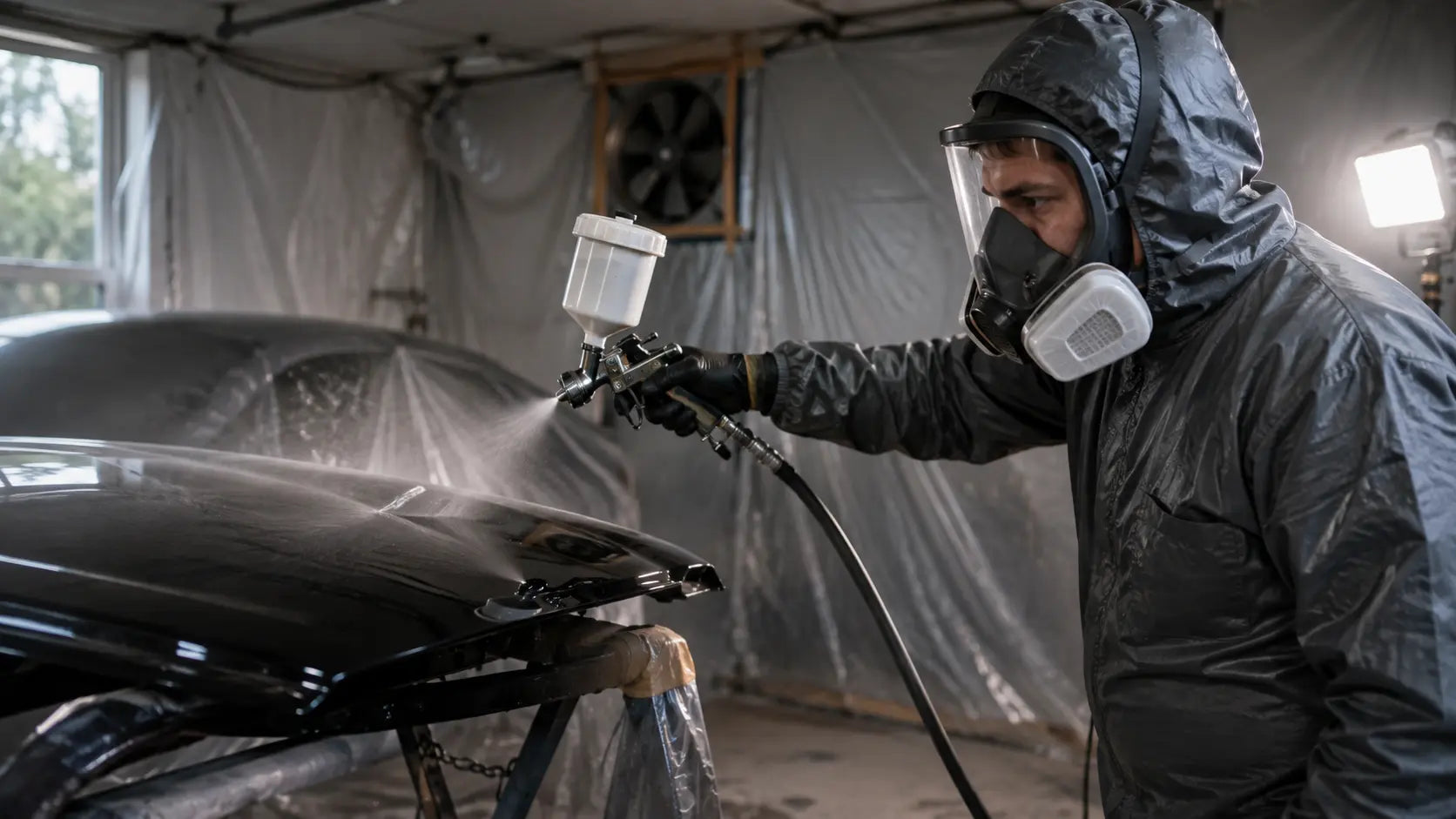
A small job does not automatically mean a small exposure. One mirror cap, one bumper corner, or one activated aerosol can can still put a concentrated cloud of spray mist into the painter's breathing zone.
That is why the question ‘Can I spray 2K clear coat at home?’ needs a different answer from ‘Which gun setting should I use?’ Before pressure, nozzle size or gloss, you need to know what chemistry is in the product and whether your spray area and respiratory protection are actually suitable for it.
This article focuses on the home-garage decision. For the broader topic, start with our full 2K clear coat safety guide.
First: Check the SDS, Not the Label on the Front
‘2K’ means two-component, but it does not tell you everything about the hazard. Many professional automotive 2K polyurethane clears use isocyanate hardeners. Others may use different chemistry. The Safety Data Sheet for the exact clear, activator and reducer is the starting point.
If the difference between coating systems is still confusing, review 1K vs. 2K paint before assuming every product with similar gloss has the same handling requirements.
If the 2K Product Contains Isocyanates, a Cartridge Mask Is Not the Same as Supplied Air
This is the most important correction to a lot of DIY advice online. HSE guidance for motor-vehicle refinishing states that air-fed breathing apparatus is mandatory when spraying isocyanate-based products and warns that filtering face masks can fail to protect without warning.
That means a dust mask, a basic half-mask with organic-vapor cartridges, or a ‘full coverage gas mask’ should not be presented as an equivalent substitute for an air-fed system when the product and rules require supplied air.
Does Spraying Outdoors Make It Safe?
No. Outdoor spraying changes dispersion; it does not remove the hazard. Wind can push mist back through your breathing zone or toward other people, vehicles, doors and neighboring property.
HSE also publishes guidance for outdoor SMART spraying with two-pack products, and that guidance still requires airline breathing apparatus and controlled work practices. ‘I am outside’ is not a replacement for the respiratory and exposure controls required by the product and local regulations.
What About One Small Aerosol Can?
Project size changes how long you spray, but it does not turn reactive chemistry into ordinary aerosol paint. Small jobs can create short, high-exposure peaks. If the activated aerosol contains isocyanates, follow the SDS and the same type of exposure-control logic rather than deciding protection based on how many seconds the trigger is pressed.
The same principle applies to small composite parts; our carbon-fiber clearcoat safety workflow treats a small part as a real 2K spraying job, not a safety exception.
A Home-Garage Go / No-Go Check
|
Question |
If the answer is NO |
|
Have you confirmed the exact SDS and whether the hardener contains isocyanates? |
Do not spray until you know the hazard and required controls. |
|
Do you have the respiratory protection specified for the product and local rules, including air-fed BA where required? |
Do not substitute a filtering mask. |
|
Can the spray area contain/extract mist without exposing other people or occupied spaces? |
Move the job to an appropriate controlled spray area. |
|
Do you have the required gloves, coveralls and eye/face protection? |
Complete the PPE setup before mixing. |
|
Can you keep protection on until the spray area is safe to re-enter without it? |
Do not remove PPE immediately after the trigger is released. |
PPE Is More Than the Respirator
Skin and eye exposure still matter. Use the gloves, protective clothing, footwear and eye/face protection specified by the SDS and your workplace or local safety rules. Do not copy one glove thickness from the internet and treat it as universal chemical protection.
Keep contaminated clothing and disposable PPE out of living areas. Remember that cleanup still involves uncured coating and solvent; the job is not ‘safe’ just because the panel is finished.
Spray Technique Can Reduce Waste. It Cannot Make an Unsafe Setup Safe.
Good atomization, correct distance and controlled overlap can reduce unnecessary overspray and improve the finish. They are not respiratory protection.
The PRD-510 is an LVLP gun with current published options of 1.0 and 1.3 mm, 1–1.5 bar operating pressure and 5.7 CFM air consumption. Its lower air demand can make it easier to run on smaller compressors, but that says nothing about whether the 2K chemistry is safe to spray in your garage.
Treat the gun as application equipment, not as a safety control.
Mixing, Flash and Cure Still Matter
Once the safety controls are in place, follow the exact TDS for mix ratio, hardener/reducer selection, pot life, coat schedule, flash and cure. Do not invent a universal two-coat schedule or a fixed wait time.
If the clear remains rubbery or soft beyond the product timeline, use our guide on what to check when 2K clear stays soft instead of adding more hardener or burying the problem under another coat.
Do Not Forget Surface Preparation
PPE protects the painter; preparation protects the paint job. Use a cleaner approved for the substrate and coating system, remove contamination, and do not assume a random household solvent is an appropriate final wipe.
For more on that decision, see our automotive paint-prep cleaner comparison.
When I Would Not Spray 2K at Home
- The SDS calls for controls you do not have.
- You do not have air-fed/supplied-air respiratory protection where required.
- The garage is connected to occupied living space or cannot be effectively isolated.
- Other people, pets or neighboring property could be exposed to overspray.
- You cannot manage contaminated air, PPE and cleanup according to the product and local rules.
In those cases, the safer answer is not a cheaper mask or a lower-air-consumption spray gun. It is to move the job to a properly controlled facility or use a coating system whose safety requirements you can actually meet.
Final Takeaway
You can get a professional finish from 2K clear only if the process is professional enough to control the hazard. For isocyanate-containing spray products, that means taking supplied-air respiratory protection, spray-area controls, PPE, clearance time and the product SDS seriously—even for a small repair.
Start with the chemistry and the controls. The spray gun comes after that.
FAQ
Can I spray isocyanate 2K clear with an organic-vapor cartridge respirator?
Do not treat a filtering cartridge respirator as equivalent to air-fed breathing apparatus when the product guidance or local rules require supplied air. HSE motor-vehicle guidance specifically requires air-fed BA for spraying isocyanate paint.
Is spraying 2K outside enough ventilation?
No. Outdoor spraying does not eliminate exposure and does not remove the need for the respiratory, isolation and other controls required by the product and applicable rules.
Is one activated aerosol can too small to worry about?
No. Even short jobs can produce high exposure peaks. Check the SDS and use the required controls regardless of project size.
Does an LVLP gun make 2K safer?
No. It may reduce air demand and wasted material in a well-tuned application, but it is not PPE and does not replace engineering controls or respiratory protection.
Compartilhar:
Atualização do Setup de Pintura para Marcenaria: Escolhas de Compressor, Qualidade do Ar e Pistola de Pintura Que Realmente Importam
Clear Coat Striping and “Tiger Stripes”: How to Diagnose the Pattern Before You Refinish