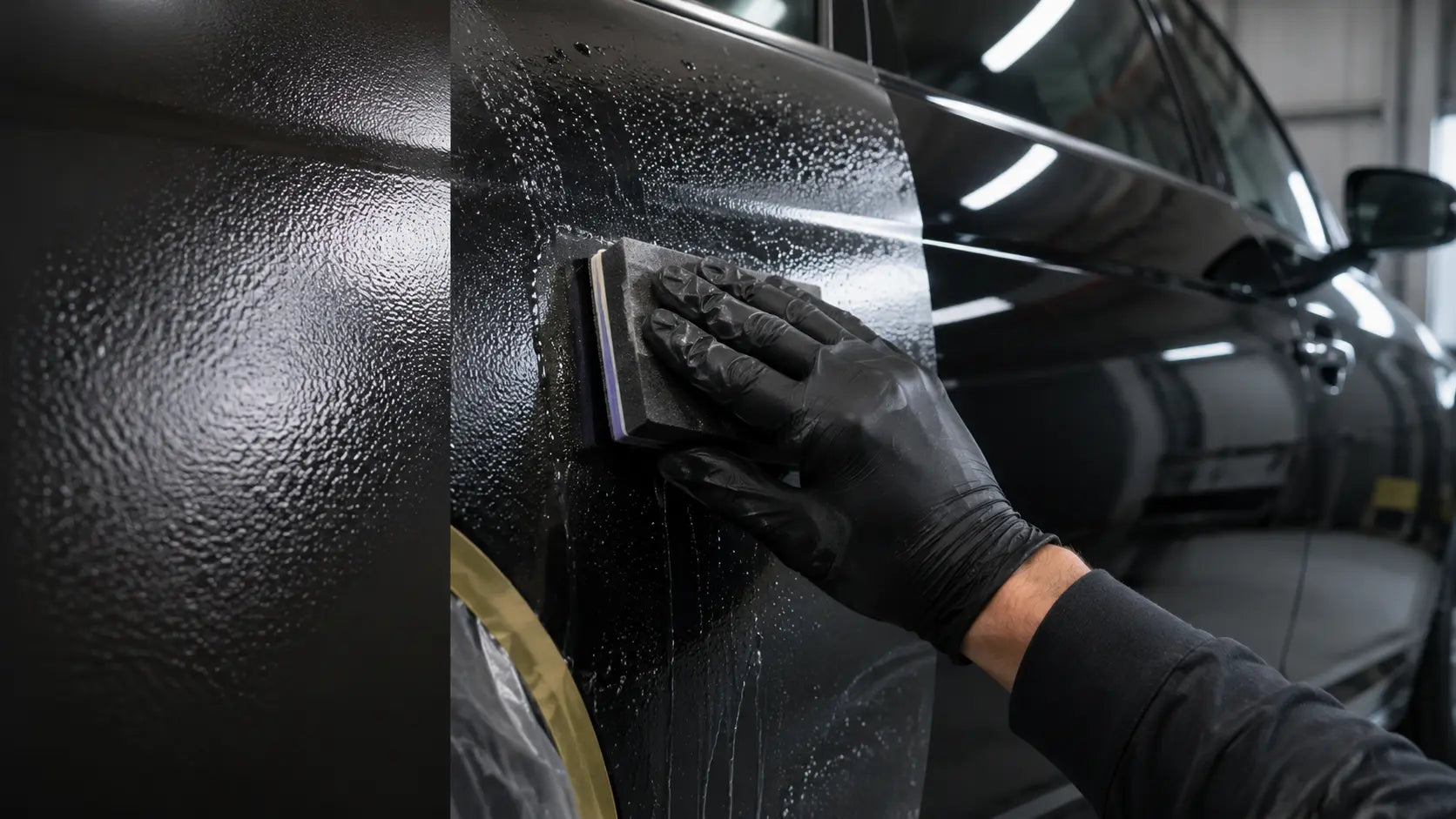
A rough finish after a paint job does not automatically mean the panel has to be stripped and sprayed again. Sometimes the texture is only in the clear coat and can be leveled safely. Other times the roughness is telling you that the problem sits deeper—in the basecoat, in dry overspray, or in the paint system itself.
The important part is diagnosis. If you start sanding before you know what you are looking at, a repair that could have been simple can turn into a repaint very quickly.
Fix Rough Paint Texture Without Repainting: When Is It Realistic?
|
What you see |
Can correction without repainting work? |
Why |
|
Moderate orange peel in fully cured clear coat |
Often, if sufficient clear remains |
The high spots in the clear may be leveled and polished. |
|
Isolated dust nibs in clear coat |
Often |
They can usually be spot-leveled if there is enough film build. |
|
Light dry spray on the clear surface |
Sometimes |
If the defect is shallow, refinement may restore gloss; severe dry spray may require refinishing. |
|
Uneven metallic / pearl orientation under clear |
Usually no |
The defect is in the color layer; polishing the clear cannot reorient metallic flakes. |
|
Very thin clear, sand-through, delamination or failed coating |
No / high risk |
Removing more material will make the failure worse. |
Start With Paint Defect Identification
Paint defect identification matters more than the first sandpaper you reach for. Orange peel, dry spray and contamination can all feel rough, but they do not fail for the same reason and they do not respond to correction the same way.
Orange Peel
Orange peel is a wavy, pebbled texture caused by the coating failing to level into a flatter film before it sets. Material viscosity, reducer or hardener choice, temperature, dynamic air pressure, gun distance, pass speed and film build can all contribute.
If you want the prevention side in more detail, see our guide on how to avoid and fix orange peel.
Dry Spray
Dry spray feels more granular. The droplets have lost too much solvent—or have not landed wet enough—to flow together properly. Excessive distance, too much atomizing air for the setup, fast material, high temperature, fast travel or poor overlap can all play a role.
For a broader system diagnosis when one part of the panel looks smooth and another looks rough, use our HVLP finish inconsistency guide.
Dust and Dirt Nibs
A dirt nib is usually a localized high spot rather than a full-panel texture. If it is trapped in a healthy, fully cured clear coat, it may be possible to level only the defect instead of sanding the whole panel.
Orange Peel or Dry Spray on My Car Paint?
|
Clue |
Orange Peel |
Dry Spray |
|
Look |
Regular pebbled texture |
Dusty, grainy or rough texture |
|
Gloss |
Can still be glossy |
Often duller or hazier |
|
Typical mechanism |
Wet film did not level enough |
Droplets arrived too dry / film too thin to level |
|
Correction potential |
Often correctable in clear if enough film remains |
Light surface dry spray may improve; severe cases can require refinishing |
Do not use appearance alone as proof. Look at where the defect begins, whether color orientation underneath is uniform, and whether the coating is fully cured before deciding on a correction process.
Can Rough Paint Texture Be Fixed With Wet Sanding and Polishing?
Yes—when the defect is truly in the clear coat and there is enough healthy clear to remove safely. Wet sanding does not “heal” paint. It removes the high points of the film so that polishing can restore a flatter optical surface.
That distinction matters. If the basecoat is mottled, striped, poorly covered or otherwise defective, leveling the clear will not correct the color layer underneath.
Wet Sanding Orange Peel: What to Check Before You Touch the Panel
- Make sure the clear coat has cured to the point allowed by the coating manufacturer for sanding and polishing.
- Check available film thickness when practical. A thickness reading is useful, but remember that standard gauges behave differently on steel, aluminum and non-metallic substrates.
- Protect edges, body lines and sharp contours. Clear is often thinner there and easier to sand through.
- Test a small area before committing to a hood, roof or complete panel.
- Use the least aggressive process that will level the defect within a reasonable time.
What Grit Sandpaper to Remove Orange Peel?
There is no single grit that is correct for every orange-peel repair. The right starting abrasive depends on the clear coat, how severe the texture is, how much film is available, how long the clear has cured and the refinishing system's correction procedure.
A safer rule is to start as fine as practical for the defect, confirm that it is actually cutting the high spots, and then refine the sanding marks through progressively finer steps before compounding and polishing. If you need to begin much more aggressively than expected, stop and confirm that repainting is not the safer option.
How to Fix Bumpy Paint on Car Without Repainting
- Wash and inspect the panel under strong, directional lighting.
- Identify whether the problem is orange peel, dry spray, contamination or a color-layer defect.
- Confirm the coating is cured enough for correction.
- Mask or protect vulnerable edges and body lines.
- Test a small area with the least aggressive suitable leveling process.
- Refine the sanding marks and machine polish until the gloss is restored.
- Stop if color appears on the abrasive/pad, if film thickness is becoming marginal, or if the defect remains visible underneath the clear.
If the panel also has sagging or excessive film build, read our guide to clear coat runs before deciding how much material to remove.
How to Tell If Paint Defect Is in Clear Coat or Base Coat
This is one of the most useful decisions in the entire repair.
|
More likely clear-coat issue |
More likely basecoat / underlying issue |
|
Texture changes with surface leveling while color stays uniform |
Metallic or pearl orientation is visibly uneven under the gloss |
|
Localized dust nib or surface texture |
Color shift, mottling or coverage difference remains under a smooth clear surface |
|
Light dry spray only on the outer film |
Defect follows the color layer or repair transition |
|
Polishing a small safe test area improves the optical surface |
Surface becomes glossy but the visual color defect remains |
Never sand through the clear just to “check” the basecoat. If you are unsure and the repair is valuable, a body shop with film-thickness and refinishing experience is the safer option.
Preventing Automotive Paint Texture Problems
- Set pressure dynamically with the trigger pulled, not from a static regulator reading.
- Match reducer/hardener speed and viscosity to the coating TDS and actual shop temperature.
- Keep gun distance, angle, speed and overlap repeatable rather than chasing one universal overlap percentage.
- Make sure the compressor and hose can maintain airflow during a full pass.
- Use clean, dry compressed air and maintain water/oil separation.
If moisture or contamination may be entering from the air system, our guide on moisture in compressed air and solvent pop explains where that water comes from and how to control it.
Where the PRD-817 Fits In
A spray gun will not repair rough paint after it cures, but a stable application setup can reduce the number of variables that create texture in the first place.
The current PRD-817 specification is a 1.3 mm VS setup, 1.3–1.8 bar (about 19–26 PSI) operating pressure, 15.2 CFM air consumption, 150 mm recommended spray distance and a published 260–350 mm spray pattern. Those numbers also tell you that the gun needs a serious air supply; it is not a small-compressor gun.
For the full model-specific discussion, see the PRD-817 spray gun product page.
Final Takeaway
The safest way to fix rough paint texture without repainting is to stop thinking of every rough finish as the same defect. First identify whether you have orange peel, dry spray, contamination or a basecoat problem. Then decide whether the defect sits in a healthy, correctable clear coat.
Wet sanding orange peel can work extremely well when the film is cured and thick enough. It is the wrong tool when the real problem is underneath the clear. Diagnose first, remove as little material as necessary, and repaint when correction would put the coating system at risk.
FAQ
Can rough paint texture be fixed with wet sanding and polishing?
Often, if the defect is limited to fully cured clear coat and enough film thickness remains. Basecoat defects generally require refinishing.
Is it orange peel or dry spray on my car paint?
Orange peel is usually a more uniform pebbled texture. Dry spray tends to look and feel grainier and often appears duller because the droplets did not land wet enough to level.
What grit sandpaper to remove orange peel?
There is no universal grit. Use the least aggressive abrasive that safely levels the defect, follow the coating maker's correction guidance, and refine through finer steps before polishing.
How to fix bumpy paint on car without repainting?
Identify the defect, confirm the clear is cured, test a small area, level only the clear-coat texture, then refine and polish. Stop if the defect is in the color layer or the clear becomes too thin.
How to tell if paint defect is in clear coat or base coat?
If surface leveling improves texture while the color and metallic orientation stay uniform, it is more likely in the clear. If color, mottling or metallic orientation remains wrong beneath a smooth surface, the defect is deeper.
Compartilhar:
Match Spray Gun CFM to Air Compressor: PSI, Tank Size & Real Air Demand
Auto Body Shop PPE Guidelines: What to Wear for Sanding, Mixing, Spraying & Cleanup