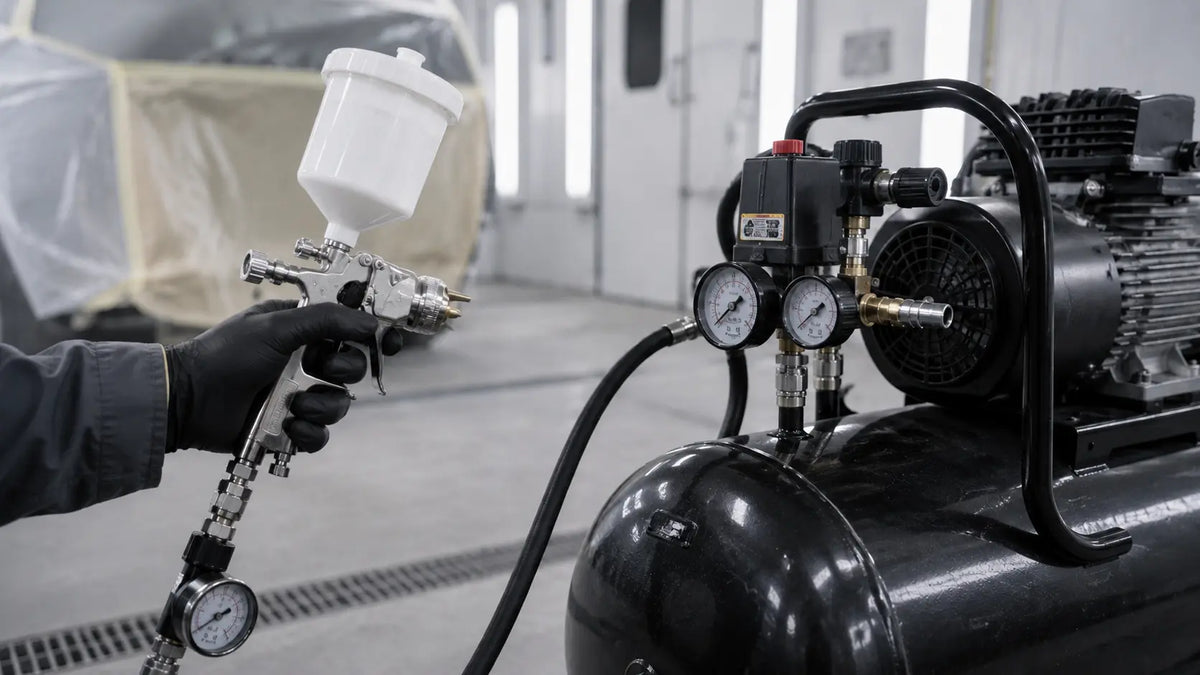
You can have the right paint, a good spray gun and a clean panel—and still get a finish that changes halfway across the hood. When that happens, the air system deserves as much attention as the gun.
The key is not choosing between PSI and CFM. You need enough airflow to feed the gun continuously, enough pressure at the gun while the trigger is pulled, and an air path that is not choking that supply through a restrictive hose, regulator or quick-connect.
Why Matching Spray Gun CFM to Air Compressor Matters
A pneumatic spray gun consumes air the entire time the trigger is held. If the compressor and air line cannot keep up, the dynamic inlet pressure drops and atomization changes during the pass.
That is why matching spray gun CFM to air compressor is not just a purchasing exercise. It is part of spray consistency.
Spray Gun PSI vs CFM Difference
|
Term |
What it tells you |
What goes wrong if it is wrong |
|
PSI / bar |
Pressure available at the gun |
Wrong dynamic pressure changes atomization and fan behavior. |
|
CFM / SCFM |
Air volume available over time |
Insufficient sustained airflow causes pressure to fall as you keep spraying. |
|
Tank volume |
Stored air buffer |
A larger tank delays pressure drop but cannot replace an undersized pump indefinitely. |
A simple way to picture it: PSI is the pressure level; CFM is the volume rate. A spray gun needs both at the same time.
For the regulator side of the setup, see our spray gun air pressure regulation guide—especially the section on measuring pressure with the trigger fully pulled.
How to Match Spray Gun CFM to Air Compressor
- Find the spray gun's published air consumption and operating-pressure range.
- Find the compressor's delivered airflow rating, and check the pressure at which that rating is stated.
- Allow for losses through the hose, regulator, filters and fittings. A system that only matches the gun on paper may still fall short at the gun.
- Check the compressor duty cycle and whether it can sustain long passes without overheating or running beyond its intended duty.
- Measure dynamic pressure at the gun with the trigger pulled. Watch whether it stays stable through a realistic pass.
Real PORPHIS Examples: What the Air Numbers Mean
|
Model |
Published air consumption |
What that means for the compressor |
|
PRD-510 LVLP |
5.7 CFM |
Lowest air demand of these examples; useful where compressor capacity is limited. |
|
PRD-725 |
8.0 CFM |
Moderate demand; still verify sustained delivery and dynamic pressure. |
|
PRD-815 |
9.5 CFM |
Requires a stronger continuous supply for full-panel work. |
|
PRD-817 |
15.2 CFM |
High air demand; a serious shop air system is required for stable full-pass performance. |
For a model-specific example of how compressor capacity affects a mid-air-demand gun, see the PRD-815 spray gun review.
For an 8.0 CFM example, the PRD-725 spray gun review explains how to verify dynamic pressure before a full panel.
Air Compressor Sizing for Spray Painting
Air compressor sizing for spray painting should start with the gun, then move outward to the rest of the system.
|
Job type |
What matters most |
|
Small parts / short passes |
Low-air-demand gun can make a small compressor practical, provided dynamic pressure stays stable. |
|
Single panels |
Compressor must sustain the full pass without a noticeable pressure/fan change. |
|
Complete vehicle |
Continuous airflow, duty cycle, cooling, moisture control and recovery become critical; tank size alone is not enough. |
Air Compressor Tank Size for Auto Paint
Air compressor tank size for auto paint matters because stored air gives the pump a buffer. A larger receiver can let you complete a longer pass before pressure falls and can change how frequently the pump cycles.
But a tank is storage, not production. If the spray gun consumes air faster than the pump can replace it, a bigger tank only postpones the shortage. During long vehicle spraying, the system eventually reaches the pump's real continuous output.
For a broader compressor, filtration and hose-layout discussion, see our woodworking spray setup upgrade. The coating is different, but the compressed-air logic is the same.
What Size Air Compressor Do I Need to Paint a Car?
There is no honest gallon-only answer. Start with the gun's published CFM, make sure the compressor can deliver that airflow continuously with reserve for real-world losses, and then check duty cycle, tank, hose size, filtration and moisture management.
A low-air-consumption LVLP gun can reduce the compressor requirement. A 15.2 CFM gun such as the PRD-817 requires a much larger continuous-air system than a 5.7 CFM PRD-510, regardless of whether both are connected to a tank that can reach 120 PSI.
Can You Adjust CFM on an Air Compressor?
You can restrict downstream flow and you can regulate pressure, but you cannot turn a compressor into a higher-capacity pump by adjusting a knob. The compressor's maximum delivered airflow is determined by the pump, motor, operating pressure and efficiency.
If the gun needs more sustained air than the compressor can provide, the practical options are to reduce system restrictions, use a lower-air-demand gun, or upgrade the air supply.
What Happens If Air Compressor CFM Is Too Low for Spray Gun?
- Dynamic inlet pressure falls during the pass.
- Atomization gets coarser or less consistent.
- The fan can shrink or change shape.
- The painter starts compensating with distance, speed or fluid adjustments, making film build less repeatable.
- Finish texture may become rougher or more uneven.
Low CFM can contribute to orange peel or dry texture, but it is not the only possible cause. Material viscosity, temperature, gun setup and technique still matter.
Why Does My Spray Gun Sputter When Painting?
This question needs a correction because true sputtering or spitting is not automatically a compressor-CFM problem.
If the gun's air supply is weak, you will usually notice pressure drop and poor atomization first. If material is actually pulsing or spitting, also check:
- Cup vent blocked or fluid supply interrupted
- Fluid nozzle not seated or damaged
- Needle/nozzle contamination
- Low material level or pickup problem
- Air leaking into the fluid passage
- Loose fittings or damaged seals
Diagnose the air side and fluid side separately instead of assuming that every irregular spray pulse comes from the compressor.
Moisture and Pressure Drop Can Look Like a CFM Problem
A compressor that is working hard also produces heat, and hot compressed air carries moisture downstream until it cools. Water, oil aerosol and restrictive filters can create defects or pressure loss even when the pump's published CFM looks adequate.
If water is showing up in the air line or clear coat, read our guide to moisture in compressed air and solvent pop.
Choosing a Lower-Air-Consumption Spray Gun
When the compressor is the hard limit, choosing the gun around the available air can be smarter than forcing a high-demand gun onto a small system.
The current PRD-510 specification is 1.0/1.3 mm, 1–1.5 bar (about 15–22 PSI), 5.7 CFM air consumption, 60 ml/min fluid delivery, 150 mm recommended distance and a 120–200 mm spray pattern.
That makes it a much easier match for limited-air setups than a 15.2 CFM full-size gun. The trade-off is that the smaller published fan and fluid delivery may change how quickly you cover large automotive panels.
See the full PRD-510 LVLP specifications before matching it to your compressor.
Final Checklist: Match Spray Gun CFM to Air Compressor
|
Check |
Pass condition |
|
Gun air consumption |
Known from manufacturer |
|
Compressor delivered airflow |
Meets gun demand under comparable conditions, with real-world margin |
|
Dynamic pressure |
Stable at the gun with trigger pulled |
|
Hose / fittings |
Large enough and not excessively restrictive |
|
Duty cycle |
Suitable for the length of spraying |
|
Air quality |
Moisture and oil controlled before the gun |
Final Takeaway
To match spray gun CFM to air compressor correctly, do not treat CFM, PSI and tank size as competing numbers. CFM tells you whether the air supply can keep feeding the gun, dynamic PSI tells you what pressure actually reaches the gun while spraying, and the tank only provides temporary storage.
When the air system is matched correctly, the gun behaves the same at the end of a pass as it did at the beginning. That consistency is what you are really buying.
FAQ
How to match spray gun CFM to air compressor?
Compare the gun's published air consumption with the compressor's delivered airflow under comparable conditions, account for system losses and duty cycle, then verify dynamic pressure at the gun during a real pass.
What size air compressor do I need to paint a car?
Choose it around the spray gun's sustained air demand rather than tank gallons alone. Full-car work also needs suitable duty cycle, hose capacity, cooling and moisture control.
Can you adjust CFM on an air compressor?
You can regulate downstream pressure and restrict flow, but you cannot increase the compressor pump's maximum delivered airflow beyond its design capacity.
Why does my spray gun sputter when painting?
Low air supply can cause pressure drop, but true spitting can also come from the cup vent, fluid nozzle, needle, material supply or air leaking into the fluid passage.
What happens if air compressor CFM is too low for spray gun?
Dynamic pressure falls, atomization and fan shape can change, and finish consistency becomes harder to maintain.
Compartilhar:
Clear Coat Striping and “Tiger Stripes”: How to Diagnose the Pattern Before You Refinish
Fix Rough Paint Texture Without Repainting: Orange Peel, Dry Spray & Wet Sanding Guide