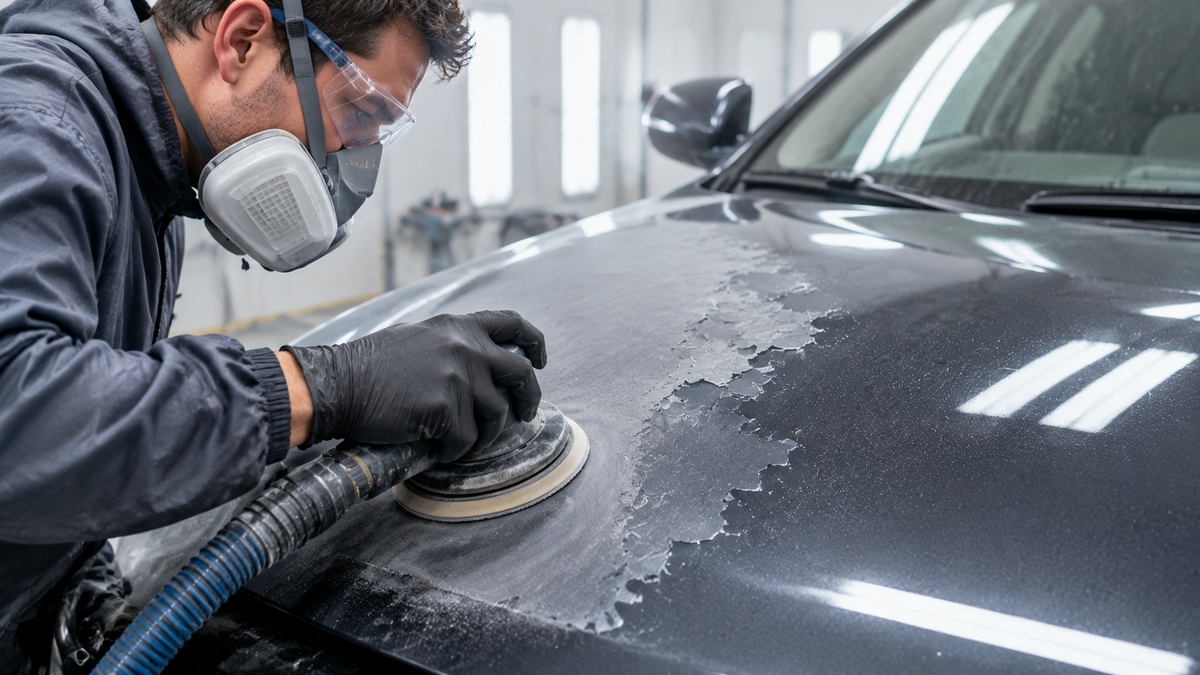
If the clear coat is lifting in flakes, do not put another coat over it. The new clear would be attached to a layer that is already coming loose. Find where the old finish is still sound, remove the failed material, then rebuild whatever layers the repair exposes.
A dull hood and a hood that sheds clear flakes may look alike from across the driveway. Up close, they call for different work. Check that distinction before buying clear coat or reaching for a polisher.
Tell Dull Clear from Delamination
Look at the clean, dry panel in good light. Raised edges or transparent flakes point to separation. A chalky or cloudy patch alone does not tell you which layer failed. Weathering can affect an older finish. If a recent repaint is peeling, check the repair history and look for adhesion failure after a repaint before assuming it is age or sun exposure.
|
What you see |
Where to start |
|
Dull finish with no visible lifting |
Check the condition and film build before considering correction. Keep abrasion conservative. |
|
Clear flakes and a distinct lifted edge |
Establish how far the loss of adhesion extends. Refinish only after you reach sound material. |
|
Several peeling areas or color coming away with the clear |
Inspect the underlying layers and plan for a wider repair. A new topcoat will not secure them. |
Remove the Failed Coating and Prepare a Sound Edge
Start with the paint maker's cleaning and preparation process. Remove loose or poorly adhered material with the approved method. If an edge keeps lifting as you work, the failure extends beyond the patch you first saw. Do not just scuff the top and cover it.
Feather the sound edge so there is no abrupt step. Select the abrasive for the exposed layer and for what goes on next. The grade that prepares a stable finish for clear is not automatically right for exposed basecoat, primer or metal. Before applying anything, check for loose edges, contamination and deep scratches that would show through.
If a basecoat is bare, aged, damaged or outside the permitted recoat condition, follow the system's instructions to restore color before clearing it. Old exposed color is not the same as fresh basecoat within its clearcoat window. If the repair reaches primer or bare substrate, restore the specified underlayers too. See paint preparation before basecoat for the broader surface checks.
Decide How Much of the Panel to Refinish
The area where paint has failed, the area where you need to blend color, and the area that needs new clear can be different sizes. A small patch may allow localized color work. The vehicle maker or clear coat procedure may still require the clear to go to the panel edges.
On a hood or roof with several lifting patches, check the whole panel. A sound edge may be farther out than the largest flake. Refinishing that panel can save repeated spot repairs; sound neighboring panels do not automatically need repainting. Ford's refinish statement, for example, specifies full-panel clear on its exterior panels. Check the procedure for the vehicle in front of you.
Choose 1K or 2K After Checking Compatibility
The first question is whether the product is approved over the prepared surface. The label does not change the condition of the old coating. Aerosol describes the package: there are single-component aerosols and activated two-component aerosols.
|
Check |
1K clear |
2K clear |
|
How it is supplied |
One component, without a separate hardener at application |
Clear and a specified activator, mixed or activated as directed |
|
Where it can fit |
A product-approved cosmetic application on a stable, compatible surface |
A compatible refinishing system where the finish requirements and spray controls can be met |
|
What to verify |
Approved substrate, preparation, exterior use and durability for the job |
Matching components, application conditions, pot life where applicable, and SDS controls |
A 1K aerosol may be convenient for a use the product allows. It cannot stop separation under the repair. When an approved refinish calls for a 2K system, compare the product data sheets for the intended application instead of assuming every 2K product fits. The 1K and 2K clear coat comparison explains the difference in more detail.
Some 2K hardeners contain isocyanates. Check the safety data sheet (SDS) and applicable workplace requirements. The HSE vehicle spray-painting guidance calls for a suitable spray booth or room and air-fed respiratory protection while mist remains. A dust mask or an aerosol can does not remove the hazard. Use a qualified shop if you cannot meet the controls in the 2K clear coat safety guide and the product documentation.
Select the Gun Once the Surface Is Ready
After the substrate and color are ready, check the setup for the chosen clear. The PORPHIS PRD-717 VS has 1.3 mm and 1.4 mm options. Use the coating's technical data sheet to select an appropriate configuration and test the fan pattern before clearing the panel.
Questions About Peeling Clear Coat
Can I spray 1K clear over peeling clear
No. A new coat cannot restore the old layer's bond. Remove the unsound coating and check that the chosen clear is approved for the resulting surface.
Can I use 2K clear over exposed basecoat
Only if the coating procedure allows it on that basecoat in its present condition. Exposure, damage or an expired recoat window can mean the color must be renewed first.
Compartilhar:
Candy Paint Repair and Pearl Paint Blending
How to Repair Clear Coat Burn Through