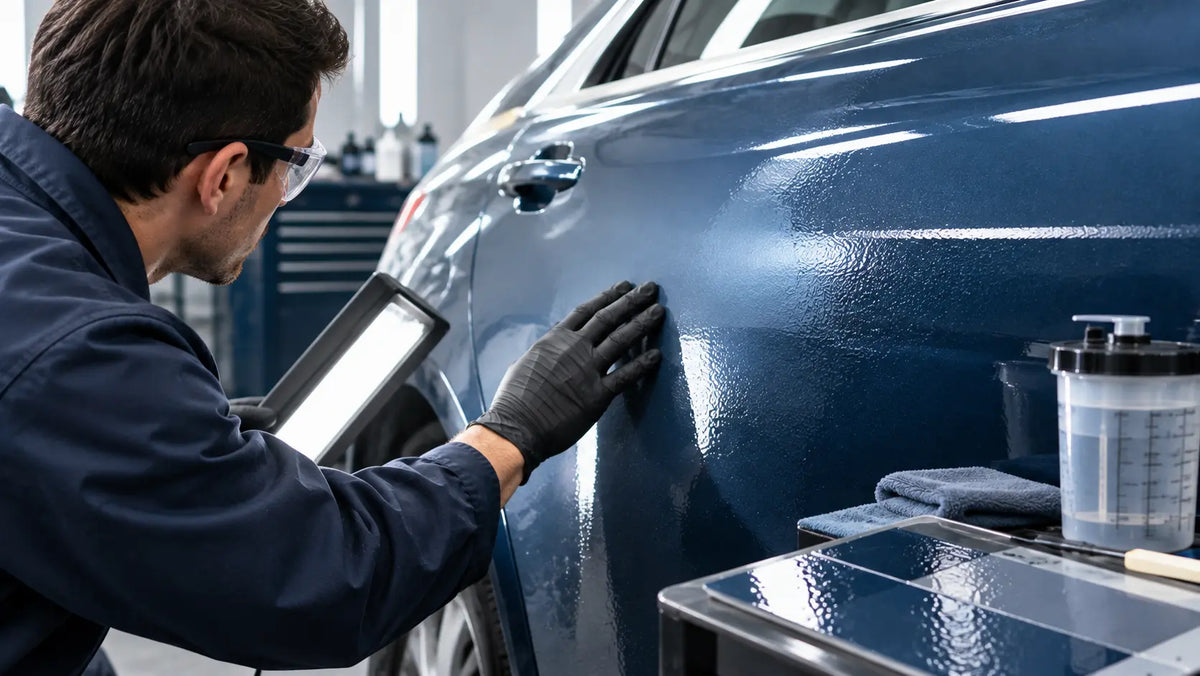
How wet should base coat be? Use the coat technique specified for the paint to develop the required hiding and colour appearance. Do not keep adding paint to make the surface look as glossy as clearcoat.
A basecoat that is too dry can leave roughness or uneven colour. Excessive wetness can create sags, prolonged flash or metallic clouding. Check coverage, film build and readiness for the next coat, rather than gloss alone.
Read the Colour Layer Before Adding Another Coat
|
What the basecoat shows |
What to investigate |
Next action |
|
Even colour developing within the stated process |
Normal progress towards coverage |
Continue the specified coat sequence |
|
Undercoat still visible |
Hiding is incomplete |
Check shade and technique, then add colour as permitted |
|
Dusty, rough or grainy texture |
Dry spray or unsuitable setup |
Check distance, mixture, pattern and conditions |
|
Heavy wet bands, pooling or sagging |
Excessive local material deposit |
Stop and use the coating's correction method |
|
Light and dark metallic clouds |
Uneven effect appearance |
Check coverage and the approved orientation process |
|
Wrinkling or lifting |
A lower-layer reaction may be involved |
Investigate the coating stack before more colour |
A change towards a matte appearance is common as many basecoats flash. It is not a universal test for clearcoat readiness, and a wet-looking coat is not automatically wrong if that product specifies it.
Why Basecoat Is Applied Differently From Clearcoat
Basecoat establishes hiding and any metallic or pearl effect. Clearcoat supplies the final gloss and protection. Trying to make the colour layer flow into a mirror finish can deposit more material than the process calls for.
A heavier metallic patch can look different even when it feels smooth. More paint in that spot may change the effect again rather than remove the cloud.
What to Check When Basecoat Keeps Looking Too Wet
Begin with the surface and mixture
Confirm that the primer or sealer is stable, prepared and ready for basecoat. See paint prep before basecoat for the preparation sequence.
Verify the product, approved reducer and ratio. Extra reducer does not correct an unsuitable nozzle or heavy application, and a slower reducer can extend the wet stage.
Check the gun before changing your movement
Inspect the air cap, nozzle and pattern. Check pressure at the gun maker's specified point with air flowing. See spray gun air pressure regulation for the supply check.
Once the pattern is sound, review fluid delivery, distance, angle and speed. A narrow fan or a pause at the end of a pass can concentrate material. Keep the prescribed distance instead of simply moving farther away, which may turn a wet deposit into dry spray.
Change one variable on a test panel
Make one supported adjustment, repeat the pass and inspect. Keep other conditions comparable so you can identify what improved the film.
A Product Example of Coat Technique and Flash
The Cromax XP basecoat TDS, revised June 2025, calls for two to three medium coats, or until hiding and colour match are achieved. Its air-dry instructions list a 15–20 minute flash before clearcoat. These are instructions for that product; they are not a wetness or waiting-time rule for every solventborne or waterborne basecoat.
Use the sheet's separate effect-coat, blending and repair guidance for those jobs. A control coat does not replace normal colour coverage.
See metallic paint flash time for reducer and drying questions. Check the maximum application window as well as the minimum flash.
How to Deal With Runs and Heavy Patches
For a run or sag, stop applying material. Let it reach the required repair condition, then use the paint maker's correction process. Check that the primer and edges remain stable.
Restore the colour after correction. Clearcoat will not repair a basecoat run. Wrinkling or lifting also needs a check of the lower layers.
What to Check Before Clearcoat
The panel should have the coverage and appearance required by the colour system. View metallics and pearls from more than one angle. Resolve runs, heavy bands, contamination and repair marks before moving on.
|
Check |
Ready to continue when |
|
Hiding |
The specified coverage is achieved across the intended repair |
|
Colour and effect |
Appearance is uniform and the spray-out comparison is acceptable |
|
Surface defects |
No unresolved run, sag, dust repair or unstable edge remains |
|
Flash |
The product's time and film-condition requirements are met |
|
Clearcoat window |
The finish is still within the permitted application window |
Before spraying the clear, review the 2K clear coat safety guide and the safety information for the selected products. Isocyanate-containing materials need the appropriate spray environment and respiratory controls.
Do You Need to Sand Base Coat Before Clear Coat
Correct basecoat within its clearcoat window generally needs no extra sanding. Sanding can alter colour or metallic appearance, so use the product's defect-repair instructions.
Cromax XP requires basecoat over nibbed or sanded colour before clearcoating. Check your product's procedure; a smooth sanded patch is not automatically ready for clear.
Choosing a Setup for Controlled Basecoat Application
The PRD-815 offers 1.2 and 1.3 mm nozzles and a published 1.6–2.0 bar operating range. Match the setup to the paint: Cromax XP specifies 1.3–1.4 mm, so that sheet does not support choosing a 1.2 mm nozzle simply because it is available.
Test the intended material on a spray-out. Carry the recorded setup to the panel and judge the colour after the required flash.
Frequently Asked Questions
Can you spray base coat too wet
Yes. Excessive build can cause runs, uneven metallic appearance or longer flash. Judge wetness against the product's specified application rather than a universal glossy or matte target.
Should solvent base coat be sprayed wet or dry
Use the coat technique stated for the exact product. Avoid flooding the panel or deliberately dry-spraying it unless that particular process calls for the technique.
How many coats are needed before clearcoat
Enough to meet the system's coverage and colour requirements within its permitted build. The number varies by product, formula and undercoat. A fixed coat count does not prove hiding.
Will extra clearcoat hide a patchy basecoat
Do not rely on it. Correct the colour layer first. Clearcoat can make the existing pattern more visible as gloss increases.
Compartilhar:
Paint Wrinkling After Spraying and How to Repair It