
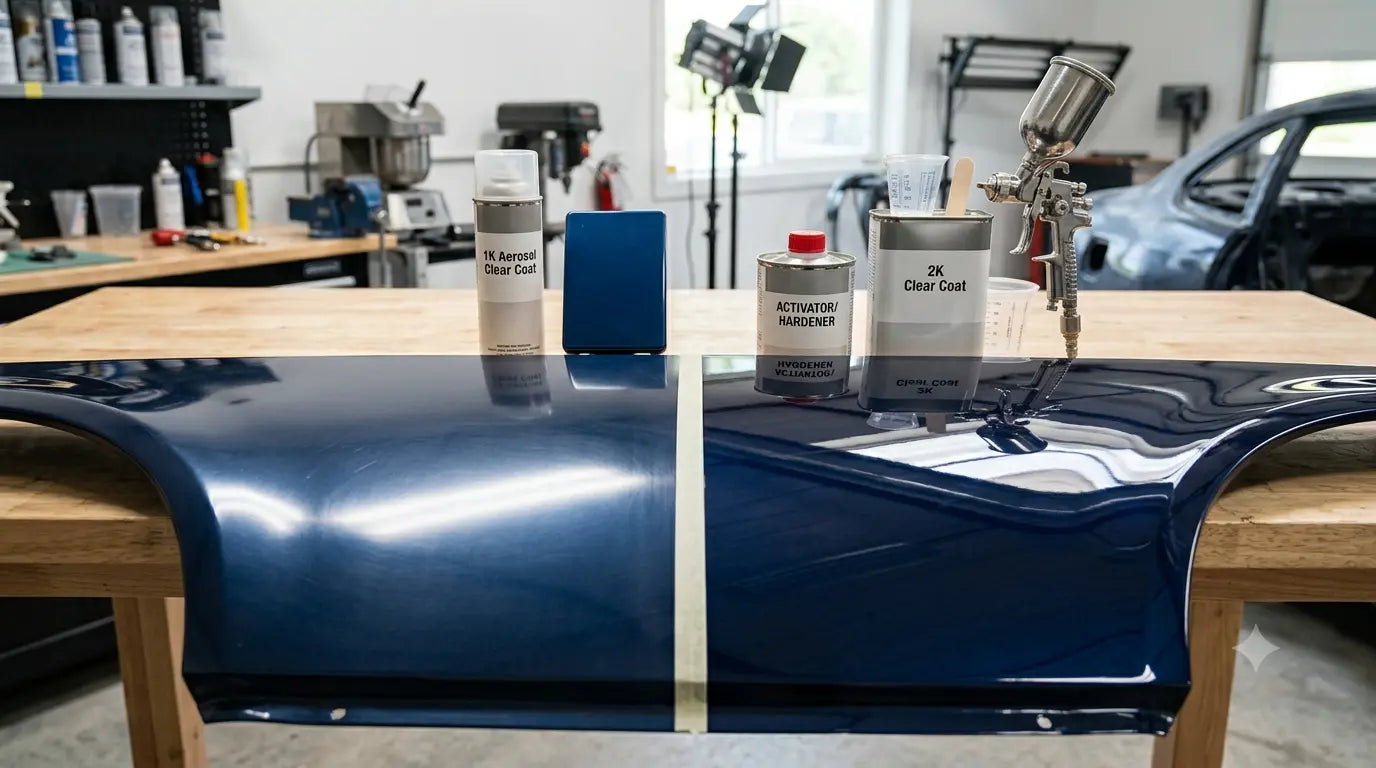
You’ve just finished laying down a flawless base coat. Now comes the moment of truth: choosing the right clear coat. Walk into any automotive paint supply store, and you’ll see two main options—1K and 2K. If you’re new to auto body work, the difference isn’t always obvious. But picking the wrong one can lead to peeling, yellowing, or a finish that fails within months.
This guide breaks down everything you need to know about 1K and 2K clear coats. You’ll learn how they differ in chemistry, durability, application, and safety. By the end, you’ll know exactly which one suits your next project—and what spray gun for clear coat will give you the best results.
1. What Is 1K Clear Coat? The Single-Component Option
1K clear coat is a single-component system. That means it comes ready to spray straight from the can or mixing cup. You don’t add a separate hardener. The coating dries primarily by solvent evaporation. Once the solvent flashes off, the film hardens.
Advantages of 1K Clear Coat
-
No mixing required. Open the container, strain it if needed, and pour it into your paint sprayer.
-
Longer pot life. Since there’s no chemical reaction, what’s left in the cup stays usable for days or weeks if sealed properly.
-
Easier to apply for beginners. You don’t have to worry about incorrect mixing ratios or pot life windows.
-
Lower toxicity. 1K clear coats typically contain fewer isocyanates, making them safer for hobbyists working without a full downdraft booth.
Disadvantages of 1K Clear Coat
-
Lower chemical and UV resistance. 1K clears are softer and more prone to damage from fuel spills, bird droppings, and prolonged sun exposure.
-
Less durability. Expect a shorter lifespan—often two to three years on a daily driver before visible degradation.
-
Not suitable for professional collision repair. Most insurance jobs and warranty work require 2K for longevity.
1K clear coat is best for: touch-up work, small parts, interior components, or projects where the vehicle won’t see harsh conditions. Many DIY painters use 1K for motorcycle tanks, custom artwork, or temporary finishes.
2. What Is 2K Clear Coat? The Two-Component Professional Standard
2K clear coat contains two components: the base clear resin and a separate hardener (often called activator or catalyst). When mixed, a chemical cross-linking reaction begins. This reaction continues until the coating forms a dense, highly durable film.
Advantages of 2K Clear Coat
-
Superior durability. 2K clears are much harder and more resistant to scratches, chemicals, and UV radiation.
-
Professional gloss and depth. The cross-linked structure creates a deeper, more reflective finish that buffs out beautifully.
-
Longer service life. A properly applied 2K clear can last five to ten years or more on a well-maintained vehicle.
-
Better resistance to solvents and fuels. Gasoline spills won’t immediately soften or stain a cured 2K clear.
Disadvantages of 2K Clear Coat
-
Requires precise mixing. Too little hardener, and the clear won’t cure properly. Too much, and it may become brittle or crack.
-
Limited pot life. Once mixed, you typically have one to four hours to use the material before it hardens in the cup.
-
Higher toxicity. 2K clears contain isocyanates, which are dangerous to inhale. A fresh air supplied respirator or downdraft booth is strongly recommended.
-
More expensive. Both the material and the required safety equipment cost more.
2K clear coat is best for: entire vehicle resprays, daily drivers, restoration projects, and any paint job where longevity and professional finish matter.
3. Key Differences at a Glance: 1K vs 2K Clear Coat
| Feature | 1K Clear | 2K Clear |
|---|---|---|
| Components | Single | Two (clear + hardener) |
| Curing mechanism | Solvent evaporation | Chemical cross-linking |
| Pot life | Unlimited (if sealed) | 1–4 hours |
| Hardness | Soft to medium | Very hard |
| Chemical resistance | Low | High |
| UV resistance | Moderate | Excellent |
| Safety | Lower risk | Isocyanates hazard |
| Typical lifespan | 2–3 years | 5–10+ years |
| Best for | Small repairs, hobby | Professional, full vehicles |
4. How to Choose the Right Clear Coat for Your Project
Choosing between 1K and 2K isn’t just about durability. Consider these four factors:
Skill Level
If you’re a beginner who hasn’t yet mastered gun setup, overlap, and environmental control, 1K is more forgiving. Mistakes can be sanded and resprayed without worrying about a short pot life. For experienced painters, 2K delivers a far superior finish.
Equipment
2K clear requires a reliable paint sprayer with consistent atomization. You’ll also need a respirator with fresh air supply or at least a high-quality organic vapor cartridge rated for isocyanates. 1K can be sprayed with a basic paint sprayer and standard painting mask.
Project Type
-
Small parts (mirrors, spoilers, trim): 1K is fine.
-
Engine bay or interior parts: 1K works well.
-
Whole car respray: 2K is the professional choice.
-
Classic car restoration: 2K for durability and gloss.
-
Custom artwork or murals: 1K for ease of layering.
Budget
1K clear costs significantly less per quart or gallon. However, if you factor in longevity, 2K often provides better value for vehicles you plan to keep for years.
5. How to Spray Clear Coat Like a Pro: Tips for Both Systems
Regardless of whether you choose 1K or 2K, proper technique makes or breaks the final result.
Gun Setup for Clear Coat
Clear coat is thicker than base coat. Use a 1.3mm to 1.4mm fluid tip for most automotive clears. For high-solids 2K clears, a 1.4mm tip may provide better flow.
Set your spray gun pressure according to the technical data sheet. For HVLP guns, that’s typically 23–32 PSI at the inlet. For MP or LVLP systems, follow the manufacturer’s recommendation.
Overlap and Flash Times
Overlap each pass by 70–75 percent when spraying clear coat. This ensures wet edges merge without leaving visible lines between passes.
Flash time varies by product and temperature. A good rule: the first coat should be medium-wet. Wait until the surface becomes tacky (not wet enough to fingerprint easily, but not dry to the touch). Apply the second coat within the window specified by the clear coat manufacturer—usually 10–20 minutes at 70°F.
Environmental Control
For 2K clears, temperature and humidity directly affect curing. Ideal conditions are 68–77°F with humidity below 70%. Too cold, and the chemical reaction slows dramatically. Too hot, and the clear may dry before it levels, creating orange peel.
Safety First
If you’re spraying 2K clear, do not skip respiratory protection. Isocyanates can cause severe respiratory issues, including chemical asthma. At minimum, use a supplied air system or a full-face respirator with fresh cartridges rated for organic vapors and particulates (e.g., 3M 60926 or equivalent).
For 1K clear, a standard NIOSH-approved painting mask is usually adequate, but good ventilation is still essential.
6. Product Spotlight: PORPHIS PRD-716 – The Ideal Spray Gun for Clear Coat
To achieve a smooth, professional finish with 2K clear coat, you need a spray gun that delivers consistent atomization and a predictable spray pattern. The PORPHIS PRD-716 is a standout choice for both 1K and 2K clear coat application.
The PRD-716 features HVLP (High Volume, Low Pressure) atomization technology with a 1.3mm nozzle—the sweet spot for most automotive clears. Operating at 23–32 PSI with an air consumption of 15.2 CFM, it produces soft, controlled atomization that helps clear coat level into a deep, uniform gloss.
What makes the PRD-716 particularly effective for 2K clear is its refined air cap design. It delivers a consistent fan pattern without pressure spikes at the edges, reducing the risk of tiger stripes or overlap lines. For high-solids 2K clears, the 1.3mm tip provides enough material flow without excessive orange peel.
Professional painters have noted that the PRD-716 offers performance comparable to guns costing twice as much. It’s a reliable workhorse for bodyshops and serious DIYers who want professional-grade results without breaking the bank.
Check out the PORPHIS PRD-716 for your next clear coat job.
If you frequently spray both base coat and clear coat, consider pairing the PRD-716 for clear with a second gun (like the PRD-510 LVLP) for base coat. Dedicated guns eliminate cross-contamination and allow you to keep each gun optimized for its specific material.
7. Common Questions About 1K and 2K Clear Coat
Can you put 2K clear over 1K paint?
Generally, yes, but only after the 1K base has fully cured (at least 24 hours). However, always test on a scrap panel first, as solvents in the 2K clear may reactivate some 1K materials.
Can you put 1K clear over 2K paint?
Technically yes, but it defeats the purpose. The softer 1K clear will scratch and degrade much faster than the hard 2K underneath.
How long does 2K clear coat take to fully cure?
Tack-free in 30–60 minutes, sandable in 4–8 hours, and fully cured in 24–48 hours at room temperature. Heat curing (140°F for 30 minutes) accelerates the process.
Do I really need an isocyanate respirator for 2K clear?
Yes. Even brief exposure can cause sensitization and long-term respiratory damage. A standard dust mask offers no protection. Invest in a fresh air system or a high-quality respirator with isocyanate-rated cartridges.
What’s the best spray gun for clear coat on a budget?
The PORPHIS PRD-716 offers excellent value. It provides professional atomization at a price point accessible to advanced DIYers and small shops.
8. Final Thoughts: Which One Should You Choose?
-
Choose 1K clear coat if you’re a beginner, spraying small parts, working in a home garage without a fresh air system, or need a temporary finish.
-
Choose 2K clear coat if you want a durable, high-gloss finish that lasts for years, and you have the proper safety equipment and a quality paint sprayer.
Remember: the best clear coat in the world won’t look good if your spray gun or technique is lacking. Pair your material choice with a reliable automotive paint gun, practice your overlap and flash timing, and always prioritize safety.
Whether you go with 1K or 2K, the PORPHIS PRD-716 is a spray gun that will help you lay down a smooth, streak-free clear coat every time.
Share:
Automotive Painting as a Career: Is It a Good Trade to Get Into in 2026?
When to Call It Quits: How Much Bad Luck Before You Take It to a Pro?