
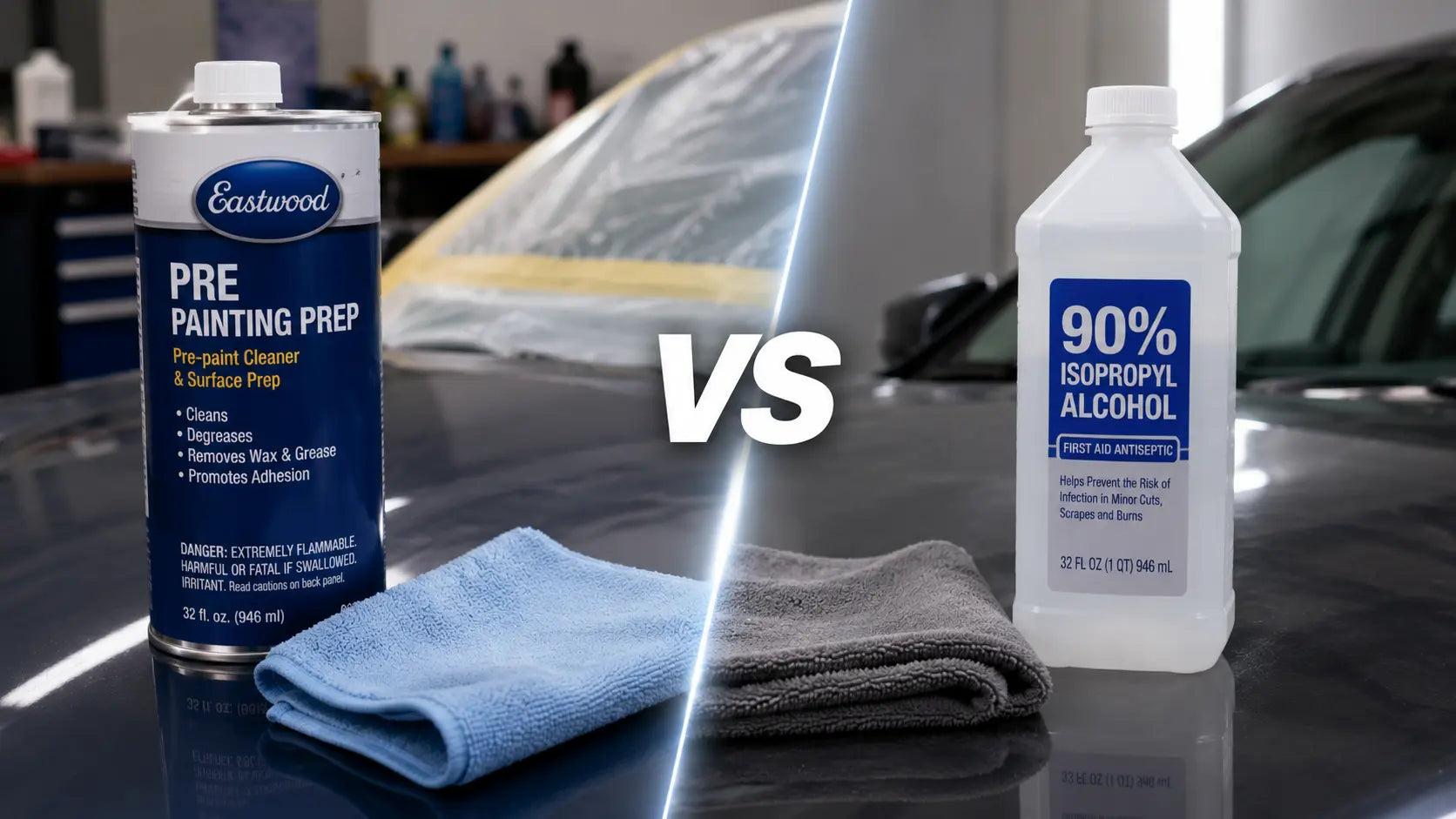
You've sanded the panel, feathered the edges, and masked everything off. Now comes the final step before the first coat of primer or paint goes on: the final wipe. This seemingly small step is one of the most critical in the entire refinishing process. A single fingerprint, a trace of silicone, or a film of polishing compound left on the surface can lead to fisheyes, poor adhesion, and a finish that fails long before it should.
The question that often comes up in shops and garages is simple: Can I just use 90% isopropyl alcohol instead of a dedicated prep solvent like Eastwood Pre-Painting Prep? On the surface, it seems like a smart way to save money. After all, alcohol is a solvent, and it's cheap and readily available. But is it really a substitute?
This guide breaks down the differences between these two approaches, explains what each can and cannot do, and helps you choose the right surface preparation method for your project.
What Is Eastwood Pre-Painting Prep?
Eastwood Pre-Painting Prep (often referred to simply as "PRE") is a solvent-based cleaner specifically formulated for automotive surface preparation. It's designed to be the final step in cleaning a surface before applying primer, paint, or powder coating.
What It Removes
PRE is engineered to tackle the specific contaminants that cause paint failures:
-
Silicone: One of the most common and problematic contaminants, often found in polishes and detail sprays. Silicone is notorious for causing fisheyes.
-
Waxes and Polishing Compounds: Residue from previous detailing work that can prevent new paint from bonding.
-
Grease and Oil: Fingerprints, cutting fluids, and general shop grime.
-
Dirt and Road Tar: Surface debris that can be trapped in the texture of sanded paint.
The product is designed to be sprayed or wiped on and then wiped off, taking these contaminants with it and leaving no residue behind.
Two Formulations: Original vs. PRE Green
Eastwood offers two versions of PRE:
Original PRE is a powerful petroleum-based solvent blend. One Eastwood representative described it as "Acetone on steroids". It's extremely effective but comes with significant health and safety risks. The Safety Data Sheet lists it as highly flammable liquid and vapor that is harmful if inhaled and causes skin irritation. It's not available for sale in California due to its VOC content.
PRE Green is a water-based, alkaline alternative that is non-flammable, non-caustic, and has no harsh chemical smell. It has a pH between 12 and 12.3 and is 50-state compliant. It's a much safer option for DIYers and hobbyists, though it may not be as aggressive on heavy silicone contamination. It can also be used between coats without worrying about solvent attack.
What Is 90% Isopropyl Alcohol?
Isopropyl alcohol (IPA) is a common solvent found in most hardware stores and pharmacies. It's a versatile cleaner used for everything from disinfecting to removing adhesive residue. In the automotive world, it's often used as a panel wipe to remove oils, waxes, and polish residue before painting or applying coatings.
Diluted with water (typically a 50/50 or 70/30 mix), it's a popular choice for a final clean before applying ceramic coatings. However, its use as a primary pre-paint cleaner is a subject of ongoing debate.
The IPA Concentration Question
When people talk about using IPA for paint prep, they're usually referring to 70% or 91% isopropyl alcohol. Higher concentrations (99%) are also available but are even more aggressive. The remaining percentage is typically distilled water, which affects the solvent's strength and evaporation rate.
The Critical Differences
While both products are solvents, they are not interchangeable. Here's why.
1. Effectiveness Against Silicone
This is the most significant difference. Silicone is the arch-enemy of a good paint job. It's incredibly difficult to remove and is the primary cause of fisheyes.
Eastwood PRE is formulated specifically to dissolve and lift silicone from the surface. It's designed to break the bond between the silicone and the paint, allowing it to be wiped away completely.
90% Isopropyl Alcohol is not an effective silicone remover. While it can remove some light oils and waxes, it struggles with silicone. In many cases, it can actually smear the silicone across the surface rather than removing it, making the problem worse. For a surface that may have been exposed to silicone-based products, IPA is simply not a reliable choice.
2. Effect on Automotive Paint
This is where IPA can be genuinely risky. Isopropyl alcohol, especially at high concentrations like 91%, can damage vehicle clearcoat by causing clouding or softening. Some users have reported that 91% IPA softened original equipment paint to the point that it wiped off with a cloth after application. Even 70% IPA has been reported as "still too tough on paint" in some cases.
Eastwood PRE, when used as directed, does not degas or soften properly cured paint. It's formulated to clean without damaging the underlying finish.
3. Residue and Evaporation
Eastwood PRE is formulated to evaporate completely and leave no residue behind. It's designed to be the final, clean step before painting.
90% Isopropyl Alcohol can leave a residue if not wiped off properly. Even if it evaporates, the contaminants it has dissolved may be left behind on the surface. Furthermore, standard rubbing alcohol often contains additives and impurities that can also leave a film.
4. Safety and Handling
This is where the choice becomes more nuanced.
Eastwood PRE (Original Formula) is highly effective, but it comes with significant health and safety risks. Its main ingredients include xylene, toluene, and petroleum-based solvent naphtha. The Safety Data Sheet warns that it is a highly flammable liquid and vapor that is harmful if inhaled, causes skin irritation, and is suspected of damaging fertility or the unborn child. It requires the use of protective gloves, eye protection, and respiratory protection in a well-ventilated area, away from any ignition sources.
Eastwood PRE Green is a water-based, alkaline alternative that is non-flammable, non-caustic, and has no harsh chemical smell. It's a much safer option for DIYers and hobbyists, though it may not be as aggressive on heavy silicone contamination.
90% Isopropyl Alcohol is generally safer to handle than solvent-based preps like PRE. While it is still flammable and can be irritating to skin and eyes with prolonged exposure, it does not carry the same level of chronic health hazards as xylene and toluene.
5. Cost
90% Isopropyl Alcohol is undeniably cheaper. A large bottle can cost a few dollars, while a can of Eastwood PRE is around $19, and a gallon is around $55.
However, the cost difference must be weighed against the potential cost of a paint failure. A single fisheye or adhesion issue can cost far more in time, materials, and frustration than the price of a proper prep solvent.
Comparison Summary Table
| Feature | Eastwood PRE | 90% Isopropyl Alcohol |
|---|---|---|
| Silicone removal | Excellent | Poor—can smear rather than remove |
| Effect on cured paint | Safe when used as directed | Can cloud or soften clearcoat, especially at 91% |
| Residue | None—evaporates completely | Can leave residue if not wiped properly |
| Safety | Original: highly flammable, toxic; PRE Green: safer | Flammable, but fewer chronic health hazards |
| Cost | Higher ($19-$55) | Lower ($3-$10) |
| Best use | Final wipe before primer/paint | Light cleaning, polish residue removal |
Can You Use 90% Isopropyl Alcohol for Paint Prep?
The answer is: It depends on what you're trying to remove and how much risk you're willing to accept.
For some DIY projects, many painters have used isopropyl alcohol as a panel wipe with acceptable results. It can remove light oils and dust. However, as one professional pointed out, if you clean properly with a dedicated wax and grease remover, an IPA wipe afterward isn't really necessary.
The critical advice for using IPA: It should not be used as a replacement for a proper wax and grease remover. It is not effective against silicone, which is one of the most common and destructive contaminants in a body shop. For a surface that has any possibility of silicone contamination, a dedicated solvent like PRE is the only safe choice.
Best Practices for Surface Preparation
Whichever product you choose, the technique is just as important as the cleaner.
The Two-Rag Method
Never apply a prep solvent and wipe it off with the same rag. This just moves the contaminants around. The correct method is:
-
Apply the cleaner to a clean, lint-free cloth.
-
Wipe the surface.
-
Immediately follow with a second clean, dry cloth to wipe off the dissolved contaminants before they can evaporate and leave a residue.
Step-by-Step Prep Process
For a professional result, follow these steps:
-
Degrease: Remove heavy grease and oil with a strong degreaser.
-
Sand: Sand the surface with the appropriate grit.
-
Clean Again: Blow off sanding dust with compressed air.
-
Final Wipe: Apply your chosen prep solvent (PRE or IPA) using the two-rag method.
-
Tack Rag: Just before painting, use a tack rag to remove any final dust particles.
The Equipment Factor: From Prep to Perfection
Proper surface preparation removes contaminants and ensures a clean foundation. However, the quality of the final finish also depends on the application equipment. Even the best-prepped surface can be ruined by a spray gun that delivers inconsistent atomization or has poor fluid control.
For painters serious about achieving a flawless finish, the PORPHIS PRD-815 is engineered to deliver consistent, professional-grade results. Featuring MP (Multi-Point) atomization technology, the PRD-815 produces an exceptionally even spray pattern that eliminates the "hot center / thin edges" problem common with standard nozzles. This ensures uniform coverage and helps prevent runs and sags.
Operating at 23-31 PSI with a low air consumption of just 10.2 CFM, the PRD-815 is compatible with a wide range of professional compressors. Its responsive air regulation system and precise fluid control allow you to dial in the exact settings for each job and replicate them consistently. When your equipment delivers predictable results, you can focus on technique and achieving a durable, professional finish.
Frequently Asked Questions
Can I use 70% isopropyl alcohol instead of 90%?
70% IPA contains more water, which means it's less effective as a solvent and takes longer to evaporate. Some users report that even 70% can be too harsh on certain paints. It is not recommended as a primary pre-paint cleaner.
Is Eastwood PRE safe on plastic?
The original solvent-based PRE can attack some plastics. Always test on an inconspicuous area first. For plastics, consider using a water-based product like PRE Green.
What happens if I don't use a prep solvent?
Skipping this step or using an ineffective cleaner is a gamble. You risk fisheyes, poor adhesion, and premature paint failure. The contaminants left on the surface will create a barrier between the new paint and the substrate.
Can I use brake cleaner as a prep solvent?
No. Brake cleaner is not designed for paint prep and can leave a residue that causes fisheyes. Some types also contain chlorine, which can be hazardous when heated during welding.
Do I need to use a tack rag after the prep solvent?
Yes. After the final wipe, use a tack rag to pick up any lint or dust particles that have settled on the surface before you start spraying.
Does PRE remove rust?
No. PRE is a surface cleaner, not a rust remover. It removes contaminants like wax, grease, silicone, and dirt, but it will not dissolve or convert rust. For rust removal, you'll need a dedicated rust converter or mechanical removal.
Conclusion
Eastwood Pre-Painting Prep and 90% isopropyl alcohol serve different purposes. For a reliable, professional-grade surface preparation that removes silicone, wax, grease, and other contaminants, a dedicated prep solvent like PRE is the superior and safer choice for your paint job. Its formulation is designed to eliminate the specific contaminants that cause paint failure.
While 90% isopropyl alcohol can be used as a panel wipe for light cleaning in some DIY situations, it should not be relied upon as the primary pre-paint cleaner, especially when silicone contamination is a possibility. The risk of damaging the clearcoat or leaving behind contaminants far outweighs the minimal cost savings.
Thorough preparation, the right products, and a quality spray gun like the PORPHIS PRD-815 are the keys to a durable, professional-looking finish.
Share:
Prepper to Painter: A Complete Guide to Pay, Career Progression, and Success in Automotive Refinishing