
1. Strategic Overview of the PORPHIS Product Ecosystem
The professional automotive refinishing market is witnessing a decisive disruption as "mid-tier" equipment increasingly challenges the dominance of the "Big Three" (Sata, DeVilbiss, and Iwata). Traditionally, workshop owners were forced to choose between premium-priced heritage brands and entry-level budget guns that lacked longevity.
However, the PORPHIS PRD Series has effectively bridged this gap, offering professional-grade atomization and build quality without the associated "premium brand tax." Extensive field evaluations indicate that PORPHIS has successfully transitioned from a budget-friendly alternative to a high-value professional tool capable of daily duty in high-output environments.
Ultimately, this market disruption is predicated on the delivery of hardware that survives the daily grind of a professional shop, providing a reliable ROI that legacy brands can no longer ignore.
2. Engineering Integrity and Build Quality Analysis
In a high-volume workshop, build quality is the primary driver of operational ROI. Equipment must withstand constant cleaning, solvent exposure, and the rigors of multiple-user handling; any failure in these areas disrupts maintenance cycles and inflates the total cost of ownership.
The PORPHIS PRD Series exhibits a manufacturing standard that often exceeds the mid-range offerings of its competitors. Specifically, the build quality of the PORPHIS is notably superior to the Sata 1500—a gun that carries a higher price point but offers a "lesser made" feel in terms of fit and finish.
Furthermore, the PORPHIS PRD Series avoids the common aesthetic and structural failures seen in high-end models, such as the Iwata WS400, which is prone to chrome tarnishing or coating flaking after several years of use.
-
Extended Service Life:
Documented reliability exceeding three years of regular workshop use. -
Operational Robustness:
Maintained peak performance even after being utilized as a "loaner" gun for three different technicians. -
Manufacturing Integrity:
Component tolerances and sealing remain consistent after repeated disassembly and deep cleaning. -
Finish Durability:
Unlike premium competitors, the exterior finish maintains its integrity without the tarnishing or "falling off" associated with high-cost chrome coatings.
This robust physical construction provides the necessary stability for the precision performance analyzed in the following section.
3. Operational Performance: Speed vs. Atomization Precision
Technicians must often navigate the trade-off between application speed and atomization precision. High-volume work demands a tool that can "wet up" a panel rapidly, whereas prestige refinishing requires a sharp, controlled fan pattern for metallic orientation and clear coat clarity.
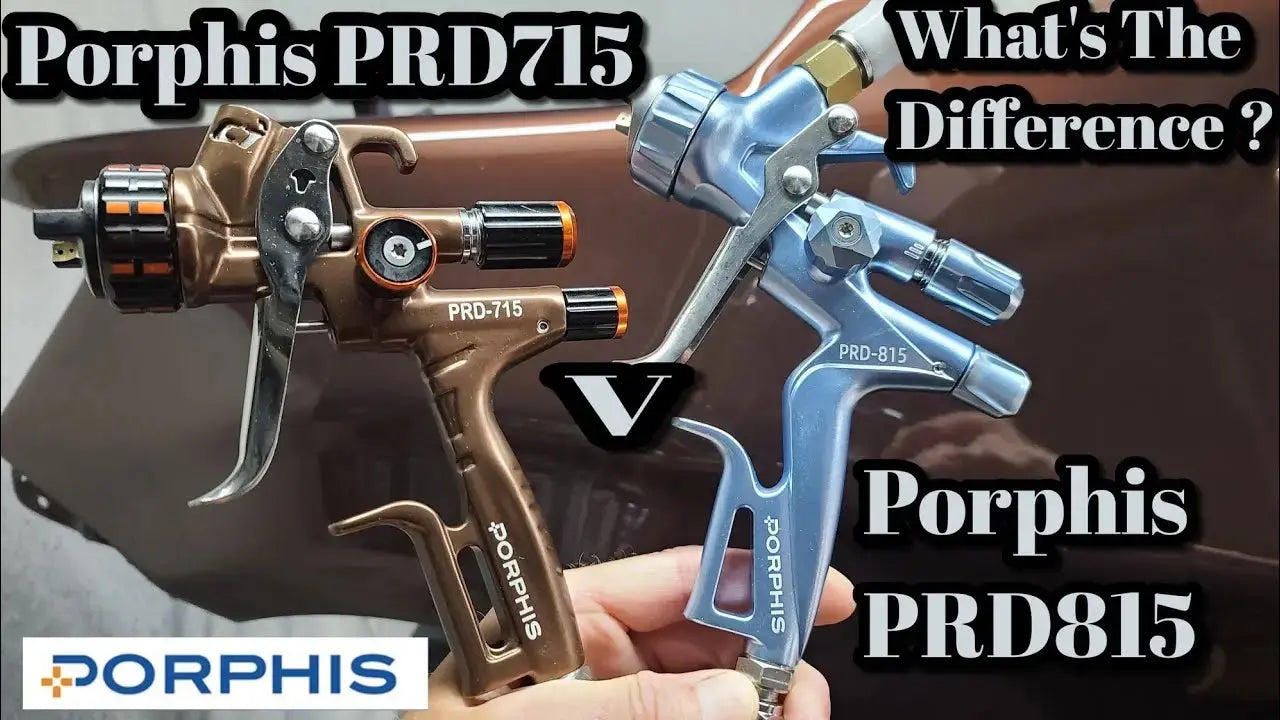
The following table contrasts the performance of the PRD-715 and the PRD-815 variants:
|
Feature
|
PRD-715 (1.3mm)
|
PRD-815 (1.3mm)
|
PRD-815 (1.2mm)
|
|---|---|---|---|
|
Spray Speed
|
High (Fast application)
|
Moderate (Precision-focused)
|
Moderate-High (Optimized)
|
|
Pattern Profile
|
Slightly smaller; "Wetter"
|
Even, smooth, "Super Sharp"
|
Exceptional sharpness
|
|
Atomization
|
Professional Standard
|
Supreme Precision
|
Finer than PRD-717 split-tip
|
|
Fan Stability
|
Stable at standard settings
|
Maintains sharp edge "fully open"
|
Absolute precision at speed
|
The "So What?" for the Professional:
The PRD-715 is the superior choice for high-volume efficiency, particularly for large surface areas like vans or buses where rapid material delivery is essential. Conversely, the PRD-815 is designed for precision clear-coating. Notably, the PRD-815 maintains a "super sharp" fan edge even when the fluid and fan controls are fully open (flat out), a trait rarely seen in mid-tier guns. The 1.2mm variant of the PRD-815 is a particularly significant entry; it "pips" even the PRD-717 split-tip by offering comparable (if not finer) atomization with a faster application speed, making it the premier choice for technicians seeking the ultimate balance of fineness and throughput.
4. Material-Specific Application Strategies (Base Coat vs. Clear Coat)
A strategic refinishing operation requires matching gun mechanics to material chemistry. The ability of a tool to handle varying viscosities dictates the quality of the "lay down" and the amount of post-paint correction required.
-
Base Coat Excellence:
The PRD-815 is exceptional for complex colors, including candies and high-metallic bases, due to its incredibly even pattern. For technicians prioritizing speed, the PRD-715 remains a highly effective base coat workhorse. -
Clear Coat Utility:
Both models were evaluated using Upol 2080 clear coat—the "test standard"—with a 10% reduction to facilitate flow-out. Both produced professional results, though the PRD-815 provided a sharper transition from wet to dry across the fan edge. -
Tactical Alternative:
Field testing has revealed a highly effective "tactical swap" for shops: utilizing the PRD-715 for base coat (speed) and the PRD-717 (split-tip) for clear coat (fineness). This combination is highly rated by painters who prefer a wetter base application followed by a supremely atomized clear. -
Waterborne Compatibility:
The PRD-815 is specifically marketed by the manufacturer for waterborne clear coat applications. Field verification has confirmed it performs "superbly well" in this role, providing the fine atomization necessary for modern waterborne chemistries while remaining equally capable with solvent clears.
 |
 |

5. Technical Resource Efficiency: Air Consumption and HVLP vs. MP
Compressed air is a significant operational overhead. High-draw guns force compressors to run longer cycles, increasing electricity costs and maintenance on air systems. Selecting a gun that matches the shop's air capacity—whether a single large compressor or a "double compressor setup"—is vital.
-
CFM Reality Check:
While the MP versions draw a lean 10.5 CFM, the HVLP versions (such as the 716) require more attention. The manufacturer claims 15.2 CFM, but field-verified testing suggests a more realistic draw of approximately 12 CFM. -
The "Efficiency Myth":
Many technicians avoid HVLP due to legacy "air hogs" like the DeVilbiss HV30. However, the PORPHIS HVLP Systems are on par with the DeVilbiss GTI Prolite (TE20) benchmark, which draws 12 CFM at 2 bar. -
Operational Benefits:
The HVLP variants allow the technician to hold the gun closer to the substrate, providing a more stable application with measurable material savings and reduced overspray, without taxing the compressor to the extent of older HVLP designs.
 |
 |

6. Economic Value Proposition and Procurement Guidance
For workshop decision-makers, the primary metric is the "Performance-to-Cost" ratio. The PORPHIS ecosystem provides a strategic advantage by delivering performance comparable to $1,000 instruments at a fraction of the cost.
-
PRD-715 ($258.99):
The "High-Volume Workhorse." This model is ideal for technicians who need proven 3-year reliability and speed on a restricted budget. It is the definitive value-for-money choice for standard production work. -
PRD-815 ($349.99):
The "Prestige Specialist." The ~50% price increase is justified by the superior atomization and the "super sharp" fan edge. It is the recommended tool for prestige clears, candies, and waterborne systems. -
Regional Procurement:
For UK-based buyers, procurement through VAT-registered suppliers like RX Spray is recommended to avoid import duties and allow for VAT reclamation, further improving the ROI.
Final Recommendation:
The PORPHIS PRD Series has successfully disrupted the professional market by proving that a $350 tool can match the results of a $1,000 Sata or Iwata. For general shop duties and maximum speed, the PRD-715 is the logical procurement choice. For high-end, technical finishing where atomization is paramount, the PRD-815 (specifically the 1.2mm variant) is the superior professional instrument.
Share:
Spray Gun Comparison: PRD-717 vs. PRD-715
Spray Gun Comparison: PRD-627 vs. PRD-717