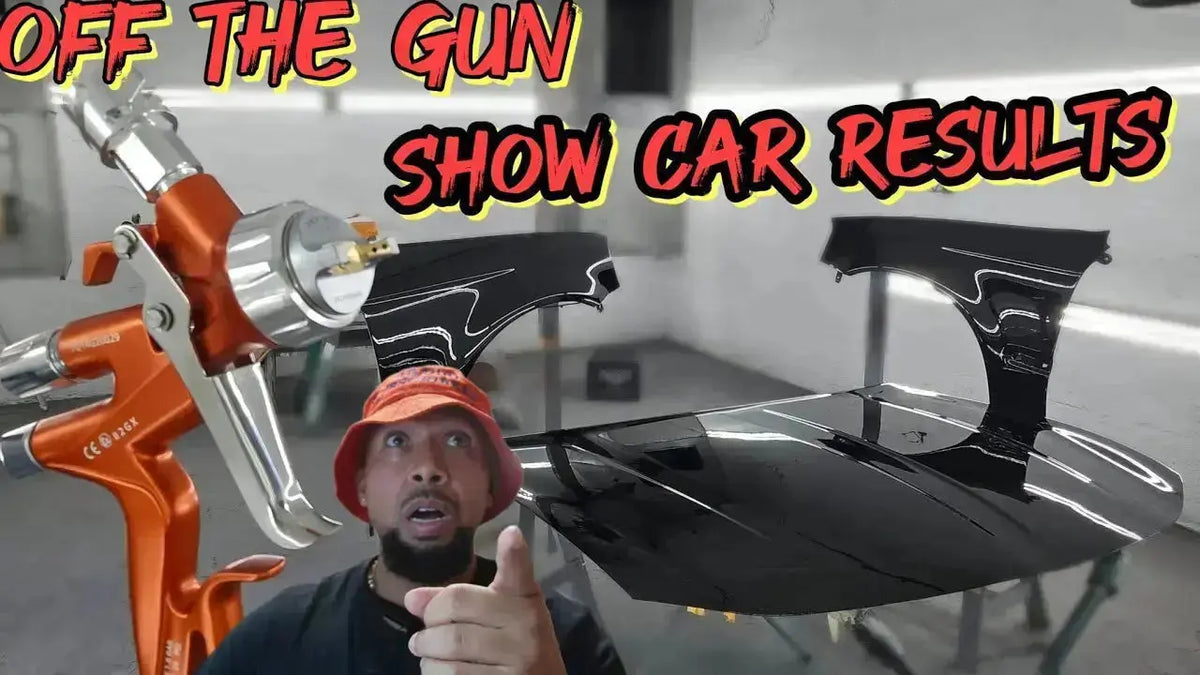
Listen, I feel like I’m losing my mind sometimes watching people struggle with texture. If you’ve been chasing that elusive "showcar finish," you know the frustration. The textbook tells you to follow the standard four-stage marathon: sealer, wet bed, base coat, and clear coat. But here is the reality they don't mention—every time you add a layer, you’re inviting texture. By the time you’ve stacked those four stages, you’ve built a mountain of orange peel that requires a week of sanding just to flatten out.For model-specific performance, setup, and application context, see our preventing and fixing orange peel.
I’m back in the lab to tell you that there’s a better way. I’m talking about a finish that is truly "beyond glass" straight off the gun, bypassing the texture trap entirely. It’s a method you won’t find in a manual, but if you want that zero-texture look without spending your life behind a sanding block, this is the only way to get it.
The Counter-Intuitive Layering Hack
The secret to a zero-texture finish isn't adding more product; it’s stripping the process down to its bare essentials. While the industry pushes complex multi-stage systems, the real "pro" move is a simplified two-stage application: one coat of single-stage enamel (specifically Nason black) followed by one coat of high-quality clear (like Amtech/Prospray).
This "one-and-one" approach is the ultimate hack because it leaves virtually no room for texture to accumulate. Single-stage typically lays down much flatter than a standard base coat, and when you only have two layers to manage instead of four, the result is mirror-flat. As the source explains:
"This is beyond a glass finish... this is like something that would have already been cut and buffed with say 1500, 2000, 3000, buffed, polished. This is what you would get once you do all of those steps."
By ignoring the four-stage "rules," you achieve a level of depth that is physically impossible to reach when you're spraying four different applications.
Defying Manufacturer Warnings with Chemistry
Mixing different product lines is the ultimate "taboo" in the paint world. Manufacturers will tell you never to cross-pollinate, but in a home-shop or DIY environment, you can make it work if you understand the chemistry. The danger is "solvent pop"—or "solvent boil," as they call it across the pond. This happens when your top layer dries faster than the bottom, trapping gassing solvents underneath and ruining your work.
The linchpin for this specific process is U-Pol Rocket accelerator. Nason single-stage is notorious for drying extremely slow. If you throw a faster-drying clear coat over it, you are asking for a disaster. You have to add a few drops of accelerator to the single-stage to force it to "kick" faster.
Here is a 10-out-of-10 recipe for failure: putting a fast-activated clear over a slow-activated base. If the top dries before the bottom gasses off, you’re done. The accelerator syncs those drying speeds, ensuring the single-stage releases its solvents and natural oils before the clear locks them in.
The "Tap Test" for Perfect Timing
You can’t just set a kitchen timer and hope for the best; you have to feel the chemistry. Generally, you’re looking at a 20-minute flash window, but the environment dictates the reality. You need to know exactly when that single stage is ready to "accept" the clear coat.
This is where the tactile "tap test" comes in:
- Lightly tap the masked-off area or a non-critical edge.
- Listen for the sound: You aren't looking for a sticky silence; you want to hear a "thud" or a "click" that signifies the surface is firm and the solvents have moved out.
- Check for transfer: If you pull your finger away and see black paint, it’s still gassing off. For model-specific performance, setup, and application context, see our orange peel prevention tips .Do not clear it yet.
Once you can tap it and hear that firm surface sound with zero color transfer, the single stage has flashed enough to be cleared without the risk of solvent boil.
Precision Hardware and Fan Control
Mastering the chemistry only gets you halfway; you still need a mechanical delivery system that can lay product down flat. I’ve been using the PORPHIS PRD-817, which utilizes "Split Nozzle V Technology." This design is critical for this method because the V-tech ensures that even with a humongous fan pattern, the delivery remains wet and consistent across the entire spread.
But even with a top-tier gun, don't just run it "wide open." I’ve developed a habit of turning the fan adjustment in about a quarter turn. While the gun is capable of a massive fan, taking that quarter turn in "cleans up the edges." It ensures you’re getting a full, wet, even fan without the dry, erratic edges that often lead to "dry spray" and texture. It’s about controlled power, not just raw volume.
The "Sunglasses" Warning
When you successfully lay one coat of clear over a single-stage black base, the visual intensity is on another level. Because there is absolutely zero texture—no microscopic hills and valleys for light to bounce off of—the reflection is perfectly sharp and incredibly deep.
Traditional base-coat/clear-coat systems always have some degree of texture, but this method is blindingly reflective.For model-specific performance, setup, and application context, see our preventing clear coat runs. If you decide to go beyond the baseline and lay down two or even three coats of clear over that single stage, be prepared. The source isn't joking: you’re going to need to "wear some shades" or "dark sunglasses" because the reflection in the sun will be legitimately blinding.
Bonus Insight: Household Uses for Leftover Orange Peels
While the focus here is on achieving that perfect automotive finish without texture, it's worth noting that orange peels and citrus peel have many practical uses beyond aesthetics. Leftover orange peels can be repurposed into natural cleaning spray solutions, bringing a fresh citrus scent into your home. For example, by candying them, you create delightful snacks combining flavor and orange zest. You can also dry orange peels and grind them in a food processor to add a natural citrus body scrub to your skincare routine, harnessing the natural oils that orange peels have for revitalizing effects.
Conclusion: Redefining the Standard
The highest quality finish doesn't come from the most expensive four-stage "textbook" system; it comes from simplifying the process and mastering the drying speeds. By narrowing the application down to two coats—one single-stage and one clear—and using an accelerator to control the gassing off, you can achieve a result that simply isn't possible with traditional methods.
Are you ready to stop sanding for a week and start spraying for a showcar finish? It requires breaking some rules and respecting the chemistry, but the zero-texture results speak for themselves. The question is: are you willing to ditch the textbook to get the glass?
Share:
Professional Standardized Guide: OEM Plastic Bumper Painting & Fender Blending