
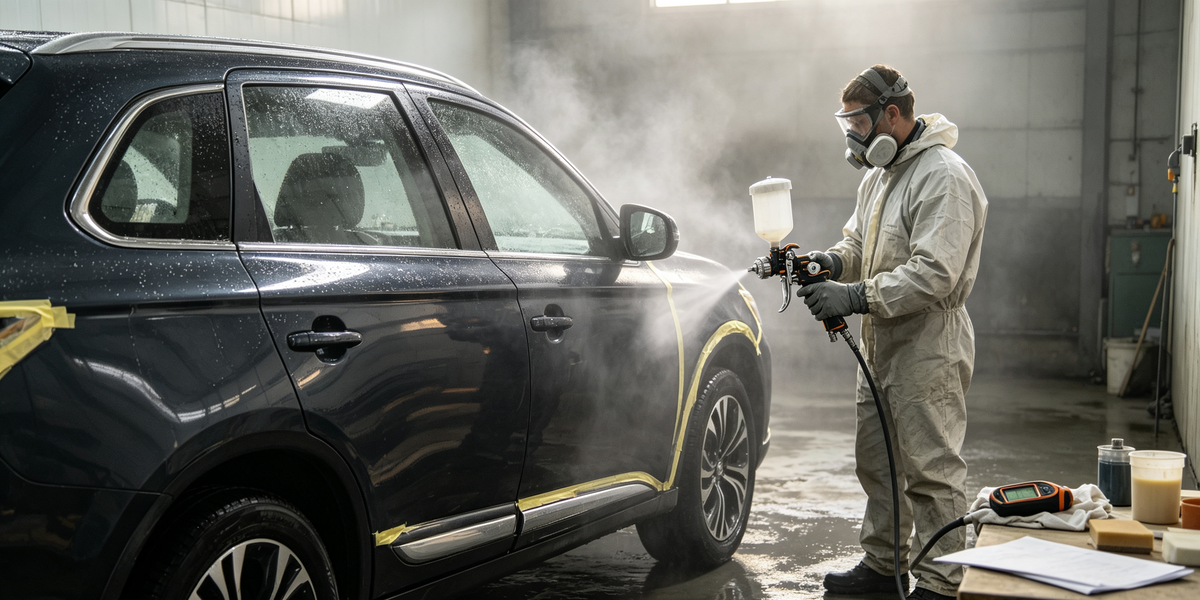
A humid day does not automatically mean you have to cancel a paint job. It does mean you should stop treating the weather app as the whole answer. The coating manufacturer’s technical data sheet, the actual panel temperature, airflow, material temperature and relative humidity together determine whether the job is inside a safe application window.
That distinction matters because painters often blame “humidity” for completely different problems: a milky haze, slow basecoat flash, dry spray on a hot panel, solvent pop, or clear coat that stays soft longer than expected. They can look related, but the fix is not the same.
Can You Spray Paint a Car in High Humidity?
Yes—if the exact primer, basecoat or clear coat you are using allows those conditions. The safest answer is not a universal humidity percentage. Check the TDS for the coating system and compare it with the conditions at the panel, not just the room.
|
Check before mixing paint |
Why it matters |
|
Air temperature |
Changes reducer/hardener selection and evaporation or flash behavior. |
|
Panel temperature |
A sun-heated hood can be much hotter than the air around it. |
|
Relative humidity |
Can affect waterborne flash, condensation risk and some moisture-related defects. |
|
Dew point / condensation risk |
A panel close to the dew point can collect moisture even when it looks dry. |
|
Product TDS |
Defines the approved application window, flash, reducer/hardener and bake process. |
Humidity Effect on Car Paint: Not Every Coating Reacts the Same Way
The humidity effect on car paint depends on chemistry. Waterborne basecoat needs controlled airflow and enough time for water to leave the film. Solvent-borne products respond differently, and very hot conditions can make some solvents leave too quickly rather than too slowly. That is why “high humidity slows all paint” is too simple to be useful.
What matters is whether the film is drying and curing the way its TDS expects. If flash behavior suddenly changes from your normal process, do not simply keep the same timer and continue stacking coats.
If you suspect water is entering from the compressor rather than the room itself, read our guide to moisture in compressed air and solvent pop. Environmental humidity and contaminated air lines are related, but they are not the same diagnosis.
Blushing Paint Defect: What It Looks Like
A blushing paint defect is usually described as a milky, cloudy or hazy appearance that develops in the film. Moisture and rapid cooling/evaporation can contribute in some coating systems, but do not label every cloudy clear coat “blushing” before checking the product, film build and cure conditions.
|
What you see |
Possible direction to check first |
|
Milky or cloudy film shortly after application |
Humidity/condensation, reducer choice, product-specific blushing guidance. |
|
Tiny pinholes or bubbles after the film starts curing |
Solvent pop, film build, flash, trapped gases or contaminated air. |
|
Rough, dry texture |
Panel too hot, material drying before landing/leveling, distance or gun setup. |
|
Clear remains soft longer than expected |
Mix ratio, product age, film build, temperature and cure schedule. |
What Happens If You Spray Paint in 100 Degree Weather?
At 100°F (38°C), you are in a condition where many automotive systems require a slower reducer, different hardener, controlled booth temperature—or simply postponing the job. But 100°F is not a magic failure point. The coating TDS decides what is acceptable.
The bigger trap is panel temperature. A hood sitting in direct sun can be far hotter than the ambient air. On a hot panel, material may lose solvent so quickly that it lands dry, refuses to level, or leaves a rough edge before you can maintain a wet edge.
If the finished surface turns pebbly instead of leveling, use our orange peel prevention guide to separate material, pressure, distance and temperature causes.
High Temperature Spray Painting Tips That Actually Help
- Move the vehicle and materials into a controlled area early enough for the panel and paint to stabilize.
- Measure panel temperature instead of assuming it matches the room.
- Use only the reducer/hardener speed approved for the product and temperature range.
- Set dynamic gun pressure with the trigger pulled and verify the spray pattern before the vehicle.
- Follow the product’s flash indicators or stated times for the actual conditions; do not shorten the process just because the surface looks dry.
- If conditions move outside the product window, postpone the job rather than compensating with random gun changes.
For the pressure side of the setup, see our spray gun air pressure regulation guide. Correct pressure is a spray-pattern decision, not a substitute for environmental control.
Painting Car in Hot Weather: Why the “Best Time of Day” Rule Can Mislead You
You will often hear that early morning or late afternoon is the best time of day to spray paint a car in summer. Sometimes that works. Sometimes early morning is the worst window because relative humidity is high and the panel is close to the dew point.
A better rule is simple: choose the part of the day when air temperature, panel temperature and humidity are all inside the coating manufacturer’s range. If you have a controlled booth, use the booth conditions—not the clock—as the decision.
How to Prevent Blushing When Painting in Humid Conditions
- Check the product TDS before mixing, including temperature/humidity limitations and reducer recommendations.
- Make sure the panel is dry and not close to condensation conditions.
- Keep compressed air clean and dry; drain and maintain the air system.
- Do not exceed the specified wet-film build or shorten flash times.
- Use the approved airflow/booth process for waterborne basecoat rather than guessing from solvent-borne habits.
- Spray a test panel when shop conditions are unusually different from your normal process.
What If the Clear Coat Cures Slowly After a Humid Job?
Do not assume humidity is the only cause. A 2K clear that stays soft can also point to mix ratio, activator condition, low panel temperature, heavy film build or an incompatible product combination.
Use the diagnostic checklist in our guide to a 2K clear coat that stays soft before adding heat, sanding, or recoating.
Where the PHS-155 Fits In
Once the environment and coating system are under control, the gun becomes one more variable you can make repeatable. The current PHS-155 is an MP spray gun offered in 1.3 mm and 1.8 mm configurations. PORPHIS publishes a 1.6–2.0 bar operating range, 10.5 CFM air consumption, 180 mm recommended spray distance and a 260–300 mm spray pattern.
That does not make it a “humidity-proof” spray gun. It simply gives the painter a known starting platform for fluid delivery and atomization. The coating TDS still decides nozzle suitability, pressure and film build for the material being sprayed.
See the current PHS-155 specifications and configurations on the product page.
Quick Decision: Spray Today or Wait?
|
Situation |
Better decision |
|
TDS allows conditions; panel dry; air system dry |
Test spray, verify flash and proceed. |
|
Panel is hot from direct sun |
Cool and stabilize the panel before mixing. |
|
Panel is near condensation / moisture is visible |
Do not spray until dry and stable. |
|
Basecoat is flashing much slower than normal |
Increase approved airflow / follow system guidance; do not stack coats by the clock. |
|
Conditions are outside TDS range |
Postpone or move to a controlled environment. |
Final Takeaway
Spray painting in high humidity is not about finding one universal humidity limit or one summer pressure setting. The professional approach is to treat weather as part of the coating system: check the TDS, measure the panel, control moisture, choose the correct reducer/hardener and verify the spray pattern before committing to the vehicle.
When the environment is outside the coating window, the best gun setting is often to wait.
FAQ
Can you spray paint a car in high humidity?
Yes, when the exact coating system allows those conditions. Check the product TDS, panel temperature, relative humidity and condensation risk rather than relying on a universal RH number.
What happens if you spray paint in 100 degree weather?
The panel and material may become too hot for the selected reducer or hardener, causing fast drying, dry spray or poor leveling. Whether 100°F is acceptable depends on the product TDS.
How does humidity affect spray paint finish?
The effect depends on coating chemistry. It can alter waterborne flash, condensation risk and some moisture-related defects, while temperature and airflow may be more important for other systems.
Best time of day to spray paint a car in summer?
Choose the window when panel temperature, air temperature and humidity are inside the coating manufacturer’s range. Early morning is not automatically best because humidity may be highest then.
How to prevent blushing when painting in humid conditions?
Keep the panel dry, use the correct reducer and coating process, maintain clean dry compressed air, follow film-build and flash requirements, and stay inside the TDS environmental window.
Share:
Reduce 2K Clear Coat Fumes: What Spray Settings Can—and Cannot—Fix