
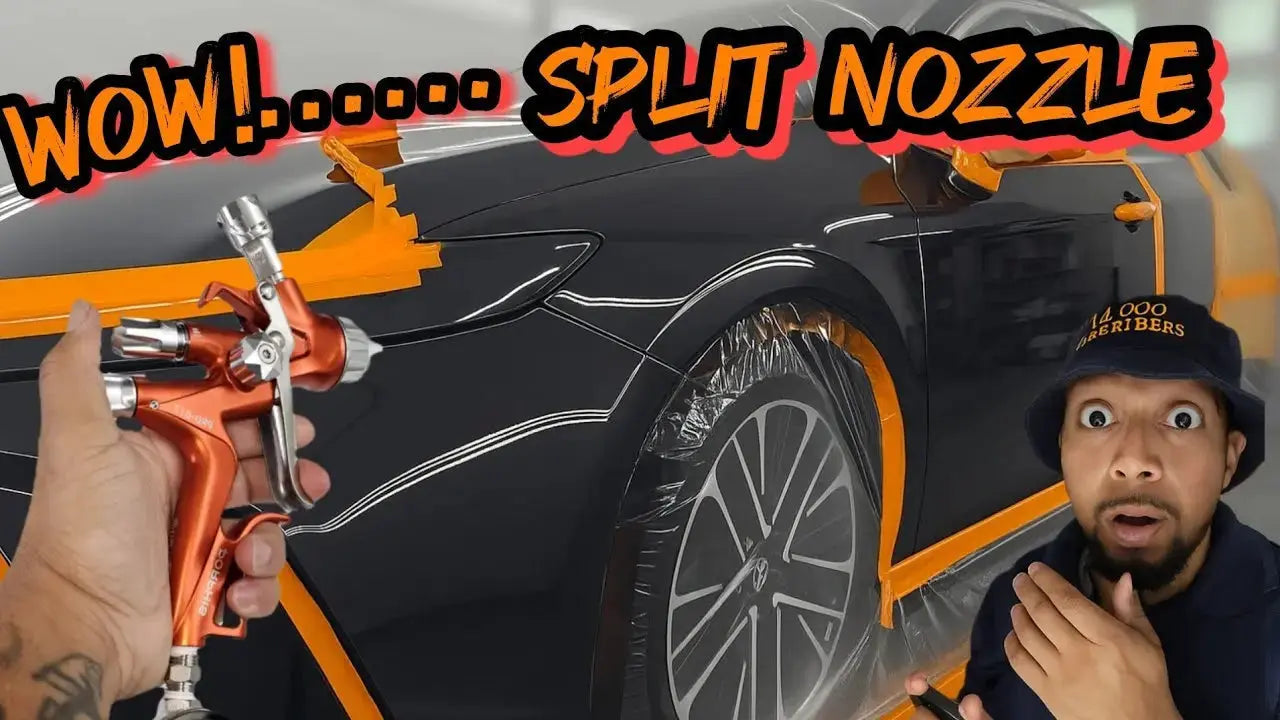
In the specialized world of automotive refinishing, we are perpetually hunting for the "unicorn"—that rare piece of kit that delivers the elite atomization of a Sigola without the staggering "poliola" (the heavy price tag) associated with Tier-1 European brands. The market is flooded with pretenders, but few manage to bridge the gap between affordability and professional-grade performance.
Recently, I stepped into the booth to commission the new PORPHIS PRD-817 for a mid-tier refinish on a late-model Toyota Camry. With a fender blend and bumper repair on the schedule, it was the perfect real-world environment to determine if this split-tip atomizer contender belongs in a high-volume production environment or if it’s merely another budget-tier distraction.
The "No-Swivel" Mandate: Why Simplicity Wins in Spray Gun Design
Before the first drop of clear coat ever hit the needle, the PRD-817 impressed me with a deliberate design choice: the absence of a swivel joint. For the seasoned specialist, a swivel is often nothing more than a secondary point of failure and an unnecessary layer of bulk that disconnects the painter from the tool.
There is a growing mandate among professionals for manufacturers to strip away these gimmicks in favor of a fixed joint. A rigid connection provides a more stable, predictable feel in the hand, which is paramount when navigating the contours of a modern body panel.
"No swivel. We don't do swivel over here. We take the swivel and we get rid of that... any spray gun manufacturer, do not put the swivel. We don't want it. We want a fixed joint."
Split Nozzle Technology: The "More Work, More Time" Trade-off
The PRD-817 features a 1.3mm split nozzle powered by "V-technology." Even during the initial cleaning process with thinner, the fan size was notably massive—an early indicator of the gun's potential for wide, even coverage. The adjustment knobs provide excellent tactile and audible feedback—that "tick tick tick tick boom" that tells you exactly where your settings are without needing to look.
However, the technical reality of split nozzle technology is a double-edged sword. Because the V-technology is "doing more work" to mechanically shear the material into a finer mist, the physics dictate a slightly slower application speed. You cannot hammer it down quite as fast as a standard nozzle because the gun is meticulously breaking down the clear coat to achieve superior fluid distribution.
"It's about the typical speed of a split nozzle. They are going to be a tad bit slower than your standard tip spray guns, but that's also because they're doing a little more atomizing... they're doing a little more work. So with more work comes what? More time."
Engineering the Ideal Workflow: The PRD-815 and PRD-817 Spray Guns Duo
While many search for a "do-it-all" tool, the PRD-817 finds its true home as part of a dedicated spray gun duo. In my assessment, the ideal professional setup involves the PRD-815 as a dedicated base coat gun—its fluid delivery is exceptionally suited for metallic orientation and uniform base coverage.
The PRD-817 should be reserved exclusively for clear coat. By separating these roles, you allow the PRD-817’s V-technology to serve as the "finishing touch," focusing its energy on the final aesthetic layer where atomization quality is most visible.
The "Factory Peel" vs. "Glass" Debate in Automotive Spray Guns
During the Camry trial, I dialed the PRD-817 to exactly two turns out from closed on the fluid, with the fan wide open and then restricted by just a quarter turn. At 22 PSI, the results were surgical. It replicated the Toyota factory orange peel with such precision that the repair was indistinguishable from the original OEM finish.
It is a common misconception that "glass" (a mirror-smooth finish) is the only hallmark of a good spray gun. In the collision world, the goal is to match the vehicle's existing texture. However, the PRD-817 has the versatility to chase that "glass" look if desired. By adjusting the material's viscosity and cranking the air pressure beyond the 22 PSI used in this test, the gun is more than capable of laying down a mirror-flat finish.
Conclusion: The Future of Split-Tip Atomizers in High-End Automotive Refinishing
The PORPHIS PRD-817 is a formidable entry into the market, offering elite-level split nozzle technology atomization for a fraction of what you’d pay for a Sigola.
The atomization quality is beyond dispute. The real question for the modern technician is this: In a world of high-volume production, is the superior finish of a split-tip spray gun a luxury you can afford to spend time on, or is it a necessity for matching the high standards of today's OEM finishes?
Our next evolution with this tool will involve pushing the atmospheric limits—cranking the pressure to see just how close to a true "glass" finish we can get. Stay tuned.
What is a split type nozzle?
A split type nozzle, also known as a split-tip atomizer, uses multiple smaller orifices to break down paint material into a finer mist for more precise atomization. This technology improves paint transfer efficiency and results in a smoother, more even finish compared to standard spray guns.
What are common problems with atomizers?
Common issues include nozzle clogging, inconsistent spray patterns, and wear of internal components leading to leaks. Split nozzle spray guns can require more maintenance due to their more complex tip design, but the trade-off is improved atomization quality.
Can I rebuild my own atomizer?
Yes, many atomizers, including those with split nozzle technology, can be rebuilt using replacement nozzle needle cap kits and seals. This can extend the life of your spray gun and maintain optimal performance.
Share:
Beyond Glass: The "Off-the-Gun" Secret to a Zero Orange Peel Showcar Finish
Is the PORPHIS PRD-817 the New King of Base Coat? 5 Surprising Takeaways from the Split-Tip Revolution