
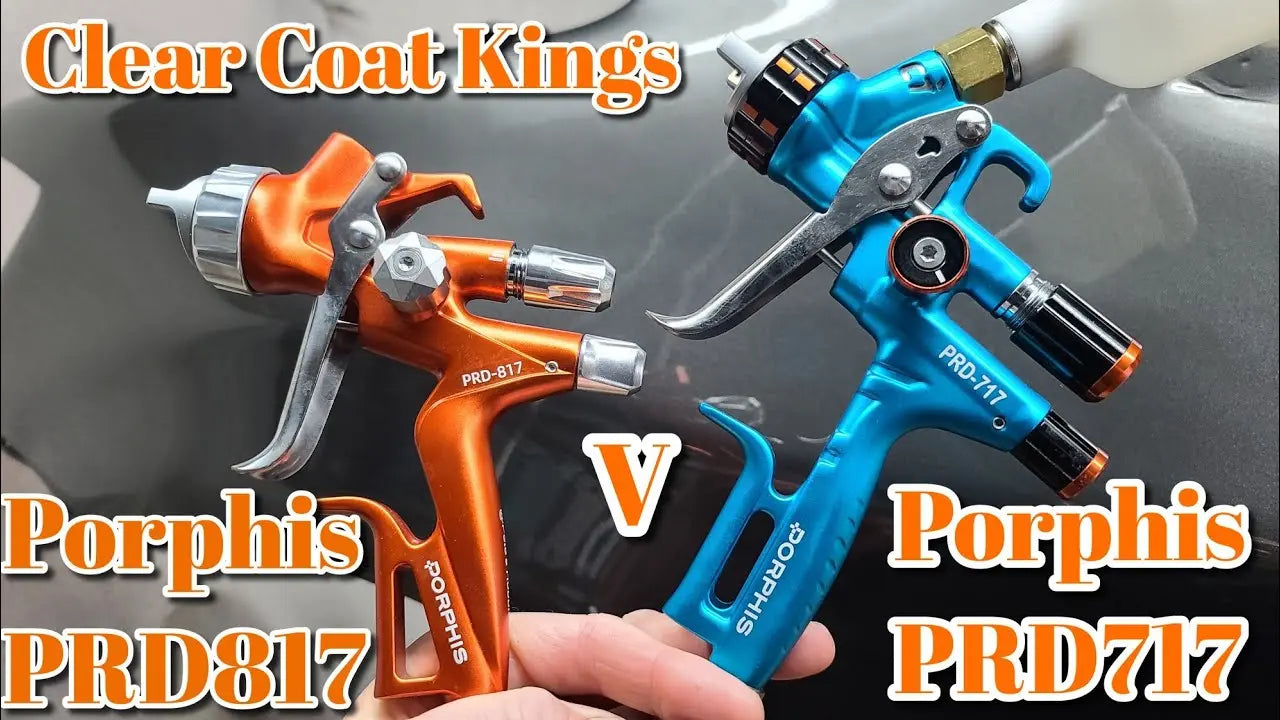
1. Product Positioning and Strategic Context
In high-volume automotive and industrial coating environments, spray gun selection is a strategic procurement decision that directly impacts operational overhead and final throughput quality. Incremental advancements in nozzle geometry—specifically regarding fluid shearing and fan distribution—correlate to measurable material savings and a reduction in post-coating labor. The PORPHIS PRD series represents a targeted evolution in this sector, transitioning from traditional atomization methods toward an advanced "Split Tip" (V-Groove) architecture.
Model Nomenclature and Logic
Professional evaluation of the PORPHIS ecosystem requires a clear understanding of the nomenclature used to distinguish nozzle technologies:
-
"7" Suffix (e.g., PRD-817, PRD-717):
Designates a Split Tip / V-Groove architecture. These models utilize specialized mechanical interruptions to enhance atomization at lower pressures. -
"5" Suffix (e.g., PRD-815, PRD-715):
Designates Standard Tip technology, utilizing traditional circular orifices for conventional fluid delivery. -
"6" Suffix (e.g., PRD-716, PRD-626):
Designates High Volume Low Pressure (HVLP) models, which prioritize high air volume (typically 11–12 CFM at 2 Bar).
The primary objective of this report is to analyze the engineering shift from the "5" series standard orifices to the "7" series Split Tip architecture and quantify the resulting performance advantages for professional technicians.
2. Anatomy of the "Split Tip": Fluid Dynamics and Nozzle Engineering
Nozzle geometry is the primary driver of atomization quality. Traditional circular orifices rely heavily on high air pressure to break down fluid surface tension. Conversely, the Split Tip design utilizes physical mechanical shearing via V-grooves to "split" the material before it even exits the orifice.
Key Engineering Differentiators
-
Orifice Architecture:
The center hole of the V-Groove tip features a significantly larger diameter than standard tips. It incorporates four distinct V-grooves that mechanically shear the coating material. -
Baffle/Deflector Integration:
In a departure from the PRD-717’s "open" design, the PRD-817 nozzle incorporates an integrated baffle/deflector. -
Air Distribution:
The PRD-817 series features an increased count of air holes in the cap, designed to facilitate finer atomization and a more controlled blending gradient.
Maintenance Note
During installation, the nozzle tip must be tightened firmly. Failure to achieve a high-torque seat can result in "nozzle flutter"—an audible vibration or pulsation that disrupts the spray pattern and compromises finish uniformity.
Component Non-Interchangeability Technical operators must not attempt to interchange tips and caps between standard ("5" series) and Split Tip ("7" series) models. The center hole of a standard air cap is smaller than the outer diameter of a V-Groove tip. Attempting to force a standard cap onto a V-Groove tip will cause mechanical interference, resulting in permanent physical damage to both the cap and the nozzle tip.
3. Comparative Performance Testing at 1.3 Bar (20 PSI)
Testing conducted at 1.3 Bar (20 PSI) identifies the "professional sweet spot" where air consumption and atomization efficiency are optimized for modern coatings.
Pattern Dimensions and Uniformity
The following data reflects performance at a standardized distance of 175mm (7 inches) using a 1.3mm nozzle setup:
|
Metric
|
PORPHIS PRD-717 (1.3mm)
|
PORPHIS PRD-817 (1.3mm)
|
|---|---|---|
|
Pattern Height (Length)
|
~250mm (10 inches)
|
~300mm (12 inches)
|
|
Percentage Increase
|
Baseline
|
~20% Increase
|
|
Atomization Quality
|
Even and Uniformed
|
High-Uniformity; Fine Droplets
|
|
Blending Capability
|
Standard Gradient
|
Superior "Split" Distribution
|
Volumetric Efficiency and Visual Analysis
-
Air Consumption:
While generating a significantly larger pattern, the PRD-817 demonstrates equivalent or marginally improved volumetric efficiency compared to the PRD-815 and PRD-717 models. It achieves greater coverage without increasing the air demand on the workshop compressor. -
Atomization and Blending Gradient:
The Split Tip technology effectively shears the material into a finer droplet spectrum. For the coating engineer, the most significant observation is the less distinct "wet vs. dry" line at the fan edges. This superior blending capability significantly reduces the risk of mottling or "tiger striping" in metallic and pearlescent finishes.
4. Low-Pressure "Forgiveness" and Professional Yield Optimization
In a professional context, "forgiveness" defines a tool’s application window—its ability to maintain a high-quality finish despite fluctuations in operator distance, travel speed, or air pressure settings.
Impact on Throughput
The PRD-817 is engineered to function optimally at lower pressures (below 2 Bar). This wide application window reduces the margin of error for technicians, significantly decreasing the likelihood of "wrong pressure" finishes. For professional workshops, this translates to higher first-pass yields and a substantial reduction in the costs associated with re-sprays and rework.
Ergonomic and Functional Features
-
300-Degree Swivel (Hose Management):
The integrated swivel features a built-in stop, allowing for necessary mobility while preventing the air hose from rotating indefinitely. This reduces hose tangling and mechanical strain on the connection point. -
Taper Joint Structural Integrity:
The regulator connection utilizes a taper-end design. To avoid mechanical failure of the taper joint, operators should only "nip up" the connection with manual torque. -
Structural Warning:
Do not apply excessive mechanical pressure to the swivel or regulator connections with heavy tools, as over-torquing can lead to structural failure of the assembly.
5. Serviceability and Industrial Lifecycle Assessment
The long-term value of a professional spray tool is dictated by its "Total Cost of Ownership" (TCO), which balances initial procurement with the availability and cost of replacement parts.
Competitive Benchmarking and Depreciation
While premium brands like Iwata and Sata offer high performance, their spare parts ecosystems often carry prohibitive costs. In contrast, the PORPHIS model provides access to genuine factory service kits at competitive price points.
-
Longevity:
Longitudinal data spanning 3.5 years of field use validates the durability of the internal components. -
Asset Value:
The combination of high durability and affordable service kits results in a lower Annualized Asset Depreciation for the workshop compared to "disposable" or ultra-premium alternatives.
Service Kit Observations
While the included service kit is high-quality, the current out-of-box experience would benefit from the inclusion of additional internal gaskets. Providing redundancy for these high-wear components would further enhance the tool's industrial readiness.
6. Summary of Findings for Professional Procurement
The PORPHIS PRD-817 represents a significant engineering advancement within the professional mid-market. By combining the mechanical advantages of a 4-groove Split Tip with an integrated baffle design, it achieves a 20% increase in pattern height over the PRD-717 while maintaining superior atomization at low pressures. Its exceptionally wide application window makes it a "crown-taking" candidate for environments where finish consistency and material efficiency are paramount.
Specifications vs. Professional Value
|
Feature
|
Technical Specification
|
Professional Advantage
|
|---|---|---|
|
Nozzle Architecture
|
4-Groove Split Tip (V-Groove)
|
Finer shearing; reduced mottling risk.
|
|
Pattern Height
|
300mm at 175mm distance
|
~20% more coverage per pass vs. PRD-717.
|
|
Operating Pressure
|
Optimal at 1.3 Bar (20 PSI)
|
Wide application window; high forgiveness.
|
|
Air Consumption
|
Equivalent Volumetric Efficiency
|
High coverage without increased CFM demand.
|
|
Hose Management
|
300° Swivel with Integrated Stop
|
Reduced hose tangles and operator fatigue.
|
|
Serviceability
|
Genuine Factory Kits Available
|
Lower Annualized Asset Depreciation.
|
Share:
How to Use an Automotive Paint Gun: Setup, Tips & Top Brands in 2026
Water Based Paints Have Advantages: A Complete 2026 Guide