
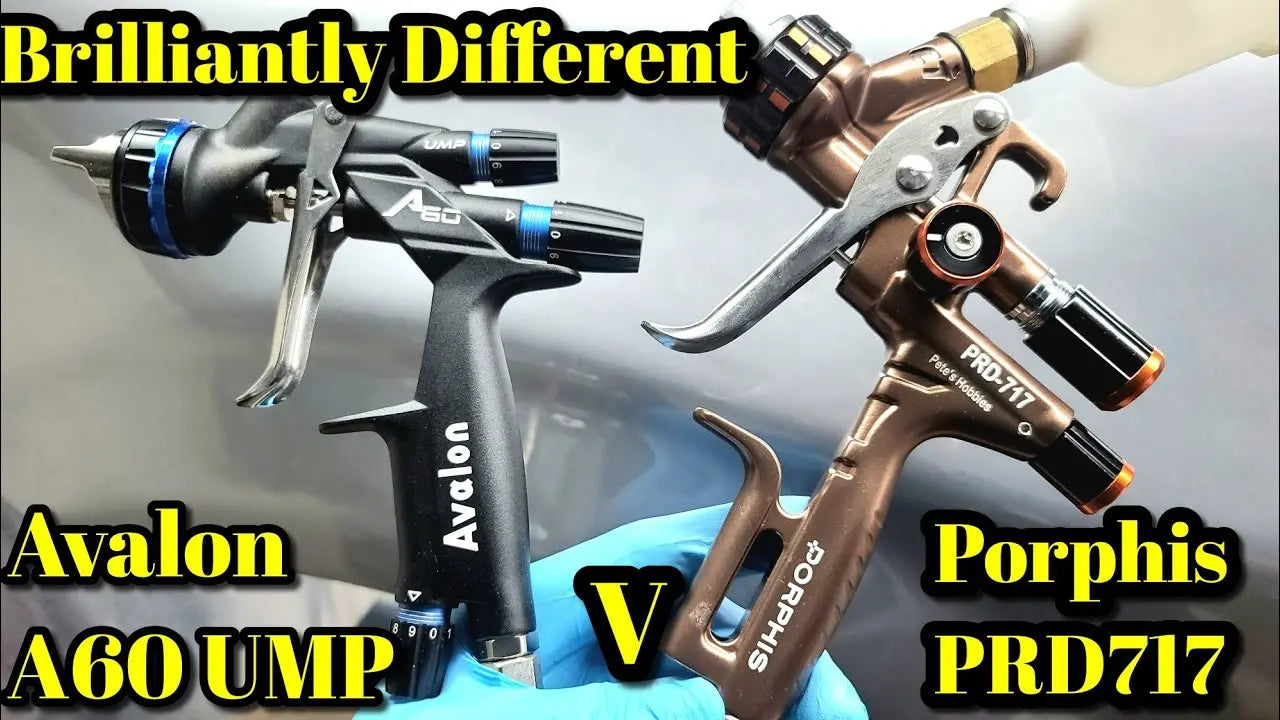
Most spray gun comparisons begin with promises about atomization and finish quality. In a real shop, the first questions are usually more practical: Will the gun match the compressor? Does it suit the coatings you spray most often? Can you clean it quickly, and can you get parts when something wears out?
The PORPHIS PRD-717 and Avalon A60 eXtreme UMP approach those questions differently. The PRD-717 puts more emphasis on tactile adjustment and simplified maintenance. The A60 UMP uses less air and offers a broader published nozzle range. That means the better choice depends less on the logo and more on the way you work.
|
Quick answer Choose the PRD-717 when you have enough compressor capacity and value click-by-click fan adjustment, an O-ring-free fluid section, and tool-free cleaning. Choose the Avalon A60 UMP when lower air demand and a wider choice of nozzle sizes matter more. Neither gun is automatically better for every painter. |
The specifications that matter first
The table below combines figures published by the two manufacturers. Treat them as selection guidance rather than a laboratory head-to-head test, because the brands may use different coatings and test procedures.
|
Specification |
Avalon A60 eXtreme UMP |
|
|
Nozzle options |
1.3 / 1.4 mm |
1.2 / 1.3 / 1.4 / 1.5 mm |
|
Published inlet pressure |
1.3–1.8 bar (about 19–26 PSI) |
2.0 bar (29 PSI) |
|
Published maximum air use |
430 L/min (15.2 CFM) |
About 290–300 L/min (10.2–10.6 CFM) |
|
Published fluid flow |
175 ml/min |
About 210–270 ml/min, depending on nozzle |
|
Adjustment concept |
Tactile click fan control |
Conventional controls; UMP airflow system |
|
Maintenance emphasis |
O-ring-free fluid section and tool-free core disassembly |
Confirm seal design and parts support with the local distributor |
|
Atomization concept |
Split-nozzle, low-pressure design |
U-groove nozzle with pre-atomization |
 |
 |
 |
 |

|
1. Start with the compressor, not the finish claim
This is the clearest difference between the two guns. PORPHIS publishes an air-consumption figure of 15.2 CFM for the PRD-717, while Avalon publishes roughly 10.2 to 10.6 CFM for the A60 UMP. On paper, the Avalon is the easier match for a smaller air system.
That does not mean a large tank automatically solves the problem. What matters is the compressor’s delivered CFM at the pressure you plan to use, together with hose size, fittings, filtration, and the length of each spray pass. A compressor that cannot recover will make any gun feel inconsistent halfway across a hood.
Before buying either model, check the compressor specification and measure pressure at the gun with the trigger fully pulled. This single step is more useful than comparing marketing descriptions of a “perfect” spray pattern.
2. The two guns create atomization in different ways
The PRD-717 uses a split-nozzle, low-pressure design. PORPHIS positions it as a practical basecoat-and-clearcoat gun, with 1.3 and 1.4 mm options for painters who prefer a controlled, lower-pressure setup.
Avalon’s A60 eXtreme UMP uses a slight U-groove in the nozzle and an airflow system designed to pre-atomize the coating before the fan is formed. Avalon says this helps keep distribution even from the center of the pattern to the edges while limiting air consumption.
Neither design removes the need for a spray-out. Material viscosity, reducer choice, temperature, gun distance, speed, and overlap can change the result more than a small difference on a specification sheet. The better gun is the one you can set up repeatedly with the products used in your shop.
3. Adjustment feel is a genuine PRD-717 advantage
The PRD-717’s fan-control knob gives a mechanical click as it moves through each detent. It sounds like a minor detail until you are in a booth wearing gloves and want to make a small change without looking away from the panel.
That tactile reference also makes a previous setup easier to repeat. You can note the approximate number of clicks used for a bumper edge, a door, or a full panel, then return to a familiar starting point on the next job. Final tuning still belongs on a test card, but the adjustment feels less vague than a completely smooth knob.
Avalon’s public product information focuses more on its nozzle and airflow system than on a tactile adjustment feature. Painters who care most about adjustment feedback may therefore find the PRD-717 more intuitive.
4. Maintenance can matter more than a small atomization difference
A gun that sprays beautifully but takes too long to clean often becomes the gun that stays in the cabinet. PORPHIS designed the PRD-717 around an O-ring-free fluid section and core components that can be removed by hand without searching for a wrench.
For a busy painter, the benefit is straightforward: fewer vulnerable seals in the fluid path and less friction in routine disassembly. PORPHIS also describes the gun as suitable for full immersion cleaning. Follow the current cleaning instructions, however, and remove any cup adapter, regulator, gauge, or accessory that is not intended to be soaked.
Avalon’s official A60 UMP page does not publish the same level of maintenance detail. That is not proof that it is difficult to service; it simply means buyers should ask the local distributor about seal kits, nozzle sets, lead times, and recommended cleaning procedures before purchasing.
5. Nozzle range and material flexibility favor the Avalon on paper
The PRD-717 is offered in 1.3 and 1.4 mm sizes, a focused range that makes sense for common automotive basecoat and clearcoat work. If those are the materials you spray most often, the limited choice may not be a limitation at all.
Avalon publishes 1.2, 1.3, 1.4, and 1.5 mm options for the A60 UMP. That wider range gives buyers more room to match different materials and application preferences. The correct size still depends on the coating manufacturer’s technical data sheet, so do not select a nozzle from a generic chart alone.
6. Parts and local support belong in the comparison
Painters often compare purchase price and ignore the cost of downtime. A nozzle set, needle, seal, or air cap that takes weeks to arrive can turn a slightly cheaper purchase into the more expensive decision.
PORPHIS lists PRD-71 series nozzle kits and repair parts through its online store. Avalon support will depend more heavily on the distributor serving your region. Before choosing either gun, check the price and availability of the parts you are most likely to replace.
Which gun fits which painter?
|
Your priority |
Better starting point |
Why |
|
Lower compressor demand |
Avalon A60 UMP |
Its published air use is roughly 290–300 L/min, notably lower than the PRD-717 figure. |
|
Tactile, repeatable fan adjustment |
PRD-717 |
The click adjustment provides a physical reference when changing fan width. |
|
Focused basecoat and clearcoat setup |
PRD-717 |
The 1.3 and 1.4 mm options cover common refinish applications without overcomplicating the choice. |
|
Broader published nozzle range |
Avalon A60 UMP |
Avalon lists 1.2 through 1.5 mm configurations. |
|
Fast routine disassembly |
PRD-717 |
Its core parts are designed for tool-free removal and the fluid section avoids conventional O-rings. |
|
Strong local dealer relationship |
Whichever brand your dealer supports |
Reliable parts, setup help, and warranty handling can outweigh a small specification advantage. |
|
PORPHIS product fit The PRD-717 makes the most sense for painters who can supply its higher air demand and want a daily basecoat/clearcoat gun with tactile controls and simplified maintenance. Review the current configurations and parts support before ordering. |
A five-minute check before you buy
- Confirm delivered compressor CFM at the gun, not only tank size or peak horsepower.
- Read the coating TDS and match the nozzle to the material you actually spray.
- Check whether your preferred cup system needs an adapter.
- Price a nozzle set and repair kit before comparing the gun-only price.
- Make a spray-out card with your real material before judging the final setup.
Frequently asked questions
Which gun uses less air?
Based on the manufacturers’ published figures, the Avalon A60 UMP uses less air: approximately 290–300 L/min compared with 430 L/min for the PRD-717. Verify that your compressor can sustain the required flow during a full panel pass.
Is the PRD-717 only for clearcoat?
No. PORPHIS presents it as an all-round automotive gun for basecoat and clearcoat. The 1.3 and 1.4 mm options should still be matched to the coating manufacturer’s recommendation and your preferred application style.
Does the Avalon A60 UMP have more nozzle choices?
Yes. Avalon’s official data table lists 1.2, 1.3, 1.4, and 1.5 mm versions, while the PRD-717 is listed in 1.3 and 1.4 mm.
Can the specification tables tell me which finish will be better?
Not by themselves. Airflow, fluid flow, and pattern dimensions are useful for setup planning, but finish quality still depends on material, temperature, pressure at the gun, distance, speed, overlap, and painter technique. A controlled spray-out is the fair test.
Final verdict
The most honest answer is that these guns solve different setup problems. The Avalon A60 UMP is attractive when compressor capacity is limited or when a wider nozzle range is important. The PRD-717 is more compelling when tactile adjustment, simplified maintenance, and a focused basecoat/clearcoat workflow matter most.
Choose the gun that fits the air system, coatings, and support network you already have. That is a better predictor of daily results than any claim that one model is universally superior.
Share:
Spray Gun Comparison: PRD-717 vs. Iwata WS400 Series2 OBS