
1. Strategic Positioning and Market Context
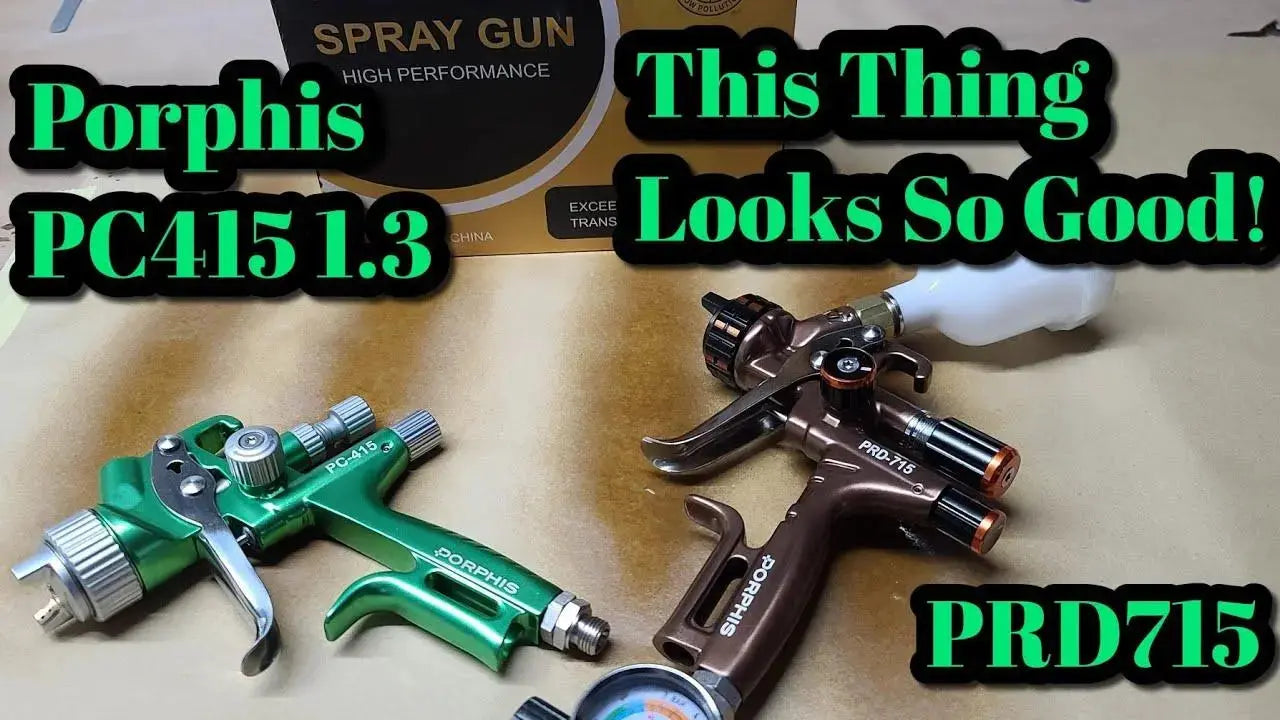
In high-output industrial finishing environments, the selection of spray equipment is a primary driver of both operational overhead and final coating integrity. Technicians must frequently choose between traditional mechanical architectures and modernized, feature-rich platforms. Within the PORPHIS professional lineup, the PC-415 is positioned as a "Professional Traditional" Middle Pressure (MP) tool, prioritizing mechanical simplicity. In contrast, the PRD-715 serves as a modernized alternative, offering tactile adjustment feedback and expanded configuration options.
2. Industrial Design and Material Durability
For the industrial consultant, "fit and finish" serves as a benchmark for tool longevity and chemical resistance. Equipment in high-production environments faces constant exposure to aggressive solvents and frequent maintenance cycles; therefore, the quality of the exterior treatment is a functional requirement rather than a cosmetic one.
Both units feature high-grade anodized aluminum bodies. Unlike the painted finishes found on entry-level tools, this anodization is chemically integrated into the casting, preventing the chipping or wear often seen during heavy use. Empirical evidence shows that these bodies maintain their integrity even after 50 to 60 full disassemblies, with no degradation of the thread areas or external surfaces.
|
Feature
|
PORPHIS PC-415 (Traditional)
|
PORPHIS PRD-715 (Modernized)
|
|---|---|---|
|
Aesthetic Styling
|
Smooth, flared body with Metallic Emerald Anodization (comparable to Kawasaki Racing Green).
|
Aggressive "chiseled" detailing for a modernized, technical appearance.
|
|
Weight Profile
|
Approximately 12g to 13g lighter than the PRD-715.
|
Slightly heavier due to additional internal adjustment hardware.
|
|
Adjustment Interface
|
Traditional mechanical spring and locking nut.
|
Integrated "Click System" for tactile, repeatable setting increments.
|
|
Ergonomic Impact
|
Superior for reducing operator fatigue during prolonged shifts.
|
Optimal for precision repeatability across varying coating viscosities.
|
3. Internal Engineering and Maintenance Profiles
The strategic advantage of the PC-415 lies in its internal simplicity, which favors rapid field maintenance and long-term mechanical reliability.
Needle and Nozzle Assemblies
The PC-415 utilizes a "Sata-style" design where the fluid adjustment machine screw threads directly into the gun body. This creates a robust, streamlined rear assembly and allows for a shorter needle profile compared to the PRD-715. While the needles and spring tensions differ between the two models to accommodate their respective housing designs, both guns utilize a standard M16 x 1.5 thread pitch.
The "Number 9" PPS Requirement
For facilities transitioning to disposable cup systems, standard adapters may fail to seat correctly. Both the PC-415 and PRD-715 require a "Number 9" PPS adapter. The technical necessity for this specific model is its longer lead, which is required to successfully reach and compress the sealing ring located at the base of the M16 thread.
Distribution Systems and Serviceability
The units differ in their air distribution hardware: the PC-415 utilizes a sided plastic baffle, while the PRD-715 employs an anodized aluminum version. Despite the material difference, performance benchmarks indicate that the PC-415’s plastic baffle provides equivalent air distribution and pattern uniformity.
Maintenance is supported by a comprehensive service kit. Notably, PORPHIS includes a thick-gauge spanner; this is a critical professional detail, as thin-stamped wrenches often provide insufficient contact points and can "chew" or deform the fluid tip during high-torque removals. The kit also includes a cleaning brush, Euro air adapter, spare trigger screws, and a nylon sealing ring.
4. Specification Analysis and Operational Performance
As MP-class tools, these guns are engineered to balance high transfer efficiency with aggressive material delivery, avoiding the excessive air consumption and slow application speeds sometimes associated with HVLP systems.
Air Consumption and Pressure Efficiency
Both models are officially rated at 10.5 CFM at 2 Bar (29 PSI). However, technical evaluation confirms that these platforms remain highly effective at lower pressures. Operators can frequently reduce input to 1.5 Bar (23 PSI) to achieve significant air savings and reduced overspray without sacrificing atomization quality or pattern stability.
Material Throughput and Configuration
A primary distinction between the two models is tip availability. The PC-415 is manufactured exclusively with a 1.3mm fluid tip, whereas the PRD-715 offers the versatility of both 1.3mm and 1.4mm configurations. Both tools operate as high-volume "blasters," capable of pushing material aggressively to achieve a high-quality "flow-out" in clear coats and gloss finishes.
Pattern Test Benchmarking
- Uniformity: Clear coat distribution is remarkably even across the vertical axis of the fan.
- Balance: There is a total absence of top or bottom overloading, ensuring a consistent film build.
-
Symmetry:
The internal baffle design maintains pattern integrity even when the gun is angled, confirming high-precision air machining.
 |
 |
5. Economic Evaluation and Selection Guidance
The PC-415 and PRD-715 demonstrate that professional-tier performance is accessible at a competitive price point. With the PC-415 priced in the 226USD range, it represents a significant value proposition for high-output environments.
The Professional Value Proposition
Decision Matrix for Equipment Selection
- Weight is a Priority: You require the lightest possible tool to minimize operator wrist and arm fatigue.
- Mechanical Simplicity: You prefer traditional spring-and-nut adjustments with fewer moving parts.
- Fixed Configuration: A 1.3mm fluid tip meets all your primary application requirements.
- Cost-Efficiency: You require professional-grade MP performance at the lowest entry price.
- Tactile Repeatability: You require the "Click System" for precise, documented adjustment settings.
- Versatility: Your workflow necessitates the use of a 1.4mm tip for higher viscosity coatings.
- Material Preference: You prefer the modernized "chiseled" aesthetic and an internal aluminum baffle.
Share:
Spray Gun Comparison: PRD-627 vs. PRD-717
Spray Gun Comparison: PHS-155 vs. PHS-156