
1. Executive Summary and Strategic Market Positioning
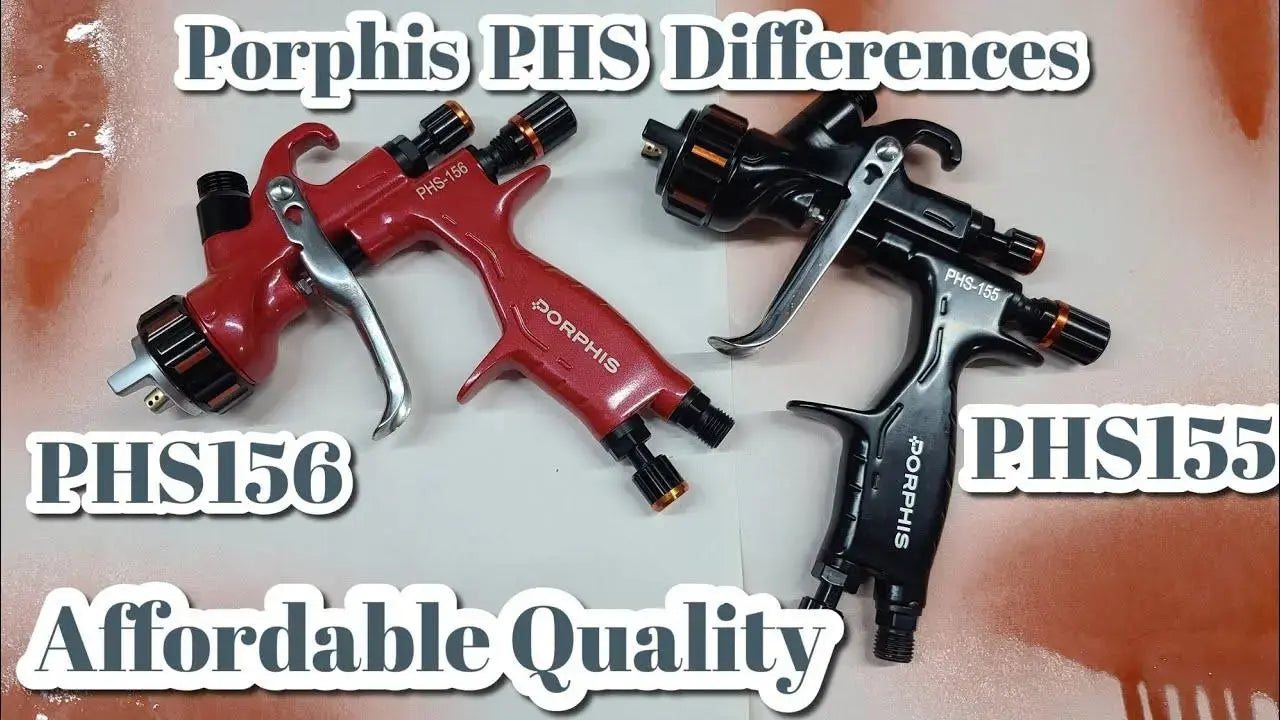
The professional automotive refinish market is witnessing a decisive strategic shift as high-value "pro-sumer" tools aggressively challenge the dominance of premium incumbents. For shop owners and independent technicians, the traditional reliance on high-surcharge brands is being re-evaluated in favor of equipment that delivers professional-grade atomization without the legacy price tag. This evaluation focuses on the PORPHIS PHS series, specifically comparing the PHS-156 HVLP and the PHS-155 MP.
The PORPHIS PHS range is positioned as a high-integrity alternative that sits just below the manufacturer’s flagship PRD line. While the PRD range offers ultimate refinement, the PHS series is designed to compete directly with mid-tier professional offerings from brands such as Iwata and ANI. At approximately half the cost of these established brands, the PHS series provides a "best-of-both-worlds" proposition for workshops looking to scale production capacity while maintaining rigorous finish standards. The following analysis examines the engineering architecture and pneumatic performance that define these tools.
2. Engineering Architecture: Seal-less Design and Build Integrity
In high-volume environments, a tool’s internal architecture is the primary driver of operational uptime. Equipment relying on complex internal gaskets or plastic baffles represents a liability; solvent exposure inevitably leads to seal degradation, leaks, and costly maintenance.
Both the PHS-155 and PHS-156 utilize a sophisticated seal-less, metal-on-metal design. The nozzle taper seals directly against the gun body, eliminating the need for internal baffles or secondary rubber seals. This engineering choice aligns the PHS series with high-end professional standards seen in brands like Iwata and Sagola. By removing failure points, PORPHIS has significantly improved long-term reliability and simplified the cleaning protocol for the technician.
- PHS-155 (MP): Features a standard black coating that is susceptible to "pulling away" from the body due to the friction of repeated air cap removal. This presents a wear-and-tear risk in high-production shops.
- PHS-156 (HVLP): Utilizes an upgraded "non-stick" coating. During testing, thinners beaded on the surface, indicating superior chemical resistance and a higher level of external refinement similar to premium Japanese equipment.
Crucially, while the 1.3mm nozzle tips appear identical between both models, the HVLP performance of the PHS-156 is achieved through air cap geometry. The PHS-156 cap features a distinct gap where it meets the tip, allowing air to bypass the perimeter for enhanced atomization, whereas the PHS-155 cap maintains a flush fit.
3. Pneumatic Efficiency and Air Consumption Analysis
Matching spray gun technology to shop air infrastructure is critical for maintaining consistent atomization. While HVLP technology offers superior Transfer Efficiency, its traditional demand for high air volume (CFM) can tax inadequate compressor systems, leading to pressure drops and finish defects.
The following table details the air consumption measured at a benchmark operating pressure of 2 bar (29 PSI):
|
Model
|
Technology Type
|
Measured CFM
|
Pressure (PSI)
|
Ideal Compressor Capacity
|
|---|---|---|---|---|
|
PHS-155
|
MP (Middle Pressure)
|
10.0 – 10.5
|
29 PSI
|
3HP – 5HP
|
|
PHS-156
|
HVLP (High Volume)
|
11.0 – 12.0
|
29 PSI
|
5HP (Minimum)
|
Consultant Insight:
"The So What?" Our testing confirmed the PHS-156’s air draw by using a PC 415 gauge baseline. At identical regulator settings, the PHS-156 drew slightly more air than the PHS-155, confirming its status in the 11-12 CFM range. While PORPHIS quotes a higher potential consumption, this 12 CFM requirement is remarkably efficient for an HVLP gun. However, from a professional consultancy standpoint, a 5HP compressor is the recommended minimum to ensure pneumatic stability. Using a smaller unit risks inconsistent fan patterns during full-panel sprays.
4. Spray Pattern Characterization and Atomization Quality
-
Fan Width:
Both guns produced a consistent 9 to 10-inch fan. This width, achieved at a tight 7-inch distance, indicates highly efficient material delivery. -
Uniformity:
The patterns were remarkably even, lacking the "heavy centers" common in budget equipment. However, the PHS-156 produced a notably "wetter" and broader pattern. -
Transfer Efficiency & Control:
While the PHS-156 offers superior atomization for a glassy finish, the wetter pattern requires a more skilled hand. The increased volume increases the risk of overloading and runs if the technician's travel speed is not precisely calibrated. - Cap Engineering: The PHS-155 cap utilizes larger air holes and a three-hole configuration to manage the higher air volume, whereas the PHS-156 uses a more restrictive two-hole setup for controlled, middle-pressure delivery.
The 1.3mm nozzle size on both guns proves highly effective for modern high-solids materials, provided the technician accounts for the PHS-156's higher fluid delivery rate.

|
 |
 |
 |
5. Professional Maintenance and Long-term Ownership Value
In professional tool procurement, "repairability" is a mandatory requirement. The PORPHIS PHS series avoids the "disposable" pitfall of many mid-tier guns by offering comprehensive spares kits. This accessibility ensures that needle, nozzle, and air cap sets can be replaced after heavy use, supporting workshop sustainability and long-term ROI.
- PHS-155 (MP) Recommendation: Ideal for technicians requiring a versatile, consistent workhorse. It is the safer choice for shops with limited air supply or for those who prefer a more controlled, "dryer" application style to minimize runs.
- PHS-156 (HVLP) Recommendation: The superior choice for clear coat specialists prioritizing a "glass" finish. The enhanced non-stick coating and superior atomization make it the better long-term investment for high-production shops, provided a 5HP compressor infrastructure is in place.
Share:
Spray Gun Comparison: PC-415 vs. PRD-715
Spray Gun Comparison: MPH-338 vs. Meiji F55、ANI R160 、Devilbiss DV1S