
1. Introduction and Strategic Context
In the precision-driven sectors of industrial and automotive finishing, the selection of spray equipment is a high-stakes strategic decision. High-efficiency, low-pressure (HELP) systems have redefined the baseline for modern operations, where the objective is to maximize material transfer efficiency while maintaining a "glass-like" finish. The choice of equipment directly impacts an operation’s bottom line through material waste reduction and the minimization of post-application labor, such as color sanding to correct excessive orange peel.
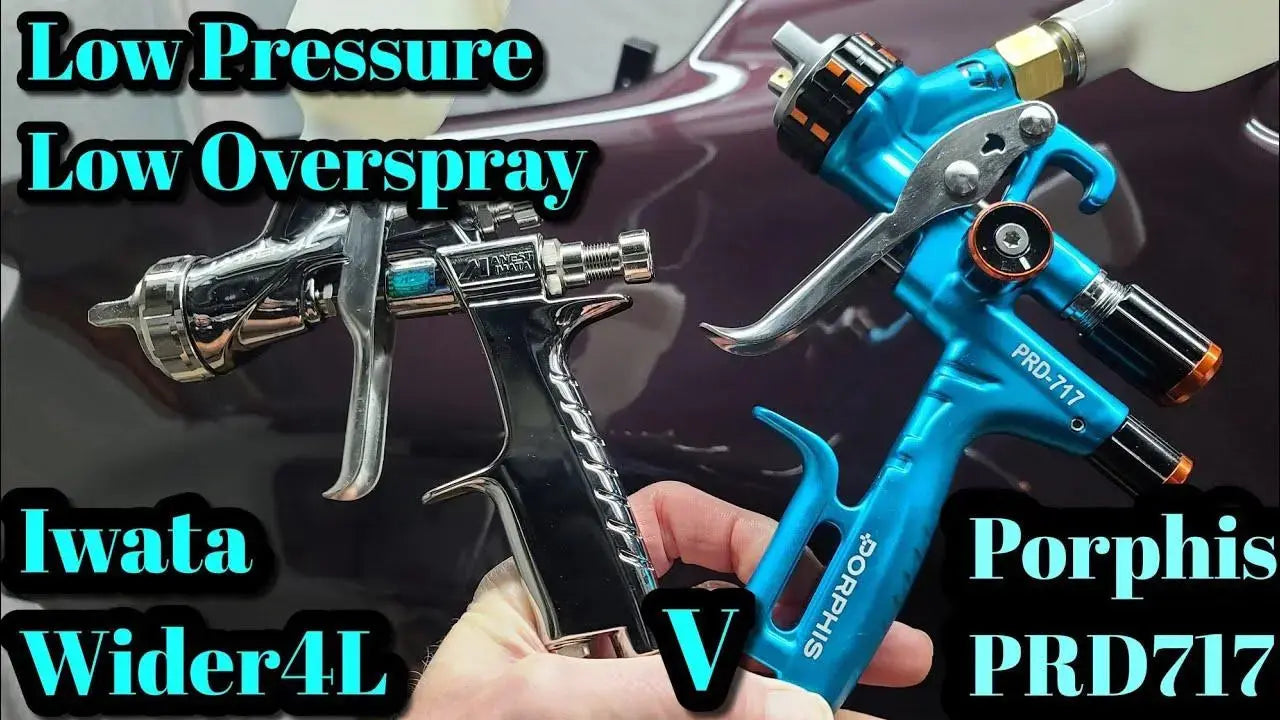
This report evaluates the comparative performance of the PORPHIS PRD-717, featuring advanced split-tip technology, and the Iwata Wider4L, the successor to the industry-staple LPH400. Both units were equipped with 1.4mm fluid tips and benchmarked at a standardized 1.4 bar (approximately 20–21 PSI). To simulate a rigorous real-world production environment, testing was conducted at an ambient temperature of 7°C (44°F), conditions where coating viscosity is higher and atomization is traditionally difficult to achieve.
The following analysis details how these units translate technical specifications into operational outcomes.
2. Technical Specification & Operational Parameters
For procurement professionals, manufacturer "spec sheets" often fail to account for the nuances of specific booth pressures. Technical data must be evaluated under controlled, real-world conditions to understand the actual load on shop infrastructure, such as compressor capacity and air filtration systems.
|
Specification
|
PORPHIS PRD-717
|
Iwata Wider4L
|
|---|---|---|
|
Manufacturer & Model
|
PORPHIS PRD-717
|
Iwata Wider4L (NSI)
|
|
Tip Size
|
1.4mm (Split-Tip)
|
1.4mm (Standard)
|
|
Weight (Grams)
|
474g
|
359g
|
|
Weight (Ounces)
|
15.2 oz
|
11.5 oz
|
|
Rated Air Consumption
|
15.5 CFM (at 2.0 bar)
|
N/A - See Analysis
|
|
Tested Air Consumption (1.4 bar)
|
Lower than Wider4L
|
Higher than PRD-717
|
|
Procurement Source
|
Factory Direct / Authorized
|
Japanese Import (PTJ)
|
|
Estimated Price (USD)
|
$250 - $280
|
$260 - $280 |
Analysis of Operational Efficiency
A critical discrepancy exists between the PORPHIS PRD-717’s rated specifications and its performance at its operational "sweet spot." While rated at a high 15.5 CFM at 2.0 bar, the air demand drops significantly when tuned to 1.4 bar—the ideal pressure for HS Clear Coats. In head-to-head testing at this pressure, the PORPHIS proved more air-efficient than the Iwata Wider4L. This represents a lower operational footprint for shops with limited compressor displacement.
 |
3. Atomization Performance & Finish Quality
-
Atomization Technology:
The PORPHIS PRD-717 utilizes a split-tip design, which mechanically shears the material into a finer mist. The Iwata Wider4L relies on its refined, traditional low-pressure air cap geometry. -
Pressure Sensitivity:
During testing, the PORPHIS showed signs of the fan pattern "splitting" (becoming top and bottom heavy) when pushed to 2.0 bar. However, when dialed back to 1.4 bar, the pattern stabilized, facilitating rapid material coalescence. -
Finish Comparison:
The PORPHIS consistently produced finer atomization than the Iwata. By delivering a "wetter" coat, the PORPHIS allowed for superior material flow-out. To the naked eye, the PORPHIS resulted in significantly less visible peel compared to the Wider4L, which struggled to match the PRD-717's level of droplet refinement under sub-optimal temperatures.
 |
 |

|
 |
4. Fan Pattern Dynamics & Material Application
Fan pattern geometry dictates application speed and the uniformity of the film build. A mismatched pattern can lead to dry spray or inconsistent gloss.
The Iwata Wider4L is characterized by a wider, thinner fan pattern. While this provides broader coverage per stroke, the material is distributed more sparsely. Conversely, the PORPHIS PRD-717 produces a "squat and wet" pattern—smaller in height but thicker and more concentrated in material delivery.
For HS Clear Coats, the PORPHIS's concentrated pattern is strategically advantageous. It allows the material to "wet up" nearly instantaneously upon contact with the substrate. This concentration of wet material is essential for promoting flow-out, resulting in a smoother, more durable finish that requires less mechanical leveling (buffing) post-cure.
5. Ergonomics, Balance, and Build Quality
-
Ergonomic Profile:
The Iwata Wider4L is approximately 20% lighter than the PORPHIS. However, the PORPHIS PRD-717 is more effectively balanced. Its substantial body acts as a counterweight to a full paint cup, preventing the "top-heavy" sensation often experienced with the lighter Iwata. -
Reliability and Longevity:
The Wider4L utilizes the same body as the Kiwami 4 series. Our evaluation notes that this specific body style has been prone to premature air leaks; in field tests, units less than a year old with light usage have required internal repairs. In contrast, the PORPHIS PRD-717 has demonstrated exceptional mechanical resilience. It has been field-tested by multiple operators with zero reported failures, and the manufacturer has shown high responsiveness in resolving minor user queries.
6. Final Procurement Analysis & Recommendations
-
Choose the Iwata Wider4L if:
- The primary goal is the absolute reduction of tool weight for operator comfort.
- The shop requires a wider spray pattern for large-surface coverage.
- The operation has an existing parts inventory for the Iwata Kiwami/LPH series (Note: The Wider4L currently has limited air cap selection and is primarily available as a Japanese import, which may impact lead times).
-
Choose the PORPHIS PRD-717 if:
-
Finish quality is the paramount priority:
The 717 offers finer atomization and less visible peel for HS clears. -
Operational efficiency is key:
The unit consumes less air at the 1.4 bar "sweet spot" than its competitor. -
Balance is preferred over weight:
The unit feels more substantial and less top-heavy during long shifts. -
Reliability is a concern:
The 717 body avoids the documented air leak issues associated with the Kiwami/Wider series.
-
Finish quality is the paramount priority:
Share:
Spray Gun Comparison: PRD-815 vs. DV1
Spray Gun Comparison: PHS-155 vs. Iwata Kiwami4 (BA4J)