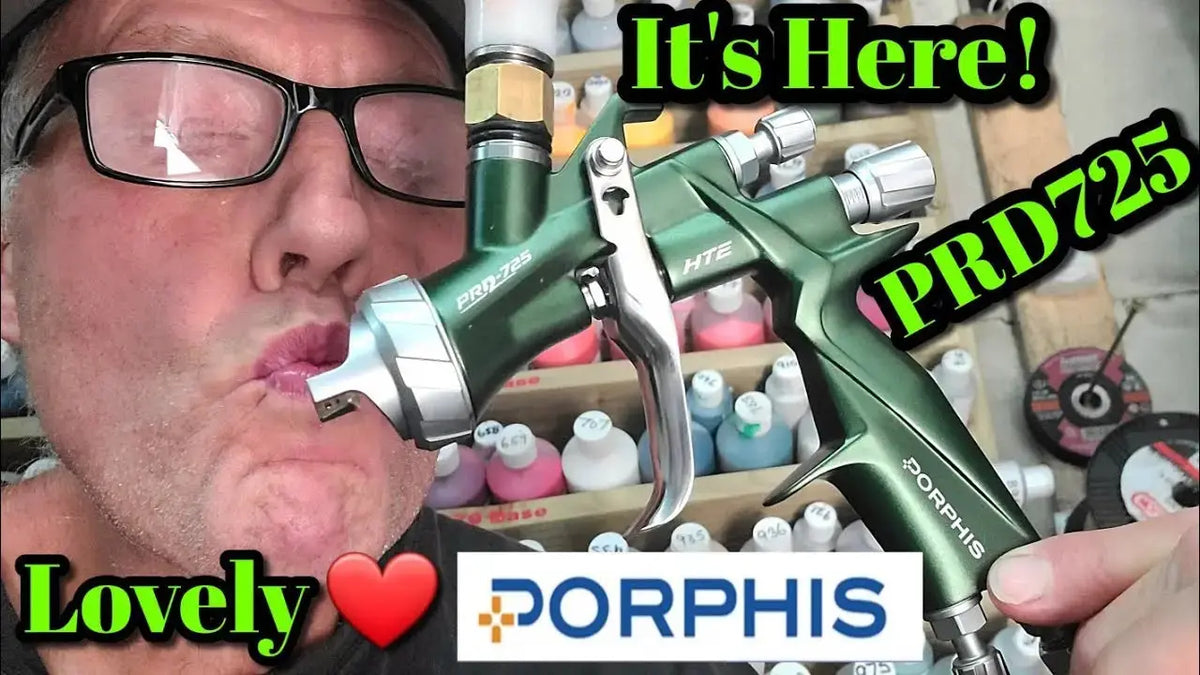
A specification sheet can tell you pressure, air consumption, and nozzle size. It cannot tell you whether a spray gun will be easy to live with after the first week.For the related air and spray-control checks, follow our guide to spray gun air pressure regulation. For working painters, the questions are more practical: Does the fan stay predictable? Can the compressor keep up? Is cleanup a chore? And does the gun make it easier to repeat a good result on the next panel?
That is the right way to look at the PORPHIS PRD-725. For model-specific performance, setup, and application context, see our PRD-725 setup and limitations review.It is not a re-skinned PRD-717, and it is not a three-nozzle gun for every material in the shop. It is a medium-pressure automotive spray gun built around an integrated needle-valve structure, a relatively modest 8.0 CFM air requirement, and two nozzle choices: 1.3 mm and 1.4 mm.
Quick Verdict
|
Question |
Practical Answer |
|
Best suited to |
Automotive base coat, clear coat, single-stage paint, panel work, and spot repair.For model-specific performance, setup, and application context, see our clear coating carbon fiber safely. |
|
Nozzle choices |
1.3 mm for finer control and many clear/base applications; 1.4 mm for slightly more material delivery. |
|
Air demand |
8.0 CFM at the recommended 22–29 PSI range. |
|
Main strengths |
Predictable material control, manageable air demand, easier daily cleaning, and a stable 260–300 mm fan. |
|
Main limitation |
No 1.8 mm option; it should not be marketed as a dedicated high-build primer gun. |
 |
 |
What the PRD-725 Actually Is
The PRD-725 uses an integrated needle-valve design intended to improve trigger response and material control. In plain terms, the adjustment you make at the gun is meant to produce a more predictable change at the panel. That matters when you are trying to keep a wet edge, reduce overspray, or repeat a setup after cleaning.
It also uses an O-ring-free body design. That removes one common source of solvent-related swelling and sticking, but it should not be interpreted as permission to leave the entire gun soaking indefinitely. Clean it promptly, use the correct solvent for the coating, protect lubricated areas, and follow the maintenance instructions.
The Features That Matter in Daily Use
1. Integrated Needle-Valve Control
The most useful feature is not a dramatic claim about atomization. It is control. A responsive fluid system helps a painter make smaller adjustments instead of jumping between too dry and too wet. That is especially useful on edges, narrow panels, and blend areas where a heavy pass can create more work than it saves.
2. Quick-Release Trigger
The quick-release trigger shortens one of the repetitive parts of maintenance. It does not make every component tool-free, but it does make routine access and cleanup less cumbersome. For a painter who changes materials or cleans at the end of every shift, that is a meaningful workflow improvement.
3. Moderate Air Consumption
At 8.0 CFM, the PRD-725 is easier on a compressor than many higher-demand professional guns. That does not mean any small compressor will run it continuously. The compressor still needs to deliver the required CFM at working pressure without a major pressure drop during a long pass. Check delivered air, hose size, fittings, and regulator restriction—not only tank capacity.
4. A Useful Fan Size for Panel Work
The published spray pattern is 260–300 mm at a recommended spray distance of about 170 mm. That is wide enough for doors, fenders, hoods, and general panel work, while still being manageable for painters who do not want an oversized fan that becomes difficult to control around edges.
1.3 mm or 1.4 mm: Which One Should You Choose?
|
Nozzle |
Choose It When... |
Watch For |
|
1.3 mm |
You want finer material control for many clear coats, base coats, and thinner single-stage materials. |
Do not compensate for slow delivery by opening everything and moving too slowly. Follow the coating TDS. |
|
1.4 mm |
You want slightly more fluid delivery for some base coats, single-stage paints, sealers, or materials that prefer a little more flow. |
It is not a substitute for a dedicated large-nozzle primer gun when the product calls for 1.7–2.0 mm. |
The paint manufacturer's TDS should always win. Viscosity, reducer speed, temperature, and the painter's pace can change which setup feels better. The nozzle chart is a starting point, not a universal rule.
How Does It Spray?
Based on the published pattern demonstration and current specifications, the PRD-725 is aimed at a smooth, even automotive finish rather than extremely high material output. The 260–300 mm fan and integrated fluid control should suit painters who prefer to build a controlled wet coat instead of flooding a panel in one pass.
A spray gun cannot remove orange peel by itself. Clear viscosity, hardener and reducer choice, booth temperature, gun distance, overlap, and film build still decide the result. The value of the gun is that it gives the painter a repeatable platform from which those variables can be managed.
What the PRD-725 Does Well—and What It Does Not
|
Does Well |
Needs a Realistic Expectation |
|
Offers a stable, practical fan for automotive panel work. |
It will not correct a poor paint mix, wrong reducer, or bad surface preparation. |
|
Runs at a published 8.0 CFM, making compressor matching easier. |
Continuous spraying still requires a compressor that can sustain the rated airflow. |
|
Makes routine cleaning easier with an O-ring-free body and quick-release trigger. |
O-ring-free does not mean maintenance-free or safe for unlimited solvent soaking. |
|
Provides 1.3 and 1.4 mm choices for common topcoat work. |
There is no 1.8 mm option, so high-build primer may require another gun. |
Who Is It Best For?
- Independent painters: A practical choice when you want professional controls without moving to a very high-air-demand setup.
- Small and mid-sized shops: Useful as a base/clear or general topcoat gun when easy cleanup and repeatability matter.
- Serious DIY painters: Approachable if the compressor, filtration, PPE, and paint system are already appropriate.
- Not the ideal buyer: Someone needing a dedicated 1.8–2.0 mm high-build primer gun or a gun that can compensate for an undersized compressor.
Technical Specifications
|
Specification |
PRD-725 |
|
Nozzle size |
1.3 mm / 1.4 mm |
|
Recommended pressure |
22–29 PSI (1.5–2.0 bar) |
|
Air consumption |
8.0 CFM / 230 L/min |
|
Fluid delivery |
190 ml/min |
|
Spray distance |
170 mm |
|
Spray pattern |
260–300 mm |
|
Gun body |
Forged aluminum, anodized surface |
|
Fluid passage / needle / nozzle |
Stainless steel |
|
Inlet thread |
G 1/4 |
|
Warranty |
1 year; confirm current policy on the product page |
Setup Notes Before the First Panel
- Confirm that the compressor can sustain 8.0 CFM at working pressure, not merely reach the pressure with no airflow.
- Use a clean, correctly sized hose and fittings so the regulator reading is meaningful while the trigger is pulled.
- Choose 1.3 or 1.4 mm according to the coating TDS and viscosity—not by habit alone.
- Spray a pattern card before the vehicle. Check fan shape, atomization, and material distribution.
- Record the pressure, fluid setting, fan setting, reducer, and temperature when a result works. Repeatability is more valuable than guessing again next time.
Frequently Asked Questions
Is the PRD-725 a split-nozzle gun like the PRD-717?
No. The current PRD-725 product information centers on an integrated needle-valve structure. It should not be described as using the PRD-717 split-nozzle platform.
Can I use a 1.8 mm nozzle on the PRD-725?
The current official options are 1.3 mm and 1.4 mm. Do not advertise a 1.8 mm configuration unless PORPHIS officially releases and lists one.
Can it spray primer?
It can handle some lower-viscosity primers or sealers when the coating TDS permits a 1.3 or 1.4 mm setup. For high-build primer that calls for a larger nozzle, use a dedicated primer gun.
Will an 8 CFM compressor be enough?
The compressor should deliver more than the gun's required airflow at working pressure and maintain it during a full pass. Allow capacity for losses through the hose, filter, regulator, and fittings.
Can I soak the whole gun in solvent?
The O-ring-free design reduces one solvent-related maintenance concern, but indefinite soaking is still poor practice. Follow the manual, clean promptly, and avoid leaving the gun submerged longer than necessary.
Final Verdict
The PRD-725 makes the strongest case when it is described accurately. It is a 1.3/1.4 mm automotive spray gun with an integrated needle-valve design, an O-ring-free body, a quick-release trigger, and a manageable 8.0 CFM air requirement. Those are useful, credible advantages.
It is not a universal primer-to-clear gun with a 1.8 mm setup, and it should not be sold through unsupported comparisons with every premium brand. For painters who want controlled topcoat application, practical air demand, and easier daily maintenance, however, the PRD-725 is a serious option worth testing on a pattern card and a real panel.
Share:
PORPHIS PRD-815 Spray Gun Review: Performance, Setup, and Best Uses
PORPHIS PRD-725 Spray Gun Review: Specs, Setup, Best Uses & Limitations
1 comment
I’m a first time painter and want to paint my vehicle with a metallic pearl color. Will this gun work, as you mention a single stage color. Thank You.