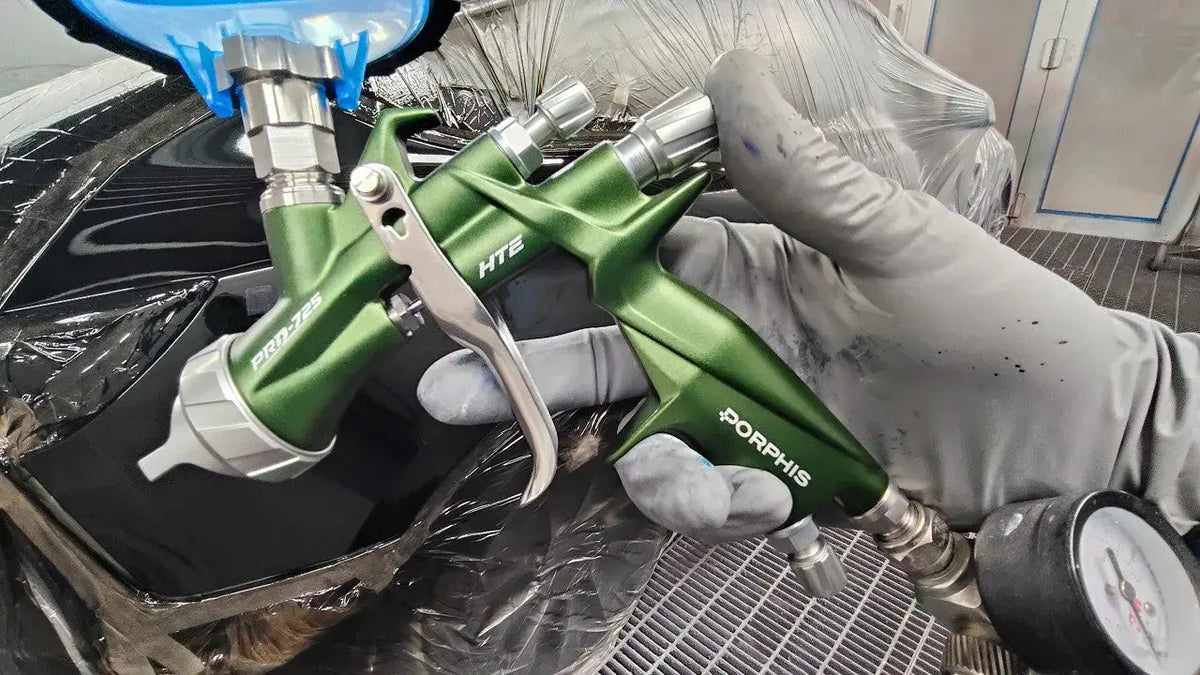
A spray gun review is only useful if it helps you decide whether the gun fits your actual setup.For model-specific performance, setup, and application context, see our PRD-725 spray gun review. With the PRD-725, the important questions are not “Is it professional?” or “Can it make a mirror finish?” They are much more practical: how much air does it need, which nozzle should you choose, how easy is it to control, and where does it make sense in a normal refinishing workflow?
One note before getting into it: the specifications below come from PORPHIS’s published product data. Spray quality still depends on the coating, viscosity, air supply, distance, overlap and the painter behind the gun. Where possible, add your own spray-out photos or test conditions to this page rather than turning the review into a list of marketing claims.
|
Specification |
PRD-725 |
|
Nozzle options |
1.3 mm / 1.4 mm |
|
Recommended working pressure |
22–29 PSI (1.5–2.0 bar) |
|
Air consumption |
8.0 CFM / 230 L/min |
|
Fluid delivery |
190 ml/min |
|
Recommended spray distance |
170 mm |
|
Published fan width |
260–300 mm |
|
Fluid connection |
Male M16 × 1.5 |
|
Air inlet |
G 1/4 |
 |
 |
What Makes the PRD-725 Different?
The PRD-725 is not just another version of the PRD-717. Its current design centers on three practical features: an integrated needle-valve structure, a quick-release trigger and an O-ring-free fluid section.
The integrated needle valve is intended to make trigger response and fluid control more consistent. In day-to-day use, that matters because small changes at the trigger can change how wet the panel gets, especially when you are trying to keep a clear coat moving without flooding an edge.
The quick-release trigger is less glamorous, but it may be the feature you appreciate most after a week of real use. Faster access for cleaning means less time fighting the gun between jobs. The O-ring-free design also removes a common maintenance point in the fluid path, particularly for painters who clean frequently with solvent.
1.3 mm or 1.4 mm: Which Setup Makes More Sense?
|
Nozzle |
Practical starting point |
What to check before spraying |
|
1.3 mm |
Common automotive basecoats and many clear coats |
Confirm the coating TDS, viscosity and desired film build. |
|
1.4 mm |
Materials that benefit from slightly more fluid delivery or painters who prefer a wetter setup |
Confirm the coating manufacturer allows the size; retest pressure and travel speed. |
There is no universal rule that 1.3 mm is “for clear” and 1.4 mm is “for base.” Modern coating systems vary too much for that. Treat the table above as a starting point, then follow the paint manufacturer’s technical data sheet and spray a test pattern before the vehicle.
The 8.0 CFM Number Matters More Than the Marketing
At 8.0 CFM, the PRD-725 asks less from the air system than some full-size high-consumption professional guns, but that does not mean any small compressor will run it comfortably. What matters is whether the compressor can maintain the required airflow while you are actually spraying, not just the tank size printed on the label.
If dynamic pressure falls during a long pass, atomization changes with it. Before a full panel, set the gun with the trigger pulled, check pressure at the gun and make sure the compressor can recover without the pattern changing.
How It Fits Into an Automotive Refinish Workflow
The PRD-725 makes the most sense as a general automotive refinishing gun for painters who want one body that can cover common basecoat and clear-coat work with 1.3 or 1.4 mm setups.
|
Job |
Fit |
Why |
|
Basecoat |
Good fit when the coating TDS supports the selected nozzle |
Stable material control and a moderate air requirement are useful for repeatable passes. |
|
Clear coat |
Good fit for many automotive clears |
1.3/1.4 mm options and 22–29 PSI working range give useful room to tune film build. |
|
Spot / panel repair |
Good fit |
260–300 mm published fan width is manageable for normal panel work. |
|
High-build primer |
Not the first choice |
There is no 1.8 mm setup in the current published range; use a primer-oriented gun when the product calls for a larger fluid tip. |
What I Like About the Design
- The published 8.0 CFM requirement is realistic for more shop setups than very high-air-consumption guns.
- 1.3 and 1.4 mm cover the nozzle sizes many painters actually use for base and clear.
- The quick-release trigger and O-ring-free fluid path are practical maintenance features, not just cosmetic changes.
- The gun’s published 260–300 mm fan is large enough for panel work without pretending that a wider fan automatically means a better finish.
What I Would Not Overpromise
A better spray gun can make a good setup easier to repeat, but it cannot rescue a bad one.For a closely related workflow, see our guide to spray gun air pressure regulation. Wrong reducer, incorrect viscosity, unstable air, excessive distance, poor overlap or rushed flash times can still create orange peel, dry spray, runs or mottling.
I would also avoid calling the PRD-725 a primer-to-clear “one gun for everything.” It can cover a wide part of the automotive workflow, but the current 1.3/1.4 mm fluid setups are not a substitute for a dedicated large-tip primer gun when a high-build product requires it.
A Better First Setup for the PRD-725
- Choose the nozzle size allowed by the coating TDS.
- Mix and reduce the material exactly as specified.
- Set inlet pressure with the trigger pulled; start inside the published 22–29 PSI range.
- Spray a pattern card and look for even material distribution from top to bottom.
- Adjust one variable at a time: pressure, fluid, fan, distance or travel speed.
- Record the final setup so you can repeat it on the next panel.
Who Should Consider the PRD-725?
|
Good candidate |
Probably look elsewhere |
|
Painter doing regular basecoat and clear-coat panel work |
User who needs a 1.8–2.0 mm primer setup |
|
Shop wanting a full-size automotive gun around an 8 CFM published air demand |
Very small compressor setup that cannot sustain 8 CFM |
|
Painter who values easier cleaning and fewer O-ring maintenance points |
Buyer looking for a mini/detail gun |
|
DIYer willing to test and record settings instead of chasing one magic pressure number |
Anyone expecting the gun alone to fix material or technique problems |
Final Verdict
The PRD-725 is most convincing when you look at it as a practical, mid-pressure automotive gun rather than a miracle shortcut to a perfect finish. Its 1.3/1.4 mm setups, 22–29 PSI working range and 8.0 CFM published air consumption make it relevant to a lot of real-world basecoat and clear-coat work.
The integrated needle valve, quick-release trigger and O-ring-free fluid section are also useful changes for painters who care about repeatability and daily maintenance.
The strongest version of this review, however, should include evidence: a real spray pattern, the coating used, pressure at the gun, nozzle size and a close-up of the finished panel. That tells a painter far more than a claim like “factory-grade finish” ever will.
FAQ
What nozzle sizes does the PRD-725 use?
The current published options are 1.3 mm and 1.4 mm.
How much air does the PRD-725 need?
PORPHIS lists air consumption at 8.0 CFM / 230 L/min. Make sure your compressor can sustain that airflow during continuous spraying.
What pressure should I run?
The published working range is 22–29 PSI. Use it as a starting range and then follow the coating TDS and verify pressure with the trigger pulled.
Can the PRD-725 spray clear coat?
Yes, it is positioned for automotive clear-coat and basecoat work.For model-specific performance, setup, and application context, see our clear coating carbon fiber safely. The exact nozzle and setup should still follow the clear-coat manufacturer’s recommendations.
Can I use it for high-build primer?
The current published nozzle range stops at 1.4 mm. If your primer calls for a larger tip, use a dedicated primer gun instead.
Share:
PORPHIS PRD-725 Review: A Practical Look at Finish Quality, Air Demand, and Daily Use
PORPHIS PRD-817 Review: 1.3 mm Setup, Air Demand, Strengths and Real Limitations