
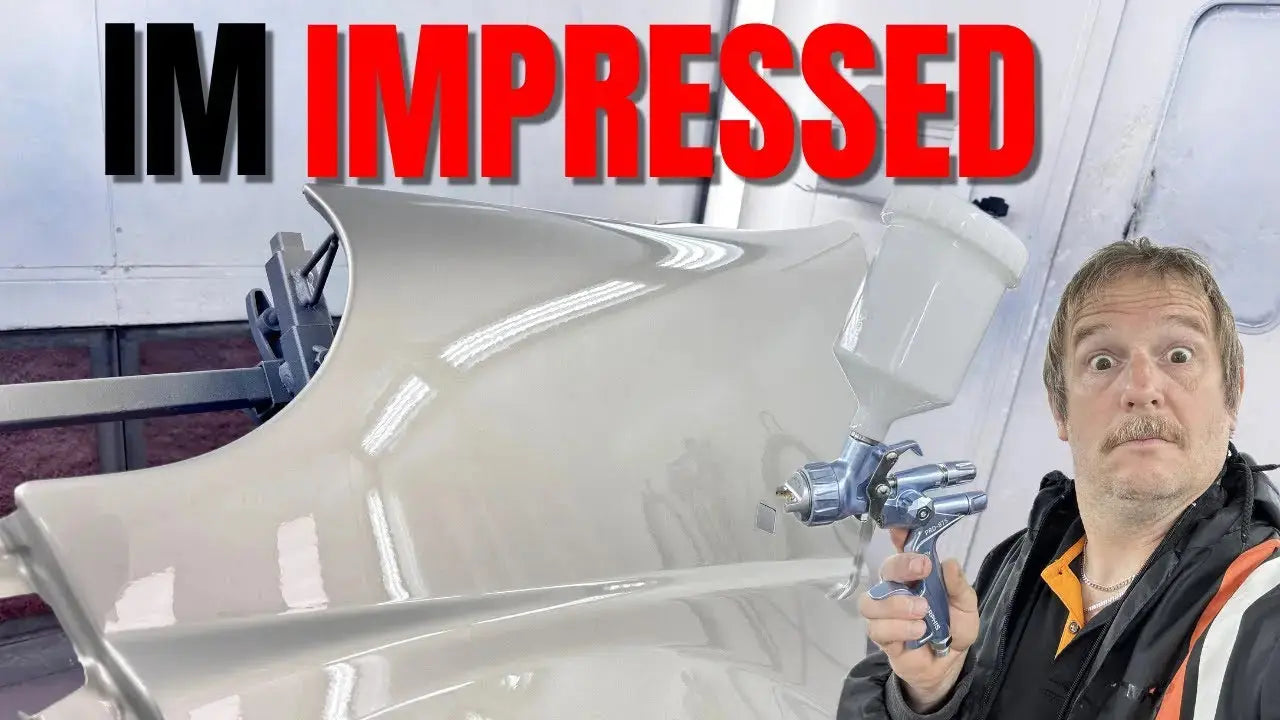
1. Executive Overview and Strategic Assessment
The core objective of this evaluation was to determine if the PRD-815 (1.3mm nozzle) could provide professional-grade results across a complete multi-stage workflow. Utilizing Mipa products as the control variable, the gun was tested through three distinct phases: a wet-on-wet primer, a metallic solvent basecoat, and a high-solid 2K clearcoat. This report analyzes whether this mid-range tool can effectively break a three-decade "habit" by delivering consistent performance that justifies its place in a professional booth.
2. Ergonomic Architecture and Build Quality Analysis
- Tactile Feedback: The fluid control mechanism is engineered with a "click" adjustment system. This provides the technician with a measurable, repeatable reference point for fluid volume, a feature that enhances precision when switching between materials.
- Weight and Balance: The chassis is noted for being extremely light. For a professional used to the robust, sometimes heavy feel of legacy SATA guns, this weight reduction significantly lowers the physical demand of a full-day painting schedule without compromising the tool's balance.
- Utility Features: The inclusion of a locking swivel is a sophisticated addition. It prevents the air hose from binding and wrapping, which is vital for maintaining a steady stroke, particularly for technicians who do not use a gauge at the gun base.
- Component Design: The air cap hole positions and pot design share a striking resemblance to the SATA benchmark, ensuring that the transition to this tool feels intuitive rather than "alien."
These design choices represent a strategic move away from "budget" aesthetics toward professional-tier utility. By prioritizing trigger smoothness and tactile precision, the PRD-815 successfully courts the professional looking for a viable alternative to more expensive legacy brands.
3. Multi-Stage Application Performance Analysis
Testing with Mipa CX2, a budget-friendly fast-dry clearcoat, highlighted the PRD-815’s efficiency. The 1.3mm nozzle delivers a significant volume of material, which can be a challenge for a "heavy painter" accustomed to a slower delivery. To compensate for the high output and prevent runs, the fluid needle was restricted by a quarter-turn. This adjustment allowed the gun to lay the clearcoat on "wet and fast," successfully managing the material's tendency to draw in or lose gloss during the drying phase.
4. Deep Dive: Atomization and Fan Consistency
- Bottom-Weighted Flutter: A noticeable "flutter" or inconsistency was observed at the extremities of the fan. Critically, this was more pronounced at the bottom of the pattern than the top. This requires the painter to be highly disciplined with their gun angle to ensure the edges of the fan remain stable.
- Central "Wet Spot": The fan pattern features a concentrated "wet spot" in the center rather than a perfectly linear distribution across the entire width. This center-heavy delivery means material accumulates faster in the middle of each pass.
- Overlap Adaptation: Because of the identified "dead zones" and the wet center, the technician must adapt their natural overlap. To avoid patchiness in metallics or heavy builds in the clearcoat, a more precise overlap and a consistent travel speed are required compared to the more forgiving distribution of a premium SATA jet.
5. Comparative Benchmark: PORPHIS PRD-815 vs. SATA Industry Standards
|
Criteria
|
SATA Standard (e.g., Jet Series)
|
|
|---|---|---|
|
Controllability
|
High; very approachable for learners and DIYers.
|
Can be a "handful" due to aggressive output/speed.
|
|
Fan Uniformity
|
Decent width; flutter noted (more at bottom).
|
Exceptional; perfectly linear and consistent.
|
|
Price-to-Performance
|
Exceptional; delivers professional results at mid-range cost.
|
High investment; the cost of risk management.
|
|
Ergonomics
|
Extremely light and smooth trigger action.
|
Robust and heavy; the industry's tactile benchmark.
|
PORPHIS PRD-815
|
Spraying effect
|
In this comparison, it is clear that while SATA provides the ultimate consistency required for high-volume OE matching, the PRD-815 is a legitimate professional tool. It offers a level of controllability that makes it arguably more accessible for those who find the raw power of a SATA jet difficult to manage.
6. Final Verdict and Strategic Recommendations
- For the DIYer and Learner: This is the ideal entry point. Its controllability and "forgiving" nature make it easier to master than a high-output premium gun, providing a professional learning curve without the professional price tag.
- For the Professional: The PRD-815 should be viewed as a versatile multi-role workhorse. It is a highly effective specialized clearcoat tool or a primary gun for shops looking to reduce overhead without sacrificing finish quality.
- Technical Optimization: For the "heavy painter" who prefers to keep the gun moving without the risk of over-application, the 1.2mm nozzle setup is the recommended configuration. This will provide a more restricted, manageable delivery for high-solids clearcoats.
Share:
Technical Performance Evaluation Report: PORPHIS PRD-817 Spray Gun (Post-Modification Analysis)
PORPHIS PRD-815 Spray Gun Review: Performance, Setup, and Best Uses