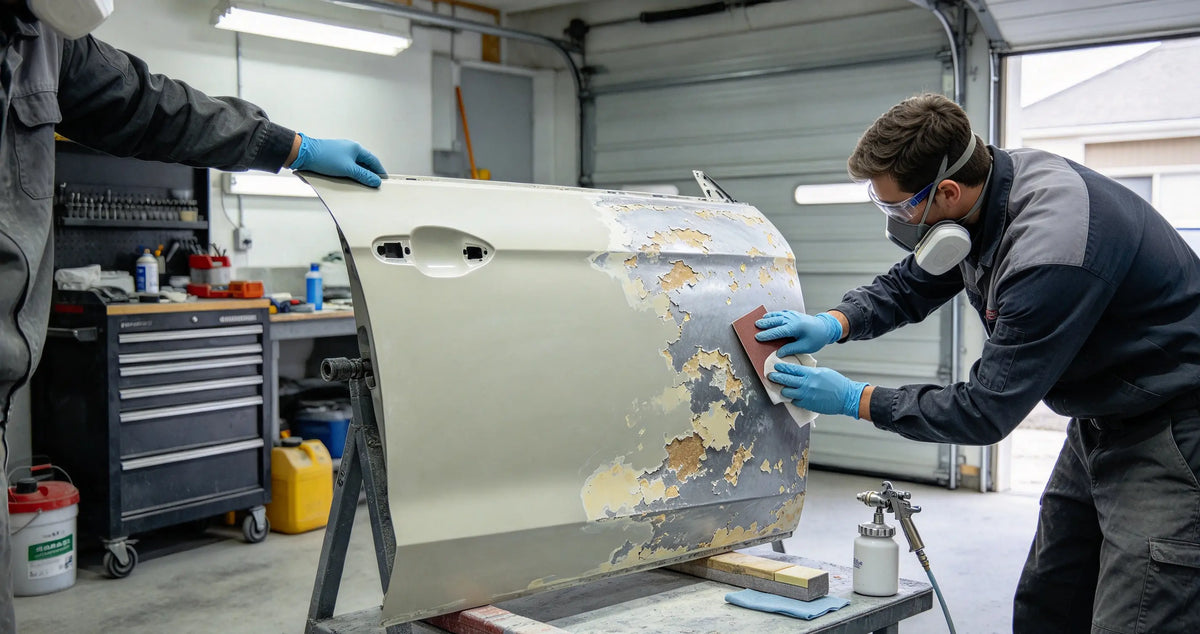
Sometimes. Epoxy primer can go over an existing automotive finish when the primer manufacturer approves that substrate and the old coating is sound, clean, and mechanically prepared. The deciding issue is not the age of the paint. It is whether the layers underneath can support the new coating.
Epoxy does not turn a weak foundation into a strong one. If the old finish is peeling, contaminated, rusted, or made from an unknown product that may react with the new system, covering it can hide the problem until the complete repair begins to fail.
|
Keep the existing finish when… |
Strip or remove it when… |
|
It is firmly attached and does not peel, blister, or crack. |
The finish is peeling, blistering, cracking, or delaminating. |
|
There is no active corrosion or trapped moisture. |
Rust is spreading beneath the coating or the substrate is pitted. |
|
Previous repairs are stable and identifiable. |
Previous repairs are lifting, separating, or made from unknown products. |
|
The surface can be cleaned and sanded to the required profile. |
Stripper residue or contamination cannot be reliably removed. |
|
The epoxy TDS explicitly allows the prepared substrate. |
The epoxy system requires bare metal for this application. |
Do I Need to Strip to Bare Metal Before Epoxy Primer?
Not in every repair. Stripping to bare metal is a tool for removing uncertainty, widespread failure, corrosion, or an incompatible coating system. A stable factory finish may remain in place if the selected epoxy permits it and the surface is prepared exactly as specified.
Bare metal is usually the better choice when
- The panel has widespread rust, paint failure, or several unknown repair layers.
- You need to investigate the substrate rather than seal it from view.
- The primer manufacturer requires direct-to-metal application.
- A chemical treatment or stripper has left a surface condition you cannot verify.
Once steel is exposed, remove corrosion, establish the specified profile, and prime within the product’s stated window where required. Bare steel can flash-rust quickly in humid conditions.
What Happens If You Spray Epoxy Over Old Primer?
The result depends on the old primer’s adhesion, cure, compatibility, and preparation. A stable and approved layer can form a durable foundation. A weak layer remains weak after epoxy is applied, and the new coating may simply make the failure harder to see.
|
Underlying problem |
What may happen after epoxy is applied |
|
Poor adhesion |
Peeling or delamination can carry the new layer away with the old one. |
|
Incompatible or uncured coating |
Solvents can cause wrinkling, lifting, or a soft film. |
|
Glossy or contaminated surface |
The new primer may lack the mechanical bond it needs. |
|
Poorly feathered repair |
Edges and sanding scratches can show through later coats. |
|
Rust left in the panel |
Corrosion can return beneath the new finish. |
Removing Old Primer and Filler Without Damaging the Panel
Remove only as much material as the repair requires, but remove enough to understand what is underneath. Aggressive grinding can thin sheet metal, create heat, and distort a panel; a controlled abrasive process is usually easier to repair later.
- Identify failed layers. Look for lifting edges, cracking, rust staining, soft filler, and places where the coating separates during sanding.
- Choose the least aggressive effective method. A suitable DA sander can cover larger areas; hand sanding gives more control around edges and body lines.
- Feather the remaining sound finish. Replace a sharp step with a gradual transition between metal, filler, primer, and paint.
- Inspect the exposed substrate. Check for rust pits, pinholes, cracks, and evidence of a previous repair.
- Clean and prime promptly. Follow the product’s mix ratio, induction time, pressure, film thickness, and recoat window.
For a more complete surface-preparation sequence, link to paint prep before base coat.
Is Ospho Residue a Problem Before Epoxy Primer?
It can be. Ospho is a phosphoric-acid-based rust treatment, and the required finishing procedure depends on the exact product and how it was used. A surface that looks dry or has turned dark is not automatically ready for epoxy.
Do not treat a rust converter, an acid-etching treatment, and a final cleaning product as interchangeable. Their residue and rinse requirements can differ, and the epoxy TDS may approve only a particular surface condition.
|
After an Ospho treatment |
What to confirm |
|
Read the exact product instructions |
Was the product used as a converter, treatment, or etch, and what cleanup does it require? |
|
Remove loose deposits |
Brush or clean away powdery or friable residue as directed. |
|
Rinse or neutralize as specified |
Do not replace a required water rinse with a generic solvent wipe. |
|
Dry completely |
Check seams, pinholes, and recesses where moisture can remain. |
|
Recheck the final surface |
Confirm that the epoxy manufacturer accepts the resulting substrate. |
Paint Stripper Residue Cleanup Before Epoxy Primer
Chemical strippers can remove several layers quickly, but residue left in seams, pinholes, folded edges, or panel joints can interfere with adhesion. Different strippers call for different neutralization, rinsing, and drying procedures.
Follow the stripper label first, then compare the cleaned surface with the epoxy TDS. If the panel remains oily, tacky, discolored, or unusually soft, do not cover it to see whether the problem disappears. Find and remove the contamination before priming.
The Correct Order From Old Paint to Epoxy Primer
|
Stage |
Action |
|
1. Assess |
Decide whether the existing paint and primer are stable enough to retain. |
|
2. Remove failure |
Strip peeling paint, failed primer, unstable filler, corrosion, and residue as needed. |
|
3. Repair the substrate |
Correct metal damage and complete the required filler work. |
|
4. Feather and sand |
Create a smooth transition and the surface profile specified by the coating system. |
|
5. Clean |
Remove grease, dust, salts, treatment deposits, and stripper residue using the approved process. |
|
6. Verify compatibility |
Confirm that the epoxy is approved for each exposed and retained layer. |
|
7. Mix and apply |
Follow the ratio, induction time, gun setup, pressure, technique, and film build in the TDS. |
|
8. Respect the recoat window |
Sand or prepare again if the manufacturer requires it before the next product. |
The order of body filler and epoxy varies by system. Some products allow filler over cured epoxy; others specify a different sequence. The product documents control.
Choosing the Spray Gun for the Finishing Stage
Surface preparation determines whether the coating has a sound foundation. Once the panel is repaired and primed, the spray gun helps produce consistent coverage and clear-coat appearance, but it cannot fix rust, poor adhesion, or incompatible layers.
For a dedicated finishing-stage option, see the PRD-515 clear coat spray gun. Match the nozzle, pressure, and fluid settings to the clear-coat TDS.
For pressure setup, use the spray gun air pressure regulation guide with the product documentation. Before spraying a 2K system, review the 2K clear coat safety guide.
Frequently Asked Questions
Can I apply epoxy primer over old paint?
Yes, if the epoxy is approved for that substrate and the old paint is stable, clean, and correctly prepared. Remove failed or incompatible layers first.
Do I need to strip to bare metal before epoxy primer?
Not always. Strip when corrosion, widespread failure, unknown layers, contamination, or the primer TDS makes bare metal the dependable choice.
Is epoxy primer bare metal only?
Some products are direct-to-metal systems; others allow specified prepared coatings. Check the exact TDS rather than applying a universal rule.
What happens if you spray epoxy over old primer?
A stable, compatible primer may work. A weak or incompatible primer can cause peeling, lifting, wrinkling, or later adhesion failure.
Is Ospho residue a problem before epoxy primer?
It can be. Follow the exact treatment instructions, remove residue as required, dry the substrate, and confirm that the epoxy manufacturer accepts the final condition.
Can I apply epoxy over body filler?
Only when the selected filler and epoxy system allow that sequence. Check both manufacturers’ documents and follow their preparation requirements.
Can I use paint stripper and apply epoxy immediately?
No. Complete the stripper’s cleanup and drying process, then verify that the surface meets the epoxy primer’s preparation requirements.
Final Thoughts
Applying epoxy over old paint is a substrate decision before it is a spraying decision. Retain sound layers only when the coating system permits them. Remove failed paint, unstable primer, defective filler, corrosion, and residue before rebuilding the finish.
Careful preparation usually takes less time than correcting an adhesion failure after the vehicle has been painted. Confirm the technical data sheet for every product in the stack, and choose spray equipment for the finishing stage only after the foundation is sound.
Share:
How Many Spray Guns for DIY Auto Painting Do You Actually Need?
How to Get a Consistent Finish When Spraying Metallic Car Paint