
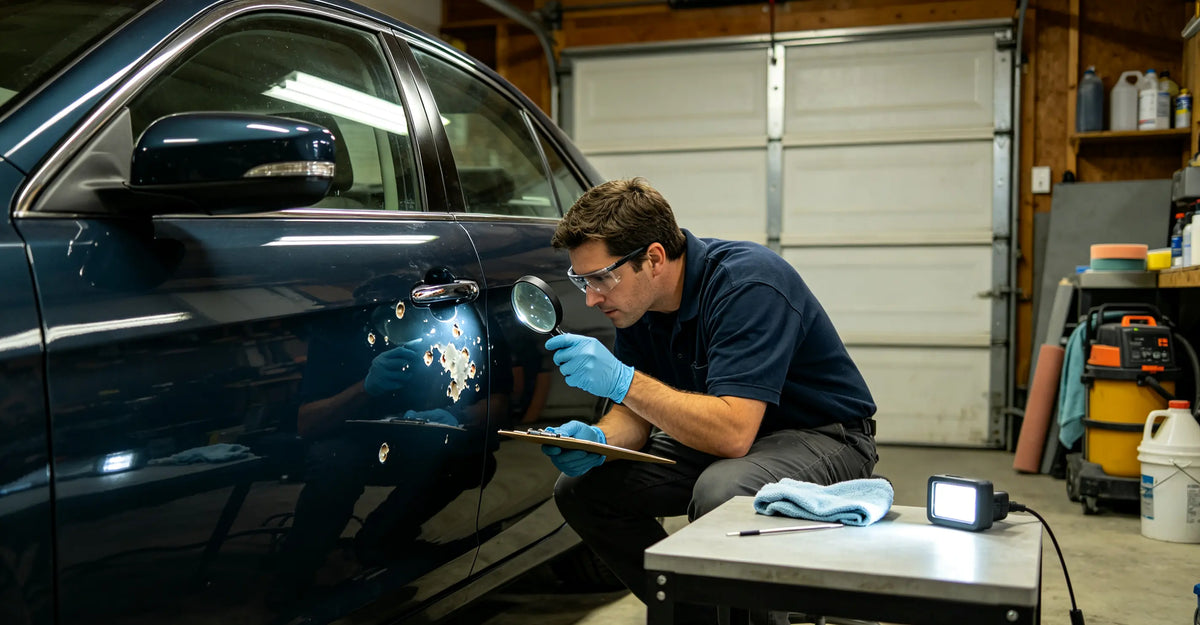
A bubble in automotive paint is not a diagnosis. It is a symptom. Two panels can both look ‘bubbled’ and need completely different repairs—one may have corrosion under the coating, another may have moisture or solvent trapped in the refinish system, and a third may actually be solvent pop or contamination craters rather than true blistering.
That is why car paint bubbling repair should start by figuring out what kind of defect you have before you start sanding the whole hood.
What Causes Car Paint to Bubble on the Hood?
Common causes include moisture left in seams or repair areas, high humidity, poor cleaning, contaminated compressed air, excessive film build, insufficient flash or dry time, material incompatibility and corrosion underneath the coating. Axalta’s blistering guidance lists many of those causes, including residual sanding water, high ambient humidity, contamination in air lines and trapped solvent from heavy undercoats.
First: Is It Really a Paint Blister?
|
What it looks like |
More likely defect |
First check |
|
Raised bubble or dome, sometimes appearing later |
Blistering / adhesion failure |
Open one carefully during repair and inspect for moisture, contamination or unstable layers. |
|
Tiny pinholes or popped bubbles after curing |
Solvent pop |
Film build, flash, reducer, heat and compressed-air condition. |
|
Round crater with paint pulled away from a center point |
Fisheye / contamination |
Silicone, wax, oil, cleaner residue or air-line contamination. |
|
Bubble near chip, seam or edge with brown corrosion underneath |
Rust blister |
Remove coating far enough to expose and treat the corrosion. |
If the defect is pinhole-like rather than a raised blister, use our solvent pop and compressed-air moisture guide.
Paint Bubbling on Hood Causes: Rust, Moisture and Old Repairs
Location is a useful clue. Bubbles around chips, edges, seams and old repairs deserve a corrosion check. Bubbles that appear soon after a repaint point more strongly toward the refinish process: trapped moisture, contamination, heavy film build, insufficient dry time or incompatible layers.
Moisture under car paint does not always mean rainwater somehow passed through a healthy finish. Water can be left from wet sanding, trapped in crevices, introduced through compressed air, or held in a porous/contaminated repair area. Diagnose the route instead of assuming ‘humidity did it.’
How to Fix Bubbling Paint on a Car Without Repainting
A true blister cannot normally be polished flat because the problem sits under the visible surface. A very small localized defect may be repaired without refinishing the entire panel—but only if the surrounding coating remains firmly bonded after the damaged area is opened up.
- Remove the blistered coating until you reach a stable edge.
- Inspect what is underneath: corrosion, bare metal, filler, moisture, contamination or weak old paint.
- Correct the root cause rather than sealing it under new material.
- Rebuild primer/base/clear using a compatible paint system and its TDS flash/cure windows.
- Expand the repair if the surrounding coating keeps lifting as you sand.
Automotive Paint Blistering Fix: How Far Should You Strip?
Do not decide the repair size before you know how stable the surrounding coating is. Start at the visible defect and widen the repair only as needed. If each new edge continues to peel, blister or separate, the failure extends beyond the bubble you could see from the outside.
Before rebuilding the color layer, follow a controlled paint prep before base coat process.
Why Did My Paint Bubble After a Cheap Respray?
A cheap respray bubbling problem does not prove the paint itself was cheap or defective. Fast turnaround can mean shortcuts in sanding, degreasing, drying, material compatibility or flash time. Heavy coats can also trap more solvent and delay the point at which the failure becomes visible.
Is Bubbling Paint Always a Sign of Rust Underneath?
No. Rust is one important cause, especially around exposed edges and chips, but blistering can also come from moisture, contamination, solvent entrapment, poor adhesion or incompatibility. The repair has to match what is actually under the bubble.
Where the PRD-515 Fits In
Once the substrate and coating stack are stable, consistent application helps you rebuild the panel without creating unnecessary film-build variation. The current PRD-515 is a 1.3 mm MP gun published at 1.6–2.0 bar, 10.5 CFM, a 180 mm recommended distance and a 260–300 mm spray pattern.
It cannot fix rust, trapped water or weak old paint. It only becomes relevant after those causes have been removed.
Final Takeaway
Effective car paint bubbling repair is about finding the failure beneath the bubble. Diagnose the defect type, open the damaged area, keep sanding until the remaining coating is genuinely stable, and rebuild with compatible materials. If the defect is widespread, a complete-panel refinish is often more reliable than chasing isolated bubbles one by one.
Share:
DIY Garage Car Painting Ventilation: What Fans, Filters and PPE Can—and Cannot—Do
Matte Paint Scratch Repair: Can You Polish It, Spot Repair It, Respray It or Wrap It?