
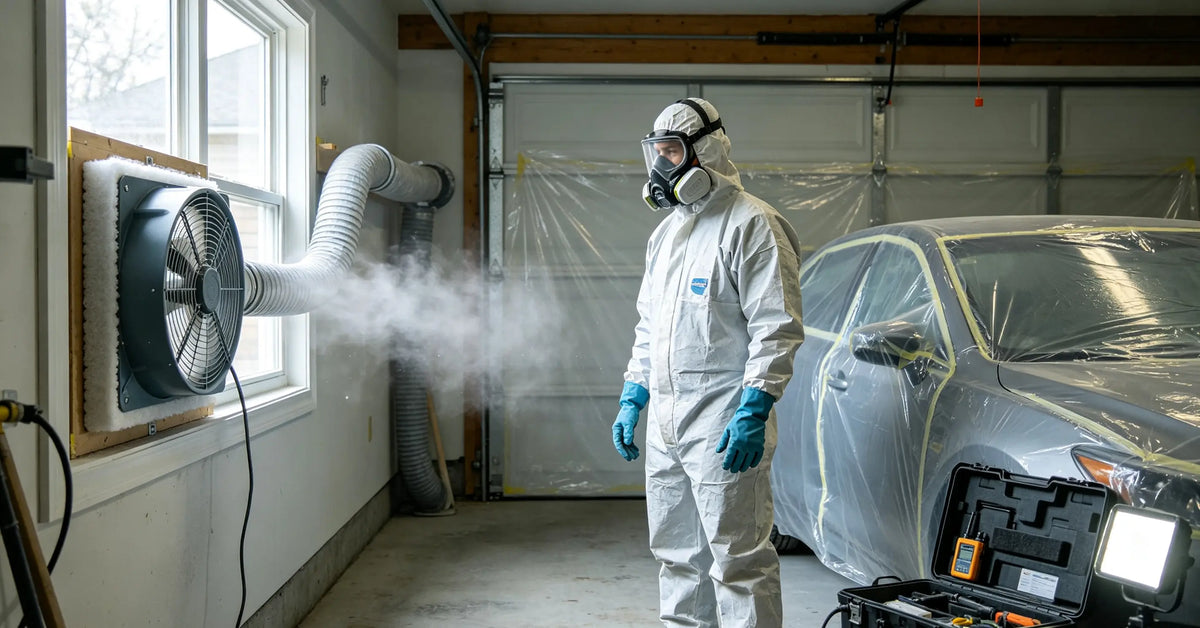
Painting a car in a garage creates two problems at the same time: airborne coating mist and chemical vapor. Opening the big door may make the room feel less stuffy, but it does not automatically create a controlled spray environment—and adding a household fan can introduce a new ignition hazard if flammable vapors are present.
So DIY garage car painting ventilation should be treated as a safety system, not a comfort upgrade. The correct setup depends on the coating chemistry, the space, airflow path, filtration, electrical equipment and local requirements. For 2K isocyanate coatings, the bar is much higher than many home setups can meet.
Why DIY Garage Car Painting Ventilation Matters
A useful airflow pattern moves cleaner replacement air through the work zone and carries mist and vapor toward a controlled exhaust. Random cross-drafts do the opposite: they can push overspray across the panel, pull dust into the finish, or recirculate contamination around the painter.
In workplace spray finishing, OSHA requires mechanical ventilation that removes flammable vapors and mists to a safe location and keeps ventilation operating during spraying and long enough afterward to clear remaining vapors. That standard is written for occupational settings, but it highlights why an ordinary garage fan is not the same thing as a designed spray exhaust system.
How to Set Up Ventilation for DIY Car Painting at Home?
The safest answer depends first on what you are spraying. For small non-isocyanate work, local rules and the coating SDS may allow a more modest controlled setup. For 2K isocyanate materials, do not assume a homemade booth is adequate simply because you can feel air moving.
|
Part of the system |
What it needs to do |
What it does NOT prove |
|
Makeup air |
Replace exhausted air without creating dead zones or strong cross-drafts. |
That vapor concentration is safe. |
|
Exhaust path |
Move contaminated air away from people, openings and HVAC intakes. |
That the fan/electrics are suitable for flammable vapors. |
|
Overspray filtration |
Capture paint particles before they load the fan/duct or discharge outside. |
That solvent vapor or isocyanate exposure is controlled. |
|
Respiratory protection |
Match the coating SDS and applicable rules. |
That ventilation can be ignored. |
What Size Exhaust Fan Do I Need for Painting a Car in My Garage?
There is no responsible one-number answer. A fan advertised at 2,000 CFM does not necessarily deliver 2,000 CFM once filters, ducts and bends are added. A larger fan can also create problems if makeup air is inadequate or the flow becomes turbulent.
For a real design, the important questions are the actual airflow through the spray zone, filter pressure drop, duct losses, discharge location, electrical classification, ignition control and the coating being sprayed. In a commercial setting, those items are normally handled by booth design standards and qualified installers—not a single garage-volume calculation.
What Filters Should I Use for a DIY Garage Paint Booth?
Overspray filters are designed to capture paint particles. Household HVAC filters are built for a different job and should not be treated as a substitute simply because they fit the frame.
Also keep the job of the filter straight: capturing overspray is not the same as removing solvent vapor or isocyanate mist from the painter’s breathing zone. A loaded filter also changes airflow, so filter condition has to be part of the pre-spray check.
What PPE Do I Need for Spraying 2K Paint in a Garage?
Start with the SDS for the exact coating. Many professional 2K automotive products use isocyanate hardeners. HSE guidance for vehicle refinishing states that filtering respirators are not suitable for spraying isocyanate paints; air-fed breathing apparatus is required while spray mist is present.
That means a disposable mask, dust mask or ordinary organic-vapor cartridge should not be presented as a complete 2K spray solution. Gloves, protective clothing and eye/skin protection also matter, but respiratory protection and extraction are the critical starting point.
Before any 2K project, read our 2K clear coat safety guide.
Can I Paint a Car in My Garage With Just Windows and Fans?
Not if your definition of ‘safe’ is simply that the smell leaves the room. Windows and general-purpose fans do not guarantee controlled capture, safe discharge, ignition protection or suitable respiratory protection. For 2K isocyanate spraying, an improvised home setup should not be treated as equivalent to a properly extracted spray booth or room.
If your real problem is visible mist or overspray rather than room design, see what spray settings can—and cannot fix about 2K fumes.
Where the PRD-510 Fits In
A low-air-demand gun can make compressor matching easier, but it does not make an unsafe garage safe. The current PRD-510 uses LVLP technology with 1.0 and 1.3 mm nozzle options, a 1–1.5 bar operating range, 5.7 CFM air consumption, a 150 mm recommended distance and a 120–200 mm published fan.
That makes it useful when available compressor capacity is limited. Ventilation, ignition control and PPE remain separate requirements.
Practical Garage Spray Booth Setup Tips
- Read the coating SDS/TDS before designing the job around your garage.
- Keep airflow directional and avoid strong cross-drafts across the panel.
- Use paint-overspray filtration designed for the task and check loading before each session.
- Keep ignition sources and unsuitable electrical equipment out of the spraying area.
- Do not discharge contaminated air toward doors, windows, neighbors or HVAC intakes.
- Keep ventilation running for the required clearance period after spraying; the trigger stopping does not mean the air is clean.
Final Takeaway
DIY garage car painting ventilation is not a fan-selection problem. It is an exposure-control, fire-safety and airflow-design problem. For non-isocyanate work, build the plan around the product SDS and local requirements. For 2K isocyanate spraying, do not treat household fans and open windows as a substitute for a properly controlled spray environment and air-fed respiratory protection.
Share:
Base Coat Cracking After Spraying: How to Find the Layer That Failed
Car Paint Bubbling Repair: Diagnose the Blister Before You Sand or Respray