
1. Executive Overview and Market Positioning
In the current automotive refinish climate, procurement strategies are increasingly shifting toward high-performance tools that disrupt the traditional "Tier-1" pricing model.
The PORPHIS PRD-715 enters the market not as a derivative "white label" replica, but as a product of dedicated in-house manufacturing. This distinction is critical; while many budget alternatives merely copy existing architectures, PORPHIS maintains control over engineering and production, allowing for professional-grade atomization energy at a fraction of the cost of premium European counterparts.
For independent technicians and high-volume collision centers alike, the PRD-715 represents a strategic opportunity to reduce equipment overhead without compromising the "off-the-gun" finish quality required by modern insurance standards and client expectations.
|
Feature
|
Specification
|
|---|---|
|
Market Price
|
$233.63
|
|
Manufacturing Origin
|
In-house (China)
|
|
Air Consumption
|
10.5 CFM
|
|
Tip Size
|
1.2mm、1.3mm、1.4mm
|
|
Air Cap Technology
|
MP (Medium Pressure)
|
From a consultancy perspective, the PRD-715’s market positioning is aggressive. It targets the "sweet spot" of the budget-pro segment, offering a return on investment (ROI) that is realized almost immediately through material savings and reduced post-paint labor.
2. Manufacturing Excellence and Ergonomic Architecture
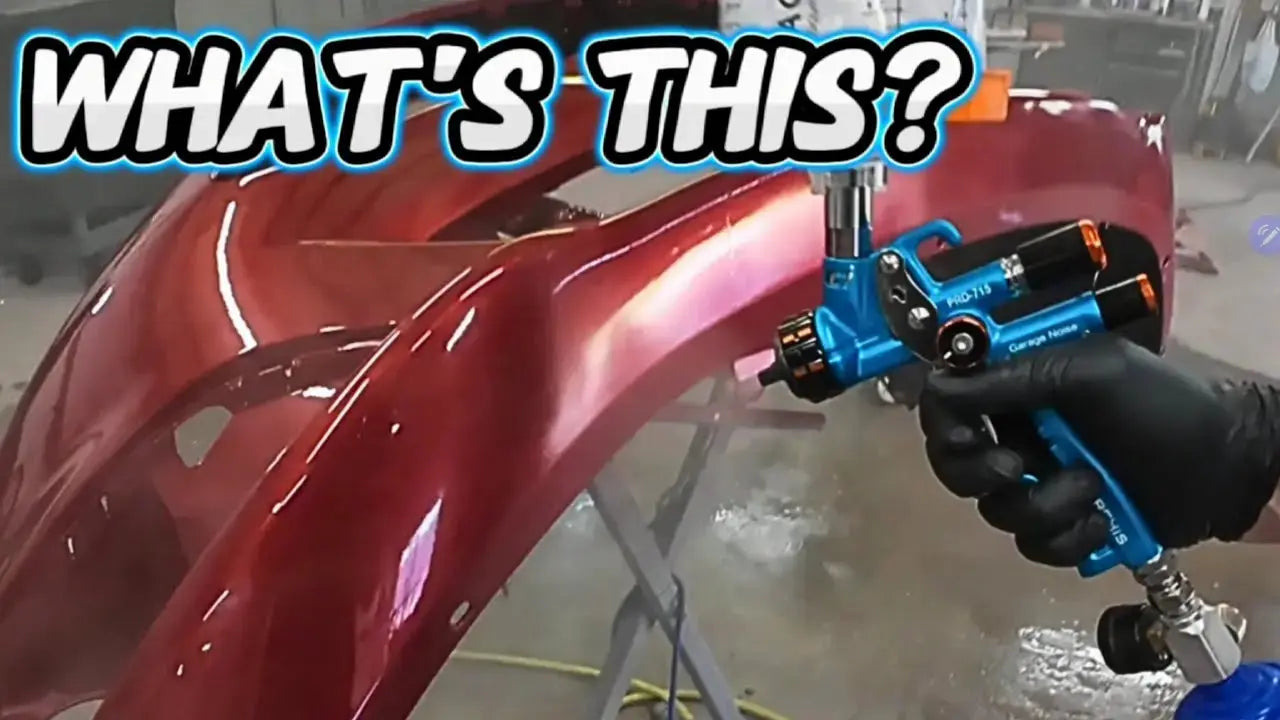
For a senior painter, a tool’s architecture is directly tied to long-shift consistency. The PRD-715 features a Blue, Black, and Gold aesthetic that reflects its robust build quality. Unlike cast-component budget guns, the control knobs for fan width, fluid volume, and air pressure possess a "machined" feel, offering the tactile resistance necessary for fine-tuned adjustments.
A standout engineering feature is the stepped fluid volume control. The implementation of tactile "clicks" or steps allows for mechanical repeatability that smooth-turn valves lack. This ensures that once a technician finds the optimal setting for a specific clear coat or sealer, it can be replicated across jobs with surgical precision, eliminating the guesswork that often leads to application errors.
Furthermore, the in-house manufacturing model allows for a level of customization and modularity rarely seen at this price point. Beyond the standard MP (Medium Pressure) cap, the system supports split-tip technology and HVLP variations. The manufacturer even offers personalized engraving—a testament to a direct-to-consumer service model that differentiates this tool from generic mass-market imports.
3. Pneumatic Efficiency and Air Management Profile
Pneumatic overhead is a primary consideration for any shop environment. The PRD-715 is rated at 10.5 CFM, which places it in a specific performance category. It is not an "air hog," but it demands respect regarding air supply stability.
Technical Warning: While 10.5 CFM is efficient for a professional shop, it represents a "danger zone" for DIY or hobbyist setups. To avoid the pressure drops that lead to inconsistent atomization and "orange peel," this gun must be paired with a dedicated industrial compressor (ideally 60-gallon minimum). Running this tool on a small 20-gallon or "pancake" compressor will result in finish failure as the pneumatic system fails to keep pace with the gun’s demand.
The Medium Pressure (MP) cap technology utilized here is designed to optimize atomization energy. By finding the equilibrium between air volume and pressure, the PRD-715 breaks down modern high-solids coatings effectively, providing the energy required for a "slick" finish without the excessive turbulence often found in high-CFM compliant guns.
4. Multi-Stage Coating Performance Analysis
Evaluating the versatility of the 1.3mm tip setup is essential for determining the gun's role as a shop "workhorse."
4.1 Sealer Application
Using a setting of 18 PSI at 2.5 turns out, the PRD-715 delivered a "silky smooth" sealer coat. The atomization at this lower pressure was exceptional, resulting in a uniform foundation for the base coat. Notably, the gun achieved full coverage on a standard bumper cover using only 6 oz of material. This indicates high transfer efficiency (TE), reducing the "overspray cloud" typically associated with entry-level equipment.
4.2 Base Coat Layering
At 22 PSI and 3 turns out, the tool produced a "larger than average" fan pattern. In technical terms, the fan profile is comparable to the Black Widow series—the current industry benchmark for high-end budget guns. This wide, consistent fan allows for superior overlap and faster travel speeds, which is critical for preventing mottling in metallic and pearl finishes.
4.3 Clear Coat Finalization
The clear coat stage was tested at 25 PSI, producing a "slick" and "flat" finish directly off the gun. This performance level is crucial for shop ROI, as it minimizes the need for wet-sanding and buffing, significantly reducing post-processing labor costs. While 25 PSI is high, the gun’s ability to lay clear flat suggests that an experienced technician could "dial in" a lower pressure (approx. 20-22 PSI) to further maximize material savings while maintaining an orange-peel-free surface.
5. Operational Efficiency and Material Conservation
The technical success of a spray gun is measured by its material conservation and its impact on the booth environment. The PRD-715’s ability to cover a bumper with 6 oz of sealer is a significant metric. In comparison, older "air hog" technology might require 8 to 10 oz for the same coverage. This represents a 25% to 40% reduction in material waste, likely meeting or exceeding EPA 6H standards for transfer efficiency.
For a shop manager, these material savings translate directly to the bottom line. Less overspray also means longer life for booth filters and reduced exposure for the technician, making the PRD-715 an environmentally and fiscally responsible choice for the professional booth.
6. Professional Verdict and Strategic Recommendation
The PORPHIS PRD-715 eliminates the financial barrier to professional-grade finishes. It is a robust, well-engineered tool that performs with the finesse of a much more expensive unit.
-
Strengths
-
Atomization Quality:
Produces a "flat" finish that drastically reduces post-paint labor. -
Tactile Repeatability:
Stepped fluid controls ensure consistent setups across multiple shifts. -
High Transfer Efficiency:
Proven material savings (6oz sealer per bumper) compared to industry norms. -
Benchmarked Performance:
Large fan pattern on par with established pro-budget standards.
-
Atomization Quality:
-
Considerations
-
Compressor Requirements:
Requires 10.5 CFM; unsuitable for hobbyist-grade air systems. -
Pressure Management:
Optimal clear coat results at 25 PSI may require fine-tuning to balance finish slickness with overspray control.
-
Compressor Requirements:
Final Recommendation
The PORPHIS PRD-715 is highly recommended for the Independent Professional and Intermediate Refinishers seeking a high-performance primary gun. It is an ideal procurement choice for budget-conscious shops that refuse to compromise on finish quality.
This tool proves that "budget" does not have to mean "compromise," providing a professional-grade workhorse that delivers Tier-1 results without the Tier-1 price tag.
Share:
Professional Standardized Guide: Professional Spot Repair and Clear Coat Blending
How to Use an Automotive Paint Gun: Setup, Tips & Top Brands in 2026