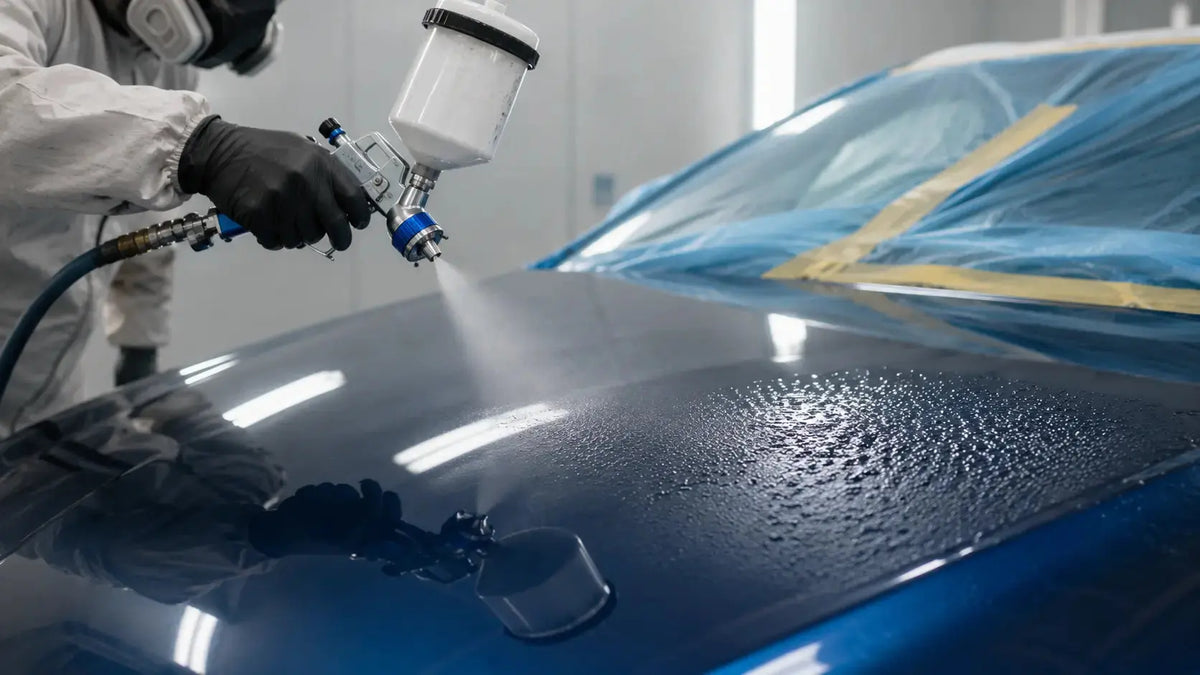
You've just pulled a freshly cleared panel from the booth, stepped back to admire your work, and spotted them — tiny bubbles, pinprick craters, or small imperfections scattered across the surface. No matter what you adjust — flash times, gun settings, or reducer ratios — the problem keeps coming back. If you've eliminated all the usual suspects, there's one culprit that often goes overlooked: moisture in your compressed air.
What Is Solvent Pop?
Solvent pop occurs when trapped solvent vapors or gases in the wet paint layer escape rapidly as the paint cures, leaving behind small craters, pinholes, or blisters on the surface. The defect typically appears as tiny bubbles or groups of pinholes that can ruin an otherwise flawless finish. For the related air and spray-control checks, follow our guide to fixing HVLP finish inconsistency .
While solvent pop is commonly associated with improper drying times, excessive film thickness, or using the wrong reducer, moisture contamination is a surprisingly common — and frequently overlooked — cause.
The Short Answer: Yes, Moisture in Air Can Cause Solvent Pop
The answer is yes — moisture in your compressed air can absolutely cause solvent pop. In fact, excess moisture is one of the most insidious causes of the defect because it's invisible, difficult to diagnose, and often dismissed by painters who assume their air supply is clean.
When compressed air contains water vapor or liquid water droplets, several things happen:
-
Moisture mixes with the paint: Water droplets become entrained in the paint as it's sprayed, creating pockets of moisture within the wet film.
-
Water reacts with solvents: Excess moisture in the air can react with the solvents in the clearcoat, creating gas bubbles that become trapped as the clearcoat cures.
-
Evaporation slows down: High humidity in the air — whether from the environment or the compressed air supply — slows the evaporation of solvents from both solvent-borne and waterborne paints. This can lead to solvent popping, poor curing, and sagging.
-
Water gets trapped under the film: When it's humid, water molecules in the air can become trapped under the refinishing coating, causing blistering and bubbling.
The result? Small craters, bubbles, or imperfections that look exactly like solvent pop — but are actually caused by moisture.
How Moisture Gets Into Your Compressed Air
Compressed air always contains some level of moisture. Here's why:
-
Atmospheric humidity: The air your compressor pulls in contains water vapor. When that air is compressed, the water vapor concentrates and can condense into liquid water.
-
Compression heat: As air is compressed, it heats up. As it cools downstream, moisture condenses out of the air stream.
-
Inadequate drying: Without an aftercooler or air dryer, your compressor simply can't remove enough moisture to provide clean, dry air for painting.
If you're running a compressor without an aftercooler or air drier setup, moisture in your air lines is almost guaranteed — especially in humid environments. Small pumps with small tanks are particularly prone to this problem because the air runs hot and full of moisture.
Solvent Pop vs. Other Moisture-Related Defects
Moisture contamination can cause several different types of paint defects. Understanding the difference helps with diagnosis:
In practice, these defects can overlap. Moisture can cause solvent pop directly, or it can cause blistering that looks similar. The key is that moisture in your air supply is a common thread across all of them.
How to Diagnose Moisture-Related Solvent Pop
If you're seeing small bubbles or pinholes and can't find another explanation, run through this diagnostic checklist:
1. Check Your Air Supply
-
Drain your compressor tank: Open the drain valve at the bottom of the tank. If water comes out, you have moisture in your system.
-
Check your air lines: Look for condensation on the outside of your air hoses. If moisture is visible on the outside, it's likely inside as well.
-
Test with a moisture indicator: Use a moisture test kit or a simple spray test — spray a clean piece of glass or metal with air from your gun. If moisture droplets appear, you have a problem.
2. Rule Out Other Causes
Before blaming moisture, eliminate these common solvent pop causes:
-
Too thick application: Are you applying heavy coats instead of multiple medium-wet coats?
-
Wrong reducer: Are you using a reducer that's too fast or too slow for the ambient temperature?
-
Incorrect air pressure: Is your compressed air pressure too low or too high? For the related air and spray-control checks, follow our guide to spray gun air pressure regulation .
-
Spraying too close or too far: Is your gun distance correct?
3. Look for Patterns
Moisture-related defects often appear intermittently — worse on humid days, better on dry days. If your solvent pop comes and goes with the weather, moisture is likely the culprit.
4. Check the Spray Environment
High humidity in the spray booth itself can also cause problems. If the air in your booth is too humid, it slows solvent evaporation and can lead to solvent popping.
How to Fix Solvent Pop Caused by Moisture
If the Paint Is Still Wet
If you catch the problem immediately — while the paint is still wet — you may be able to salvage the job:
-
Increase flash time: Allow more time between coats for solvents and moisture to escape.
-
Reduce film thickness: Apply lighter coats to minimize trapped material.
-
Improve airflow: Ensure proper booth ventilation to help solvents and moisture evaporate.
-
Check your air supply: Stop and address any moisture problems before continuing.
If the Paint Has Cured
Once the paint has cured, the only fix is sanding and repainting:
-
Assess the depth: If the solvent popping is on the surface only (micro-popping), sanding and buffing may sometimes remove it. If it's beneath the surface, the entire area must be sanded, primed, and repainted.
-
Block sand the affected area: Use 600-800 grit to level the surface.
-
Progress through finer grits: Move to 1000, 1500, then 2000.
-
Prime and repaint if necessary: For extensive solvent pop, sand the panel and reapply primer, basecoat, and clearcoat.
Important: If you don't fix the underlying moisture problem, the new paint will suffer the same defects.
Preventing Moisture-Related Solvent Pop: A Pro's Checklist
1. Install Proper Air Drying Equipment
An aftercooler or air dryer is essential for automotive painting. Options include:
-
Aftercooler: Cools compressed air after the compressor, causing moisture to condense out before it reaches your lines.
-
Refrigerated air dryer: Removes moisture by cooling the air to below its dew point.
-
Desiccant bead dryer: Absorbs moisture from the air stream — ideal for final-stage drying.
-
Inline water separator: A filter that removes liquid water from the air line.
2. Drain Your Compressor Regularly
Make it a habit to drain your compressor tank every day you're painting. Open the drain valve at the bottom of the tank and let any accumulated water escape.
3. Use Multiple Water Separators
A single water trap may not be enough. Consider a staged approach:
-
Primary separator: At the compressor outlet.
-
Secondary separator: At the wall outlet or near the gun.
-
Gun-mounted filter: A small inline filter at the spray gun for final protection. For the related air and spray-control checks, follow our guide to diagnosing common spray gun problems .
4. Monitor Humidity Levels
If you're painting in a high-humidity environment, consider:
-
Using a dehumidifier in your paint booth.
-
Painting during low-humidity times of day.
-
Using slower reducers to compensate for high humidity.
5. Test Your Air Supply Regularly
Before every painting session, test your air supply:
-
Blow air onto a clean piece of glass or metal.
-
Look for moisture droplets.
-
If you see any, stop and address the moisture problem before you start spraying.
6. Use Proper Spray Technique
The Equipment Factor: Why Your Spray Gun Matters
Even with clean, dry air, a poorly performing spray gun can create conditions that lead to solvent pop. Inconsistent atomization can leave uneven film thickness — heavy spots that trap solvents and moisture. Unreliable fluid control can make it difficult to apply the correct coat weight, increasing the risk of solvent pop.
For painters who want consistent, predictable results, the PORPHIS PRD-815 is engineered to deliver. Featuring MP (Multi-Point) atomization technology and a versatile 1.2/1.3mm nozzle set, the PRD-815 produces an exceptionally even spray pattern that eliminates the "hot center / thin edges" problem common with standard nozzles. The result is uniform film thickness across the entire panel — no heavy spots waiting to trap solvents and moisture.
The PRD-815 operates at 23-31 PSI with an air consumption of just 10.2 CFM, making it compatible with a wide range of professional compressors. Its responsive air regulation system and precise fluid control allow you to dial in the exact settings for each job and replicate them consistently.
When your equipment delivers predictable atomization and fluid delivery, you can focus on technique — and on ensuring your air supply is clean and dry.
Frequently Asked Questions
Can moisture in air cause solvent pop?
Yes. Excess moisture in compressed air can mix with paint solvents, create gas bubbles, and cause solvent pop. High humidity also slows solvent evaporation, increasing the risk.
How do I know if moisture is causing my solvent pop?
Look for patterns. If the problem worsens on humid days, or if you see water droplets when you test your air supply on a clean surface, moisture is likely the cause. Also check your compressor tank — if water drains out, you have moisture in your system.
Do I really need an air dryer for automotive painting?
Yes. An aftercooler or air dryer is essential for professional automotive painting. Without proper drying equipment, moisture in your compressed air will cause paint defects — including solvent pop, fish eyes, and blistering.
What's the difference between solvent pop and fish eyes?
Solvent pop appears as tiny bubbles or pinholes caused by trapped gases escaping from the paint film. Fish eyes appear as small, crater-like spots where the paint has been repelled from the surface, typically by oil, wax, or silicone contamination.
Can I fix solvent pop without repainting?
If the solvent pop is on the surface only (micro-popping), you may be able to sand and buff it out. But if the defects are deep or extensive, you'll need to sand the panel and repaint. Either way, fix the underlying moisture problem first.
How often should I drain my compressor tank?
Every day you're painting. Moisture accumulates in the tank continuously. Draining it daily prevents water from being pushed into your air lines.
Does high humidity in the booth cause solvent pop?
Yes. When the air in the spray booth is too humid, it slows the evaporation of both solvent-borne and waterborne paints. This can lead to poor curing, sagging, and solvent popping.
Conclusion
Moisture in compressed air can and does cause solvent pop. It's not the only cause — but it's one of the most overlooked, and one of the most frustrating because it's invisible until the damage is done.
The good news is that moisture-related solvent pop is entirely preventable. Install proper air drying equipment, drain your compressor daily, use multiple water separators, and test your air supply before every painting session. When you eliminate moisture from your air lines, you eliminate a major source of paint defects.
And when your air is clean and dry, a quality spray gun like the PORPHIS PRD-815 ensures that your paint goes down evenly and consistently — reducing the risk of solvent pop from the application side as well. Clean air, proper technique, and reliable equipment: that's the formula for a flawless finish.
Share:
Clear Coat Runs Driving You Crazy? Here's How to Stop Them for Good
How to Remove Rattle Can Paint Without Damaging the Original Paint