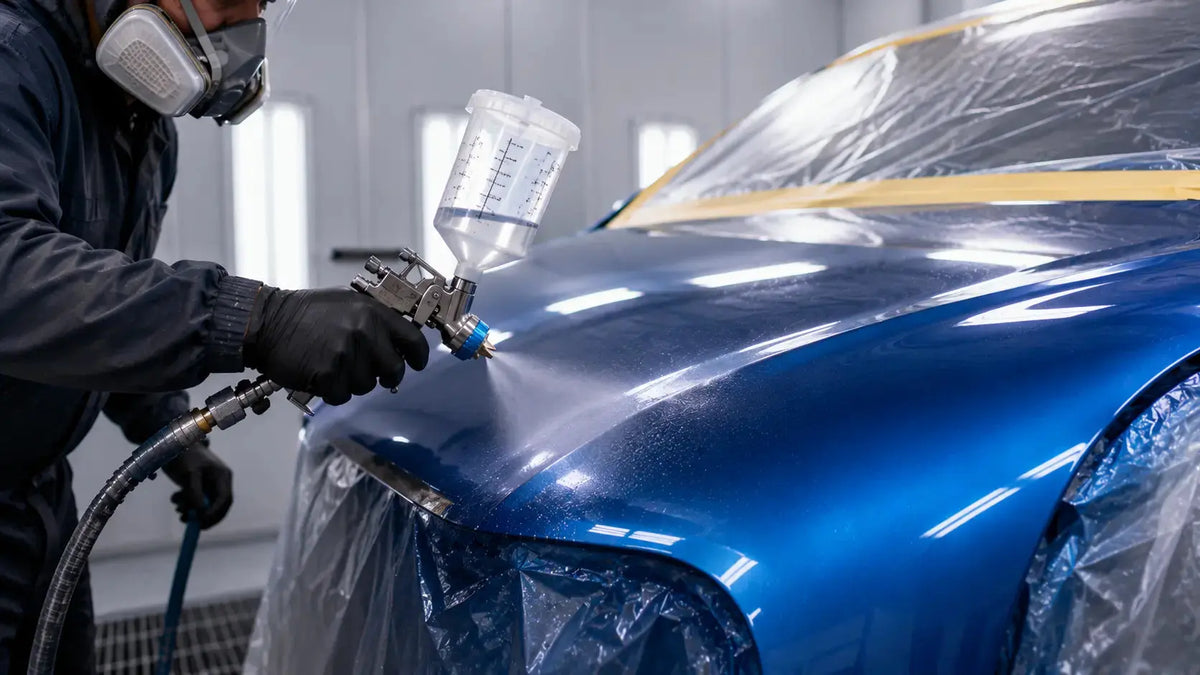
In many automotive basecoat/clearcoat systems, the answer is yes. A 1K color base followed by a catalyzed 2K clear is a normal refinishing process.
But that answer needs an important qualifier: not every product sold as '1K paint' is the same thing. A dedicated automotive basecoat designed to receive clear is very different from a general-purpose aerosol enamel, lacquer, or unknown single-component coating.
The safest question is not simply, 'Is it 1K?' It is, 'Is this exact base coat approved for this exact 2K clear, and am I still inside the correct recoat window?'
First, Identify What Kind of 1K Coating You Have
A professional 1K basecoat is usually designed to provide color and then be protected by clear. It dries mainly through solvent or water evaporation and remains relatively thin.
A 1K topcoat, aerosol enamel, lacquer, or repair paint may behave differently. Some can react when a strong 2K clear is applied over them, especially if the lower layer is not fully flashed or the solvent package is aggressive.
If the products are from different systems, the labels are unclear, or the repair is over an unknown old finish, treat compatibility as unconfirmed until you check the technical data sheets and spray a test panel.
When 2K Clear Over 1K Base Usually Works
- The 1K base is an automotive basecoat intended for a clear-coated system.
- The base and clear are approved as compatible by the manufacturer or paint system.
- The base has flashed evenly and no wet or trapped solvent remains.
- The clear is applied inside the stated recoat window.
- The surface has not been contaminated by fingerprints, wax, silicone, dust, or moisture.
- Mixing ratio, reducer/hardener choice, booth temperature, and film build follow the product instructions.
If those conditions are met, a 1K base with 2K clear is not an unusual combination. It is how many modern refinishing systems are designed to work.
Why 2K Clear Wrinkles, Lifts, or Peels
The base was still too wet: A wet base can trap solvent. The first clear coat may disturb the color layer or slow the cure, leading to wrinkling, solvent pop, or weak adhesion.
The recoat window was missed: If the base sits too long, the clear may not achieve the intended chemical or mechanical bond. Some systems require a scuff, fresh base, or sealer after the window closes.
The lower coating was not compatible: A strong 2K clear can attack an unknown aerosol, enamel, lacquer, or poorly cured repair layer.
The surface was contaminated: Silicone, oil, dust, or fingerprints can create localized adhesion failure that shows up later as peeling or delamination.
The clear was applied too heavily: Heavy first coats can load the surface with solvent and disturb a sensitive base. They also slow solvent release.
The 2K clear was mixed incorrectly: Wrong hardener, reducer, or mixing ratio can create poor cure, soft film, gloss loss, or reduced durability.
How Long Should 1K Base Coat Dry Before 2K Clear?
There is no universal number. Some automotive basecoats may be ready after a short flash under controlled booth conditions, while other products need more time. Temperature, airflow, humidity, coat thickness, reducer choice, and the paint system all change the answer.
Do not judge only by the clock. Look for an evenly flashed surface with no wet areas, and follow the minimum and maximum clear-coat window in the technical data sheet.
If you are working with an aerosol or an unfamiliar 1K coating, 'touch dry' does not necessarily mean safe to clear. A test panel is much cheaper than stripping a wrinkled hood or bumper.
A Simple Compatibility Checklist Before Clearing
- Confirm the exact product name and whether it is intended to be clear coated.
- Read the base coat and clear coat technical data sheets, including compatible substrates and recoat windows.
- Use the recommended hardener and reducer for the booth temperature.
- Spray a test panel using the same base film build, flash time, and clear coat process planned for the vehicle.
- Watch the test panel for lifting, wrinkling, color movement, soft film, or slow cure.
- Only proceed on the vehicle after the system behaves normally.
A Practical Base-and-Clear Workflow
- Finish bodywork and primer sanding, then clean the panel according to the paint system instructions.
- Apply the 1K base in controlled coats. Build hiding without flooding the surface.
- Allow each coat to flash. Do not chase color coverage with one heavy wet coat.
- After the final base coat, wait for the specified flash and confirm the surface is uniformly ready.
- Apply the 2K clear using the manufacturer’s recommended coat count and flash time.
- Allow the clear to cure before sanding, polishing, assembly, or exposure to harsh chemicals.
Does Compressor Size Matter?
It matters more as the panel gets larger. A small compressor may handle a mirror, trim part, or spot repair, but it can struggle to maintain pressure and airflow across a full hood, door, or quarter panel.
If the air supply falls during the pass, atomization and fan width can change. That creates dry areas, uneven gloss, or inconsistent film build. Check the spray gun's real air-consumption requirement and make sure the compressor can sustain it, not just reach the target pressure for a few seconds.
Where Spray Gun Choice Fits In
Compatibility and flash time come first. A better spray gun cannot make incompatible coatings bond.
Once the material system is correct, however, stable atomization helps the painter apply the base evenly and lay the clear with a controlled wet edge. That is especially useful on larger panels, where one dry pass can remain visible across the entire repair.
The PORPHIS PRD-815 MP Spray Gun is designed for automotive base and clear applications. Its 1.2 mm and 1.3 mm nozzle options allow the setup to be matched to the material, while the stable pattern supports consistent film build across a panel.
Use it as part of a controlled process, not as a substitute for TDS instructions, proper flash time, or a compatibility test.
Recommended Product: PORPHIS PRD-815 MP Spray Gun


Frequently Asked Questions
Can you put 2K clear over 1K base coat?For the next clear-coat decision in this process, see our guide to 1K vs. 2K clear coat.
Yes, when the 1K product is a compatible automotive basecoat designed to receive clear and the application follows the paint system instructions.
Can I spray 2K clear over 1K aerosol paint? For the next clear-coat decision in this process, see our guide to 1K vs. 2K automotive paint.
Sometimes, but compatibility varies widely. Check both product data sheets and test the exact combination on a sample panel first.
Why did my 2K clear wrinkle the base coat?For the next clear-coat decision in this process, see our guide to 2K clear coat safety guide.
The base may have been too wet, the clear may have been applied too heavily, or the solvent package may have attacked an incompatible lower coating.
Why is the clear peeling off the base?
Common causes include contamination, missed recoat windows, insufficient flash, incompatible materials, or an unstable coating underneath.
How long should I wait before clearing 1K base?
Use the product’s stated flash and recoat window. Drying time changes with temperature, airflow, film thickness, and paint chemistry, so a universal time is unreliable.
Can a better spray gun prevent peeling?
No. It can improve application consistency, but peeling is usually a preparation, compatibility, contamination, or recoat-window problem.
Final Thoughts
Applying 2K clear over 1K base is common, but the labels '1K' and '2K' do not tell the whole story. The exact products, flash time, recoat window, film build, and existing substrate determine whether the system will work.
When in doubt, read the technical data sheets and test the combination before spraying the vehicle. That small step is far more reliable than assuming every single-component paint will tolerate every catalyzed clear.
Share:
Pearl White Paint Matching: How to Control a Tri-Coat Blend
Clear Coat Still Soft? How to Diagnose a 2K Clear That Won’t Cure