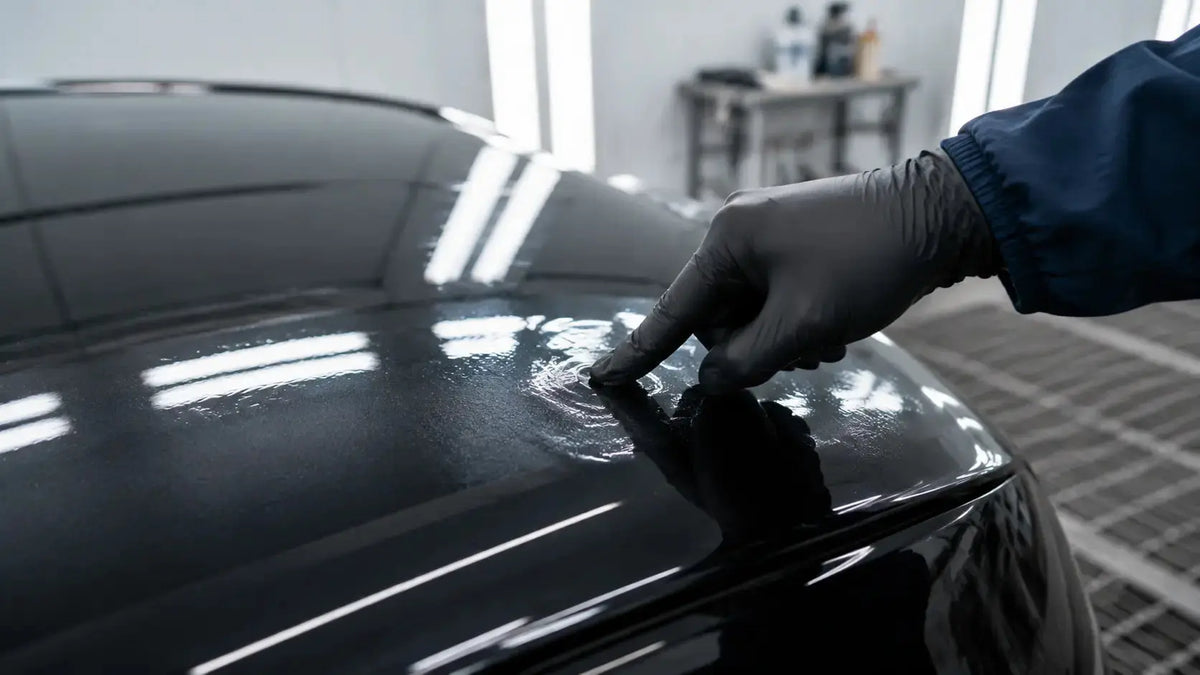
A clear coat that feels soft the next morning is not automatically a failed paint job. For the next clear-coat decision in this process, see our guide to 2K clear coat safety guide .A clear coat that is still rubbery after the product's stated cure time is a different matter. The difficult part is knowing which situation you are dealing with before you wait too long, sand too early, or spray another coat over a film that never cured correctly.
Start with the technical data sheet for the exact clear, hardener, and reducer you used. Terms such as dust-free, touch-dry, polishable, and fully cured do not mean the same thing. The time also depends on the product, film build, material temperature, panel temperature, airflow, and whether the finish was air-dried or baked.
|
First rule: Do not add more hardener to the surface, spray fresh clear over a soft film, or force-bake the panel unless the coating manufacturer specifically approves that process. |
Is the Clear Actually Uncured?
|
What You See |
What It May Mean |
First Check |
|
Surface is dry but can be lightly marked within the early TDS window |
The clear may still be progressing from touch-dry to full cure. |
Compare elapsed time, panel temperature, and cure schedule with the TDS. |
|
Whole panel remains rubbery or wipes/scrapes easily after the stated cure time |
Mixing ratio, activator condition, product compatibility, or temperature is likely wrong. |
Check the leftover material in the mixing cup and review every component used. |
|
Only heavy areas, edges, or sags stay soft |
Excessive film build or insufficient flash may have trapped solvent. |
Compare coat thickness and flash time with a normally sprayed area. |
|
Clear is hard in the cup but soft on the panel |
The mix may be capable of curing; look harder at film build, substrate, temperature, and contamination. |
Record panel temperature, coat count, flash, and substrate condition. |
The Mixing-Cup Check: A Fast Diagnostic Clue
Whenever possible, keep a small amount of mixed clear in the cup or on a labeled test card. It gives you a useful comparison later.
- If the leftover material is also soft: suspect the ratio, wrong hardener, expired or moisture-damaged activator, incompatible reducer, or contaminated mixing tools.
- If the leftover material cured but the panel did not: look at panel temperature, film build, flash time, substrate, and localized contamination.
- If both are slowly getting harder: the environment may have slowed the cure, but only wait longer if the TDS and material supplier support that decision.
This is not a laboratory test, but it is more useful than relying on a fingernail mark alone.
Five Causes to Check—In the Right Order
1. The Ratio or Measuring Method Was Wrong
Two-component clear must be mixed exactly as the manufacturer specifies. Do not assume the product is 2:1 or 4:1 because another clear used that ratio. Also confirm whether the ratio is by volume or by weight; the numbers are not automatically interchangeable.
- Use the matching ratio marks on a clean mixing cup, or a scale only when the TDS supplies weight data.
- Add components in the order specified by the manufacturer.
- Do not add “a little extra hardener” to make the clear cure faster. An off-ratio mixture can cure poorly in either direction.
2. The Activator or Reducer Was Wrong, Old, or Contaminated
A correct-looking mix can still fail if the activator belongs to another product line, has exceeded its shelf life, has absorbed moisture, or was stored with a damaged cap. The same applies to an incompatible reducer or a contaminated mixing container.
If two different clear coats failed in the same workspace, do not immediately blame both clears. Look for a shared variable: the same hardener, reducer, mixing cup, cleaning solvent, gun, air line, or storage condition.
3. The Material or Panel Was Too Cold
The air may read 20°C while the metal panel, clear, and hardener are colder. Chemical cure slows as temperature falls, and a cold panel can stay below the air temperature for a long time. Measure the panel, not just the room.
Use the hardener speed and cure schedule approved for the actual temperature. Do not improvise with heaters or a bake cycle that exceeds the product instructions.
4. The Coats Were Too Heavy or Flashed Too Quickly
A heavy wet film can skin over while solvent remains underneath. The surface may look glossy and dry first, yet the lower part of the film stays soft. Heavy edges, sags, and overlap zones often reveal this problem before the rest of the panel.
- Follow the specified number of coats and flash indicators—not a generic clock time.
- Choose the correct reducer and hardener speed for the booth temperature and panel size.
- Keep gun distance, overlap, speed, and fluid delivery consistent so one part of the panel is not carrying twice the intended film.
5. The Substrate or Prep System Was Incompatible
Contamination can cause localized soft spots, fisheyes, adhesion loss, or irregular cure. Silicone, wax, grease, uncured filler, incompatible aerosol products, and residue from cleaning materials all deserve investigation.
However, when the entire panel is uniformly rubbery, check the ratio, activator, and temperature before treating contamination as the main explanation.
What to Do Next
|
Situation |
Recommended Action |
|
Still within the TDS cure window and becoming steadily harder |
Maintain the approved temperature and ventilation. Recheck only at the next TDS milestone. |
|
Past the stated cure time, but the supplier says the low-temperature schedule is longer |
Follow the supplier’s documented recovery or extended cure guidance. |
|
Still rubbery, transferable, or easily scraped after the approved cure schedule |
Stop. Do not topcoat. Contact the coating supplier and plan removal according to its recommendation. |
|
Only localized defects remain soft |
Map the affected area, identify the shared substrate/prep product, and repair only after the cause is understood. |
|
Uncertain about removal or exposure control |
Use a qualified body shop. Uncured 2K material can remain chemically hazardous and is difficult to sand cleanly. |
What Not to Do
- Do not spray another coat of clear over a film that is still soft.For the next clear-coat decision in this process, see our guide to 2K clear coat over 1K base coat.
- Do not wipe extra hardener onto the surface.
- Do not assume heat will repair an off-ratio mix.
- Do not polish or assemble parts simply because the surface is dust-free.
- Do not dry-sand uncured material without a removal plan, suitable extraction, PPE, and guidance from the coating manufacturer.
How the Spray Gun Fits Into the Diagnosis
A spray gun cannot fix the chemistry of a 2K clear.For the next clear-coat decision in this process, see our guide to 1K vs. 2K clear coat. It cannot correct a wrong ratio, revive an expired activator, or make an incompatible product system cure.
What it can do is help the painter apply a more uniform film. The PORPHIS PRD-725 uses 1.3 and 1.4 mm configurations, a published 22–29 PSI working range, and 8.0 CFM air consumption. When matched to the coating TDS and a capable air supply, that control can reduce heavy zones and inconsistent film build—two application problems that can complicate curing.
Prevention Checklist for the Next Job
- Download the current TDS and SDS for the exact clear, hardener, and reducer.
- Confirm the ratio and whether it is measured by volume or weight.
- Check batch age, storage condition, caps, and product compatibility.
- Bring the panel and materials into the approved temperature range before mixing.
- Record panel temperature, booth temperature, humidity, reducer/hardener speed, coat count, flash, and bake schedule.
- Keep a labeled sample of the mixed clear for comparison.
- Use clean mixing tools, clean compressed air, proper filtration, and a spray gun setup that produces an even film.
- Use the PPE and ventilation specified in the SDS. Many 2K automotive coatings contain isocyanates and require serious respiratory and skin protection.
Frequently Asked Questions
Will soft clear eventually harden?
Sometimes a correctly mixed clear cures slowly in a cold environment. But an off-ratio or chemically compromised mix may never reach the intended hardness. Use the TDS timeline and material supplier guidance rather than a generic number of days.
Can I bake clear coat that is not curing?
Only if the product TDS provides an approved bake schedule and the cause is compatible with additional heat. Baking cannot reliably repair a wrong ratio, wrong activator, or incompatible material system.
Can I spray fresh clear over the soft layer?
No. A new coat does not create a stable foundation underneath. The uncured material must be diagnosed and, when required, removed before refinishing.
Why is the clear hard in the cup but soft on the panel?
That points away from a completely dead mixture and toward panel-specific variables such as film thickness, temperature, substrate, flash time, or contamination.
Does too much hardener make clear dry faster?
No reliable rule supports that shortcut. Use exactly the ratio stated for the product. Too much or too little hardener can change cure, flexibility, gloss, and durability.
Safety Note
|
Important: Uncured 2K clear may still contain reactive chemicals. Read the SDS, use the specified spray booth/ventilation and PPE, and avoid creating dust or vapor without proper exposure controls. NIOSH identifies polyisocyanates and solvents as hazards in automotive paint overspray. |
Final Takeaway
When clear coat will not cure, the fastest path is not to guess. Check the exact TDS, compare the panel with the leftover cup material, and work through the shared variables in order: ratio, activator and reducer, temperature, film build, and substrate compatibility.
If the film is beyond the approved cure schedule and remains rubbery, do not bury it under more material. Confirm the cause with the coating supplier, remove it using an approved process, and rebuild the finish on a stable foundation.
Share:
Can You Spray 2K Clear Coat Over 1K Base Coat?
Paint Adhesion Failure on Plastic Parts: Why It Peels and How to Fix It