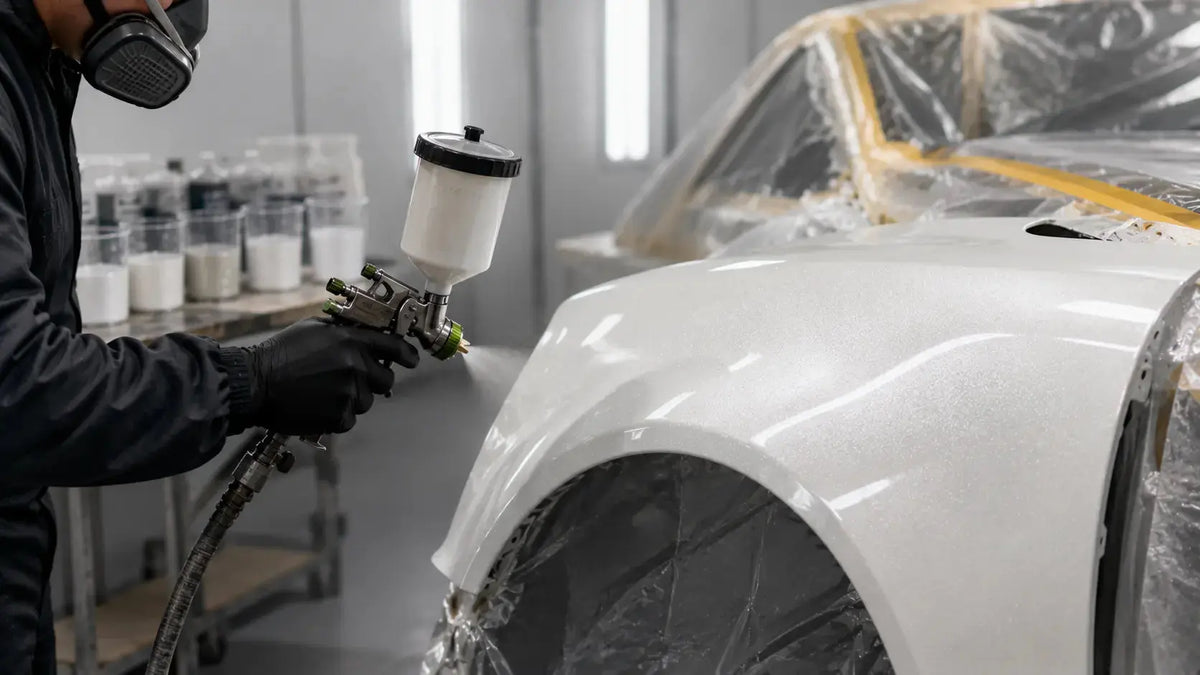
Pearl white can look perfect in the booth and completely wrong five minutes later in daylight. That is what makes it such an unforgiving color to repair.
The paint code may be correct. The formula may be mixed correctly. The base may even look close on a spray-out card. But if the pearl mid-coat is one pass heavier than the original finish, the repaired panel can turn darker, warmer, cooler, or more yellow depending on the viewing angle.
That is why pearl white paint matching is less about finding one 'correct' formula and more about controlling the entire process: the ground color, the number of pearl passes, the overlap, the gun distance, the blend area, and the lighting used to judge the result.
Why the Paint Code Is Only the Starting Point
A factory paint code tells you which formula family to start with. It does not guarantee that a fresh mix will match a vehicle that has spent years in sunlight, been polished repeatedly, or had an earlier repair.
Two cars with the same code can also show different production variants. On top of that, pearl white changes with film thickness. The same material can look different simply because one painter applied two light pearl coats and another applied three wetter passes.
For that reason, experienced refinishers do not go straight from the mixing room to the vehicle. They make spray-out cards first.
Understand What the Three Layers Are Doing
Most pearl white tri-coat systems are built from three visually important stages: Ground coat or base color:
- usually a solid or slightly tinted white that establishes brightness and hiding.
- Pearl mid-coat: a translucent layer that changes depth, warmth, face color, and flop as more material is applied.
- Clear coat: protects the finish and adds gloss, but can also deepen the final appearance slightly.
The pearl layer is where most matches are won or lost. It is translucent, so every additional pass changes what you see underneath. One extra pass across the repair area can create a visible island even if the base formula is correct.
Start With Spray-Out Cards, Not Guesswork
Before touching the vehicle, prepare several spray-out cards using the same gun, pressure, reducer, booth conditions, and technique you plan to use on the repair.
Keep the ground coat consistent, then vary only the number of pearl passes. A practical set might include one card with one pearl coat, one with two coats, and one with three. Label them clearly and clear coat the cards if the system requires it for an accurate comparison. For more control over metallic or pearl orientation, see our guide to pearl color shift between clear coat layers.
Check the cards beside the vehicle under booth light, natural daylight, and at different angles. Pearl can match face-on and still be wrong from the side.
A Practical Pearl White Blending Process
- Repair and prime the damaged area, then sand and clean the full blend zone according to the paint system instructions.
- Apply the white ground coat only far enough to achieve hiding over the repair. Avoid carrying a heavy white edge farther than necessary.
- Extend the final ground coat passes gradually so the transition is soft rather than ending at a hard line.
- Apply the pearl mid-coat with the same pressure, distance, speed, and overlap used on the selected spray-out card.For more control over metallic or pearl orientation, see our guide to vertical spraying and pressure control.
- Fade each pearl pass farther into the blend area while keeping the center of the repair from becoming too heavy.
- Stop and inspect before adding another pearl pass. Once the repair becomes too dark or too pearl-heavy, the only real correction may be to restart the color stage.
- Clear the full panel or the planned clear area according to the paint manufacturer and repair procedure.For more control over metallic or pearl orientation, see our guide to metal flake paint and spray tip guide.
Spray the Pearl Mid-Coat Like a Controlled Test
Pearl white rewards consistency more than aggression. A painter who changes gun distance halfway across the panel can change the color even when the material mix stays the same.
Keep your passes parallel, maintain a steady speed, and use the overlap that produced the correct spray-out card. Do not chase coverage with a wet pearl coat. The mid-coat is there to build an effect, not to hide the panel like a solid base.
If the pearl looks patchy, the answer is not always another full coat. Sometimes a light, controlled orientation pass is enough. Follow the paint system's technical data sheet rather than improvising a universal technique.
Why Blending the Adjacent Panel Often Looks Better
A butt match at the panel edge asks the repaired color to match the original finish perfectly. With pearl white, that is often unrealistic.
Blending spreads a small color difference over a larger area so the eye sees a gradual transition instead of a sharp change. On many repairs, extending the base and pearl into the neighboring panel is the difference between a repair that looks acceptable in the booth and one that still looks correct in the parking lot.
The exact blend plan depends on the damaged area, panel shape, paint system, and shop procedure. Always confirm the repair method before spraying.
Common Reasons a Pearl White Repair Still Looks Wrong
Too much pearl over the repair: The center becomes darker or more yellow than the surrounding finish.
Different technique from the spray-out card: Changing pressure, distance, overlap, or speed changes pearl orientation and film build.
Judging under one light source: A repair may look acceptable under booth lamps but fail in sunlight or shade.
Skipping the spray-out card: The vehicle becomes the test panel, which is an expensive way to discover the wrong coat count.
Trying to stop at a hard edge: Even a close formula can become obvious when the transition ends abruptly at a panel gap.
Where Spray Gun Consistency Fits In
A spray gun cannot correct the wrong variant or replace spray-out cards. What it can do is help you repeat the application that produced the correct card.
For pearl work, the fan pattern needs to stay stable from one pass to the next. Material delivery should be predictable, especially during the mid-coat fade where small changes can alter the final color.
The PORPHIS PRD-815 MP Spray Gun is a practical option for painters who want one platform for base, pearl mid-coat, and clear coat work. Its 1.2 mm and 1.3 mm nozzle options allow the setup to be matched to the material, while the stable pattern supports more repeatable passes across the blend area.
It is not a shortcut to a perfect match. The match still comes from the formula, spray-out card, coat count, and technique. The gun simply makes that technique easier to repeat.
Recommended Product: PORPHIS PRD-815 MP Spray Gun
 |
 |
Frequently Asked Questions
Why is pearl white so hard to match?
Because the final color is created by several layers. The number and thickness of pearl mid-coat passes can change the color even when the base formula is correct.
How many coats of pearl mid-coat should I apply?
Use the coat count that matches your spray-out card and the paint manufacturer’s procedure. There is no universal number that works for every formula and painter.
Can I spot repair pearl white without blending?
Very small repairs may be possible, but blending usually hides small differences more effectively than trying to stop the color at a hard edge.
Why does the repair match indoors but not outside?
Pearl pigments respond strongly to light source and viewing angle. Always evaluate spray-out cards and the completed repair in more than one lighting condition.
Does a better spray gun guarantee a color match?
No. A stable gun helps you repeat your technique, but it cannot correct the wrong formula, coat count, or blend plan.
Final Thoughts
Pearl white paint matching is a process of controlled variables. The formula matters, but so do the spray-out card, ground coat coverage, pearl coat count, gun distance, overlap, and lighting.
Take the time to prove the match on cards before spraying the vehicle. Build the pearl slowly, blend far enough to soften the transition, and stop before the repair becomes too heavy. That approach may feel slower at the beginning, but it is much faster than repainting a panel that only looked correct under booth lights
Share:
How Long Does Clear Coat Last in the Sun? UV Damage, Oxidation, and Protection
Can You Spray 2K Clear Coat Over 1K Base Coat?