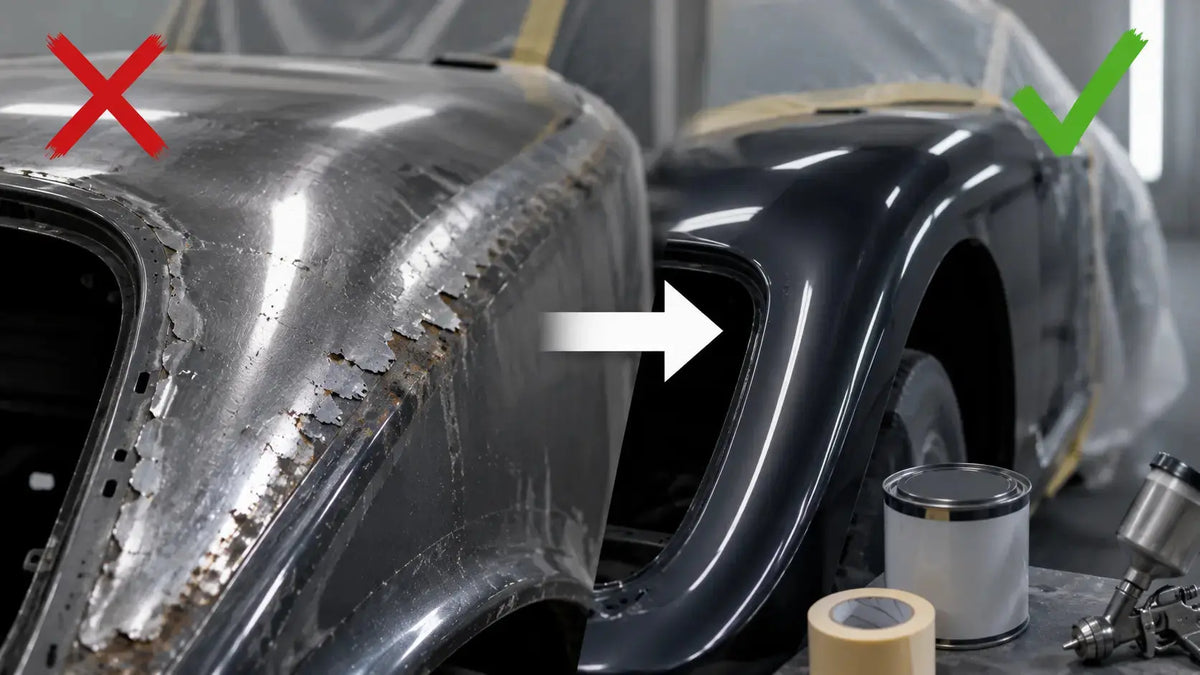
If you're staring at a rusty truck, a stripped project car, or a panel that's seen better days, the thought might have crossed your mind: Why not just sand it down to bare metal and spray clear coat over it? It seems like a quick, cheap way to buy some time—a temporary barrier against the elements until you can afford a proper paint job.
It's a tempting shortcut. But here's the hard truth: clear coat over bare metal is a terrible idea that will almost certainly make your problems worse. Here's why—and what you should do instead.
Why Clear Coat Over Bare Metal Fails
1. Clear Coat Doesn't Stick to Bare Metal Properly
Clear coat is formulated to bond to a prepared substrate—typically a basecoat or a properly primed surface. When applied directly to bare metal, it lacks the mechanical and chemical adhesion it needs to form a durable, lasting bond.
Even with an adhesion promoter, there's still a reasonable chance of the coating failing. The clear may adhere initially, but over time, it will lift, peel, or flake away from the metal surface. Some users report that urethane clear will stick "OK" to bare metal, but it's a compromise at best.
2. Rust Will Form Underneath—Even If You Can't See It
This is the most insidious problem. Clear coat is not a rust inhibitor. It does not contain the anti-corrosive properties of a proper primer. If you apply clear coat directly to bare steel, the metal will continue to oxidize underneath the clear film.
Here's what happens:
-
The clear coat creates a barrier that traps moisture against the metal.
-
Rust begins to form at the metal-clear interface.
-
Because the clear is transparent, you may not see the rust immediately—but it's there, spreading.
-
Over time, the rust will creep under the edges of the clear, causing it to lift and peel.
One experienced painter summarized it bluntly: "Clear coat is not meant to be applied to bare metal, plain and simple".
3. It's a Temporary Illusion, Not a Permanent Fix
Clear coating bare metal is mostly a show car trick—something that looks great in a climate-controlled garage but falls apart in the real world. The moment you get a stone chip or a scratch, that imperfection becomes an entry point for moisture. Rust will start at that chip and spread outward under the clear, eventually destroying the panel.
4. The Clear Coat Itself Will Degrade
Even if you could solve the adhesion and rust problems, the clear coat itself would be vulnerable. Most clear coats are not designed to be the only layer of protection on bare metal. They can yellow with age, oxidize, and become brittle when exposed to UV light and the elements. Epoxy clears, while they stick better to metal, will oxidize and turn dull and chalky in the sun.
What's the Correct Way to Protect Bare Metal?
If you want to protect bare metal from rust and prepare it for a durable finish, there's no shortcut. You need to follow the proper refinishing process:
Step 1: Treat the Bare Metal
Before applying any primer, the bare metal surface needs to be properly prepared. This means:
-
Degreasing to remove any oil, wax, or contaminants.
-
Sanding or media blasting to create a clean, uniformly abraded surface.
-
Applying a metal treatment, such as a phosphoric acid metal conditioner, to etch the surface and provide a corrosion-resistant layer.
Step 2: Apply an Epoxy Primer
Epoxy primer is the foundation of any durable refinish job on bare metal. It's specifically designed to be applied "direct-to-metal" (DTM) and provides:
-
Superior adhesion to bare steel, aluminum, and other metals.
-
Excellent corrosion resistance that prevents rust from forming under the paint.
-
A sealed, stable base for subsequent layers of primer, basecoat, and clearcoat.
Epoxy primers can fill coarse sand scratches and provide a cushion against stone chips. They're the industry standard for a reason.
Step 3: Apply Primer, Basecoat, and Clearcoat
Once the epoxy primer is cured, you can proceed with the rest of your paint system:
-
Primer surfacer (if needed) to fill minor imperfections.
-
Basecoat to provide color.
-
Clearcoat to provide gloss, UV protection, and durability.
Each layer serves a specific purpose. Skipping any of them—especially the primer—compromises the entire system.
What If You Just Need a Temporary Fix?
The user in the original post was looking for a temporary solution—something to slow down rust until they could afford a proper paint job. If that's your situation, here are better alternatives than clear coating bare metal:
Option 1: Use a Rust-Converting Primer
Products like POR-15 or Rust-Oleum's rust-converting primers are designed to be applied directly over rust. They chemically convert rust into a stable, paintable surface and provide a protective barrier. Some users report excellent success with POR-15 clear on metalwork that sits out in the weather permanently.
Option 2: Use an Epoxy Primer as a Temporary Seal
If you can't paint the whole vehicle right now, at least apply an epoxy primer to the bare metal areas. Epoxy primer provides real corrosion protection and can be topcoated later when you're ready. It's a much better temporary solution than clear coat.For the next clear-coat decision in this process, see our guide to diagnosing paint peeling after clear coat.
Option 3: Use a Quality Spray Can Primer
If you don't have spray equipment, a high-quality spray can primer (preferably an etch primer or epoxy primer) applied over clean, dry metal will provide better protection than clear coat. It won't look as glossy, but it will actually protect the metal instead of hiding the rust that's forming underneath.
The Equipment Factor: Why Proper Application Starts with the Right Spray Gun
Whether you're applying epoxy primer, basecoat, or clearcoat, the quality of your application equipment makes a significant difference in the final result. A spray gun that delivers inconsistent atomization or unreliable fluid control makes it difficult to achieve uniform film thickness—which is critical for both corrosion protection and a professional-looking finish.
For painters who need consistent, professional-grade results across the entire refinish process—from primer through clearcoat—the PORPHIS PRD-625 is engineered to deliver. Featuring MP (Multi-Point) atomization technology and a versatile 1.3/1.4mm nozzle set, the PRD-625 produces an exceptionally even spray pattern that eliminates the "hot center / thin edges" problem common with standard nozzles. This means you can achieve uniform coverage across the entire panel—critical for ensuring that your epoxy primer provides complete protection and that your topcoats lay down smoothly.
The PRD-625 operates at 23-31 PSI with an air consumption of just 10.2 CFM, making it compatible with a wide range of professional compressors. Its responsive air regulation system and precise fluid control allow you to dial in the exact settings for each job and replicate them consistently. When your equipment delivers predictable results, you can focus on technique—and on achieving a durable, professional finish that actually protects the metal underneath.
Whether you're spraying epoxy primer over bare metal or applying the final clearcoat, the PRD-625 gives you the control and consistency that professional results demand.
Frequently Asked Questions
Can I put clear coat directly on bare metal?
Technically yes, but it's a bad idea. Clear coat doesn't adhere well to bare metal, doesn't prevent rust, and will eventually fail—often with rust forming underneath the clear film.
What happens if you clear coat bare metal?
The clear coat may look good initially, but rust will eventually form underneath the clear. The rust will creep under the edges of any chips or scratches, causing the clear to lift and peel. The clear itself may also yellow or oxidize over time.
Can you use clear coat as a rust inhibitor?
No. Clear coat is not a rust inhibitor. It does not contain the anti-corrosive properties of a proper primer. Only a primer—especially an epoxy primer—provides the corrosion resistance needed to protect bare metal.
What's the best primer for bare metal?
Epoxy primer is the industry standard for bare metal. It provides superior adhesion, excellent corrosion resistance, and a stable base for subsequent layers of paint.For the related preparation and adhesion steps, use our guide to paint prep before base coat.
Can I just sand the rust off and clear coat it?
No. Sanding removes visible rust but doesn't prevent new rust from forming. Clear coat doesn't seal out moisture effectively on bare metal, and rust will return—often worse than before.
Is there any situation where clear coat over bare metal is acceptable?
Clear coat over bare metal is mostly a show car trick for vehicles that never see moisture, road salt, or stone chips. For any vehicle that will be driven outdoors, it's not recommended. Some specialty clear coats are formulated for bare metal (like Eastwood's Diamond Clear), but even these are better suited for interior or decorative applications rather than exterior automotive use.For the related preparation and adhesion steps, use our guide to automotive pre-paint cleaner comparison.
Conclusion
Clear coat over bare metal is a shortcut that leads to a dead end. It doesn't adhere properly, doesn't prevent rust, and will eventually fail—often with rust spreading underneath the clear, unseen until it's too late.
If you're dealing with bare metal on your vehicle, do it right: treat the metal, apply an epoxy primer, and then build your paint system from there. It takes more time and effort upfront, but it's the only way to ensure a durable, lasting finish that actually protects your vehicle.
And when you're ready to spray that primer, basecoat, or clearcoat, a quality spray gun like the PORPHIS PRD-625 ensures that every layer goes down consistently and professionally—giving you the results you deserve.
Share:
Paint Cracking After a Repaint? Here's Why — and How to Fix It for Good
How to Fix Paint Delamination on a Hood: Strip It or Repair the Damaged Area?