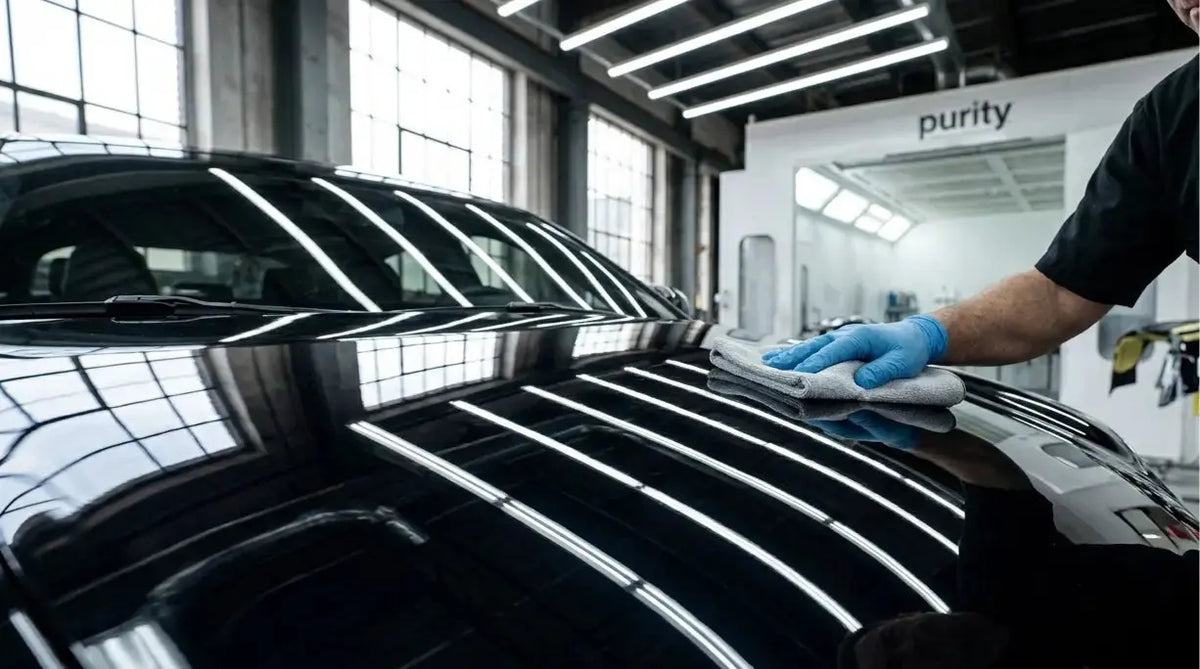
You’ve invested in a quality HVLP spray gun, mixed your paint correctly, and set up your compressor. But when you step back to inspect your work, the finish is anything but consistent. One area looks smooth and glossy; the next is dull, textured, or covered in what looks like tiger stripes. It’s frustrating—and it’s one of the most common complaints among automotive painters.
The truth is, HVLP finish inconsistency is rarely caused by a single factor. More often, it’s the result of multiple variables working against each other. This guide breaks down the most common causes of uneven HVLP finishes and provides step-by-step solutions to help you achieve the smooth, professional results you’re after.
What Does HVLP Finish Inconsistency Look Like?
Before you can fix the problem, you need to identify exactly what you’re dealing with. HVLP finish inconsistency can manifest in several ways:
-
Orange Peel: A textured surface that resembles the skin of an orange. The paint hasn’t flowed out properly before drying.
-
Tiger Stripes: Alternating light and dark bands across the panel, common with metallic and pearl paints.
-
Dry Spray: A rough, gritty texture, often appearing on edges or in areas where the gun was held too far from the surface.
-
Uneven Gloss: Some areas are shiny while others appear flat or hazy.
-
Sputtering or Spitting: Irregular paint delivery that creates spots or an inconsistent film.
Each of these defects points to a different underlying cause. Let’s diagnose them one by one.
The Most Common Causes of HVLP Finish Inconsistency
1. Incorrect Paint Viscosity
HVLP spray guns rely on airflow rather than high pressure to atomize paint. If your paint is too thick, it won’t break into fine particles. Instead, it lands on the surface in heavier droplets that don’t have enough time to level out before drying. The result is a textured orange peel finish that no amount of technique can fix.
The Fix: Always check viscosity with a viscosity cup before you start spraying. For most HVLP systems, a Zahn #2 reading of 20–30 seconds is the sweet spot. Follow your paint manufacturer’s recommended reduction ratio, but be prepared to adjust based on actual conditions—temperature, humidity, and the specific material all affect how paint behaves.
2. Wrong Reducer for the Conditions
Choosing the wrong reducer speed is one of the most common—and most overlooked—reasons for finish inconsistency. In warm conditions or when using a turbine system that produces warm air, a fast reducer causes paint to flash before it has time to flow out and level. The surface skins over while the material is still settling, locking in texture.
The Fix: Match your reducer to the temperature and your equipment. As a general rule:
-
Hot conditions or turbine air source: Use a slower reducer to extend open time
-
Cool conditions: Use a medium reducer and monitor for runs
-
Moderate conditions: Start with the manufacturer’s recommendation and adjust from there
Many experienced painters step down to a slightly slower reducer when using an HVLP turbine system than they would use with a compressed air setup.
3. Improper Gun Distance
This is perhaps the most common—and easiest to fix—mistake. If you hold the gun too far from the panel, the atomized paint begins to dry during its travel through the air. The droplets fail to merge and flow out smoothly by the time they reach the surface, resulting in dry spray and excessive texture.
The Fix: Keep your spray gun 4–6 inches from the surface. Spray at a 90‑degree angle for even application, and avoid excessive wrist movement that causes inconsistent distances. If you’re used to spraying with a conventional gun at 8–10 inches, this will feel close—but it’s essential for HVLP systems.
4. Inconsistent Spray Technique
HVLP systems lay down a high volume of material at low pressure, making speed control crucial. Moving too fast creates dry spray and poor gloss; moving too slow creates runs, sags, and uneven buildup.
The Fix:
-
Use controlled, even strokes
-
Maintain a consistent speed across every pass
-
Overlap each pass by at least 75% to keep a wet edge and prevent tiger stripes
-
Practice on a test panel to fine-tune your technique before painting the actual surface
5. Inadequate Air Supply
HVLP spray guns require high volumes of air (CFM) to operate correctly. Many compressors—particularly those bought at hardware stores—are rated at 9 CFM or less, which is often insufficient for an HVLP spray gun. If your compressor can’t keep up, you’ll experience inconsistent atomization, spitting, and an uneven finish.
The Fix: Check your compressor’s CFM rating against your spray gun’s requirements. If your compressor is undersized, consider upgrading or using a low‑CFM air cap—though these may not provide sufficient breakup for heavier paints.
6. Clogged or Damaged Air Cap or Fluid Nozzle
A partially clogged air‑cap port is a classic cause of uneven spray patterns. If the pattern is heavy on one side, rotate the air cap 180°. If the problem side reverses, the issue is in the air cap. If it doesn’t reverse, the fluid nozzle is likely clogged.
The Fix:
-
Remove the air cap and soak it in lacquer thinner
-
Use micro‑brushes to clean the air‑cap ports from both sides—they meet inside at a 90° angle
-
Blow out the ports with compressed air (wear eye protection)
7. Poor Gun Setup
Incorrect gun settings contribute to orange peel more often than painters realize. If fluid flow is too low, material won’t be deposited in adequate quantities per pass. If the fan pattern is too narrow or uneven, coverage becomes inconsistent.
The Fix: Test your spray pattern on masking paper or scrap material before you start your project. Adjust the fluid control, fan pattern, and air pressure until you achieve a consistent, even ellipse. A couple of pounds of air pressure can make a significant difference in atomization. For the related air and spray-control checks, follow our guide to spray gun air pressure regulation .
Diagnosing HVLP Finish Inconsistency: A Step-by-Step Approach
When you encounter an inconsistent finish, work through this diagnostic sequence:
-
Check the spray pattern on test paper. Is it even and consistent? If not, clean or replace the air cap and fluid nozzle.
-
Verify viscosity. Is your paint at the right thickness for HVLP? Use a viscosity cup.
-
Confirm reducer selection. Are you using the right reducer for the temperature and your equipment?
-
Check gun distance. Are you holding the gun 4–6 inches from the surface?
-
Review your technique. Are you maintaining consistent speed and at least 75% overlap?
-
Evaluate your air supply. Is your compressor delivering enough CFM?
Why Your Spray Gun Choice Matters
Even with perfect technique and setup, a poorly designed or low‑quality spray gun can make consistency nearly impossible to achieve. An HVLP gun with poor atomization, an uneven fan pattern, or inconsistent material delivery will produce finish defects regardless of how carefully you prepare.
For automotive painters seeking consistent, professional results, the PORPHIS PRD‑717 is an outstanding choice. Here’s why it’s designed to eliminate the variables that cause finish inconsistency:
-
Superior HVLP Atomization: The PRD‑717 features a high‑efficiency HVLP air cap that delivers exceptional atomization of a wide range of automotive paints, from base coats to clear coats. This ensures a fine, even spray pattern that lays down consistently—coat after coat, panel after panel. For model-specific performance, setup, and application context, see our fixing dry spots under clear coat .
-
Optimized for Automotive Finishes: With a 1.3/1.4mm nozzle and recommended 23‑32 PSI inlet pressure, the PRD‑717 is precisely calibrated for automotive base coats and clear coats, giving you the control to apply thin, even layers that build coverage without tiger striping or orange peel.
-
Professional Build for Consistent Performance: The precision‑engineered components—from the air cap to the fluid needle—deliver a predictable spray pattern every time. This consistency allows you to focus on your technique, confident that your equipment isn’t the weak link.
Prevention: Building Consistency into Your Process
The best way to deal with HVLP finish inconsistency is to prevent it from happening in the first place. Build these habits into every job:
-
Always test your spray pattern on scrap material before painting
-
Check viscosity every time you mix a new batch of paint
-
Match your reducer to the conditions—don’t rely on a one‑size‑fits‑all approach
-
Maintain consistent gun distance (4–6 inches) and overlap (75%)
-
Clean your spray gun thoroughly after every use to prevent clogs For the related air and spray-control checks, follow our guide to diagnosing common spray gun problems.
-
Use a gun‑mounted air gauge to measure pressure at the inlet, not at the compressor
Frequently Asked Questions
Q1: Why does my HVLP finish look good in some areas and rough in others?
A: This is almost always a technique issue. Inconsistent gun distance, speed, or overlap creates uneven film thickness. Areas where the gun was too far or moved too fast will be dry and rough; areas where it was closer or slower will be smooth. Practice maintaining consistent distance and speed across the entire panel.
Q2: Can I fix orange peel after the paint has dried?
A: Yes. Mild orange peel can be sanded out with 1500‑2000 grit and then compounded and polished. For model-specific performance, setup, and application context, see our orange peel prevention tips . However, severe orange peel indicates a systemic issue that will likely require respraying. Prevention is always better than correction.
Q3: What’s the difference between tiger stripes and orange peel?
A: Orange peel is a uniform textured surface across the entire panel. Tiger stripes are alternating light and dark bands, most common with metallic and pearl paints. Tiger stripes are caused by inconsistent overlap or uneven metallic flake orientation, while orange peel is typically a viscosity or reducer issue.
Q4: Why does my HVLP gun spit or sputter?
A: Common causes include: a loose fluid nozzle, insufficient material in the cup, an obstruction in the fluid passage, or a dirty air cap. Check these in order and clean or tighten as needed.
Q5: Is HVLP or LVLP better for consistent finishes?
A: Both can produce excellent results. HVLP is preferred by many professionals for its high transfer efficiency and minimal overspray. LVLP can atomize more difficult coatings and apply them faster. The key to consistency isn’t the technology—it’s proper setup, technique, and equipment quality.
Final Verdict
HVLP finish inconsistency is frustrating, but it’s rarely a mystery. In most cases, the cause is one of a handful of factors: incorrect viscosity, the wrong reducer, improper gun distance, inconsistent technique, inadequate air supply, or a clogged gun. By systematically diagnosing and addressing these issues, you can eliminate inconsistency and achieve the smooth, professional finish your work deserves.
Remember: consistency starts with your equipment. A high‑quality spray gun like the PORPHIS PRD‑717 gives you the reliable, predictable performance you need to build consistency into every job—so you can focus on your technique, not on fighting your tools.
Share:
Professional Clear Coat Application on Large Panels: Techniques for a Flawless Finish
Paint Prep Before Base Coat: The Professional’s Guide to a Flawless Finish