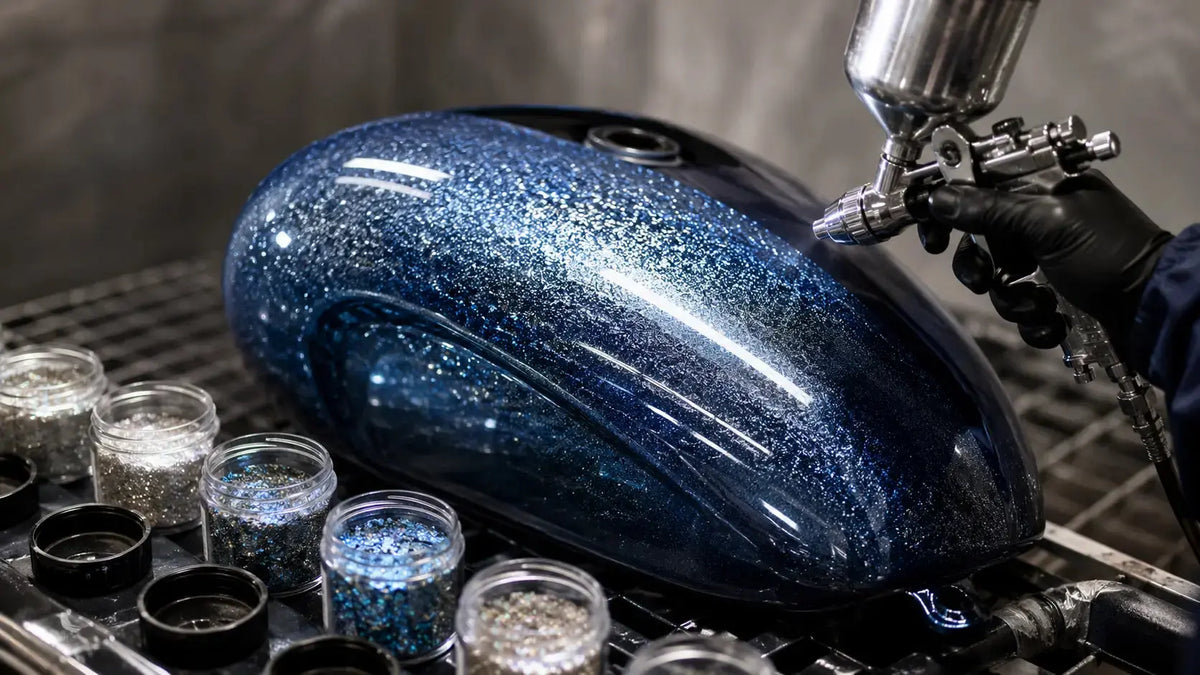
A metal flake finish can look incredible when it is done right. Under the sun, the panel changes every time you move around it. That is why flakes are still popular on custom cars, motorcycles, lowriders, hot rods, helmets, tanks, and show builds.
But metal flake is not as forgiving as a normal base coat. If the mixture is too heavy, the gun can clog. If the flakes settle in the cup, the finish can look patchy. If the nozzle is too small, the material may spit instead of spraying evenly. And if you do not bury the flakes with enough clear, the surface can stay rough even after polishing.
This guide focuses on the practical side: how to mix metal flake, how to choose the right spray gun tip size, and how to avoid the problems that usually show up when spraying flakes for the first time.
What Makes Metal Flake Paint Different?
Metal flake paint uses reflective particles that are much larger than the metallic particles found in regular automotive metallic paint. Those larger flakes are what create the deep sparkle and custom effect, but they also make the job harder to spray.
With regular metallic base coat, the metallic particles are already built into the paint system and usually stay suspended more evenly. With metal flakes, the painter often mixes the flakes into an intercoat clear or another compatible carrier before spraying. That means the flakes can settle in the cup, collect around the fluid passage, or spray unevenly if the setup is wrong.
That is why a metal flake paint job should be treated as its own process, not just as a normal base coat with extra sparkle added.
Plan the Job Before Mixing Anything
Before you open the flake bottle, decide what kind of finish you are trying to build. A light sparkle over a base color is very different from a heavy show-car flake job.
A few questions matter right away
- Are you using fine, medium, or large flakes?
- Is the project a full panel, a motorcycle tank, a helmet, or a complete vehicle?
- Will the flakes be sprayed in intercoat clear?
- How much clear will be needed to bury the flakes afterward?
- Does your spray gun have the nozzle size needed for the flake you are using? For a closely related workflow, see our guide to spray gun air pressure regulation.
Planning this early saves a lot of frustration. Most bad flake jobs do not fail at the final clear coat. They usually go wrong earlier, when the mixture is too heavy, the gun is not set up correctly, or the flakes are not applied evenly.
How to Mix Metal Flake
Always start with the flake manufacturer’s instructions. Different flakes and paint systems may require different mixing ratios. But the general approach is similar in most custom refinishing work.
In many cases, flakes are mixed into an intercoat clear instead of the final clear coat. For more control over metallic or pearl orientation, see our guide to pearl color shift between clear coat layers. Intercoat clear gives you more control because you can build flake coverage in stages, check the look, and then bury the flakes with clear afterward.
A practical mixing process
- Prepare a compatible intercoat clear or carrier according to the product instructions.
- Add the metal flakes gradually rather than dumping in a large amount at once.
- Stir slowly and thoroughly until the flakes are distributed through the mixture.
- Keep mixing or gently agitating the cup during spraying because flakes settle faster than most beginners expect.
- Do not overload the mix. Too many flakes can cause clogging, uneven spray, and a rougher finish that is harder to bury later.
A good rule is to build the effect slowly. Several lighter flake coats are usually easier to control than one heavy pass. Heavy coats may look faster at first, but they can leave tiger-striping, dry patches, or uneven sparkle across the panel.
Why Intercoat Clear Is Commonly Used for Flakes
Intercoat clear is useful because it gives the flakes a controlled layer to sit in before the final clear coat. It lets you adjust the amount of flake without locking yourself into the final finish too early.
If the first pass looks too light, you can add another flake coat. If the effect is strong enough, you can move on to clear. That flexibility is one reason many custom painters prefer intercoat clear for flake work.
The final clear coat still matters. Metal flakes create texture, especially medium and large flakes. You need enough clear to cover the flakes properly so the surface can later be sanded and polished without cutting into the particles.
What Size Spray Gun Tip for Metal Flake?
The spray gun tip size depends mostly on the flake size. A tip that works fine for normal base coat may be too restrictive for larger flakes. When the fluid passage is too small, flakes can clog the gun or spray unevenly.
|
Flake Size |
Common Tip Size |
Notes |
|
Fine flakes |
1.3-1.4 mm |
Usually manageable with many automotive base coat setups. |
|
Medium flakes |
1.4-1.8 mm |
Often sprays more consistently with a larger setup. |
|
Large flakes |
1.8 mm or larger |
May require a dedicated flake gun or larger fluid passage. |
These are general guidelines, not a replacement for the flake manufacturer’s instructions. Air pressure, reduction, material viscosity, and spray technique all affect how well flakes move through the gun. For more control over metallic or pearl orientation, see our guide to vertical spraying and pressure control.
If you are between two nozzle sizes, a slightly larger setup is usually safer than one that is too small. You can control material flow and technique, but you cannot make large flakes pass smoothly through a fluid passage that is too restrictive.
Best Way to Spray Metal Flake on a Car
The best way to paint a car with flakes is to slow down and build the finish in layers. The job is more about control than speed.
1. Prepare the surface properly
The panel needs to be straight, clean, and ready before any flake work begins. Sanding scratches, dirt, wax, grease, or uneven primer will not disappear just because the finish has sparkle. Flakes may even make surface problems more obvious under direct light.
2. Apply a consistent base color
The base color affects the final look. A dark base can make flakes look deeper and more dramatic. A bright or matching base can create a cleaner custom effect. For more control over metallic or pearl orientation, see our guide to pearl white tri-coat paint matching. Whatever color you choose, spray it evenly and let it flash according to the paint system’s instructions.
3. Test before spraying the panel
Before spraying the actual car, test the mixture on a small panel or card. Check whether the flakes are flowing through the gun, whether the pattern looks even, and whether the flake density matches the look you want.
This step is easy to skip, but it can save the job. It is better to discover a clogging or coverage problem on a test panel than on the hood, tank, or quarter panel.
4. Spray light, even flake coats
Keep the gun moving at a steady speed and keep your overlap consistent. Do not chase full coverage in one pass. If the flake looks too light, add another controlled coat instead of flooding the panel.
Also remember to stir or gently shake the cup during the job. Flakes settle. If you ignore that, the first part of the panel may look light while the last part gets overloaded.
5. Bury the flakes with clear coat
Once the flake coverage looks right, apply enough clear coat to bury the flakes. Medium and large flakes can leave texture. If the clear is too thin, the finish may feel rough and may not polish safely.
Many painters refer to this stage as “burying the flakes.” It simply means applying enough clear to fully cover the flake layer so the final surface can be sanded and polished without exposing the particles.
Common Problems When Spraying Metal Flake
Clogging at the gun
This usually happens when the nozzle is too small, the mixture is too heavy, or the flakes are too large for the setup. Straining recommendations vary by flake type, so follow the product instructions. Some flakes should not be filtered through a fine strainer because the flakes themselves may be removed.
Patchy sparkle
Patchy sparkle often comes from uneven passes, inconsistent overlap, or flakes settling in the cup. Stirring regularly and applying multiple light coats can help keep the appearance more even.
Rough clear coat
A rough finish may mean the flakes were not buried with enough clear. Larger flakes need more clear than a normal base coat job. If you plan to sand and polish, make sure there is enough material above the flake layer.
Too much flake in the mix
More flake does not always mean a better finish. Overloading the mix can make the gun harder to control and can leave the panel looking uneven or dirty instead of clean and reflective.
Choosing the Right Spray Gun for Metal Flake
For fine flakes, many standard automotive spray guns can work if the material is mixed correctly. For medium and larger flakes, the gun setup becomes more important. You need enough fluid passage for the flakes to move through, a stable fan pattern, and consistent material flow.
A good flake setup should help with
- consistent flake distribution
- reduced clogging
- stable fan pattern across the panel
- smooth material flow
- the option to use a larger nozzle when needed
The spray gun will not fix poor mixing or bad prep. But when the material and surface are ready, the right nozzle size and a stable gun make the job much easier to control.
Recommended PORPHIS Spray Gun for Metal Flake Work
For painters who want one gun that can cover both regular refinishing work and some custom finishes, the PORPHIS PRD-515 MP Spray Gun is a practical option.
The main reason it fits this type of job is the available nozzle range. With both 1.3 mm and 1.8 mm options, the PRD-515 can be used for conventional base coat work as well as medium flake applications that need more fluid passage.
The 1.3 mm setup is suitable for many base coat and clear coat jobs. The 1.8 mm setup gives more room for heavier material or medium-sized flakes, depending on the paint system and flake manufacturer’s recommendations.
For a metal flake paint job, that flexibility matters. You are not always spraying the same material. One project may need a fine flake over a base color, while another may need a heavier custom effect. Having the right nozzle option helps reduce clogging and makes flake distribution more predictable.
Recommended Product: PORPHIS PRD-515 MP Spray Gun

FAQ
How do you mix metal flake paint?
Mix flakes gradually into a compatible intercoat clear or carrier, stir thoroughly, and keep the mixture agitated during spraying. Avoid adding too much flake at once, because an overloaded mix can clog the gun and create uneven coverage.
Can you mix metal flakes directly into clear coat?
Some systems allow it, but many painters prefer intercoat clear because it gives more control. You can build the flake effect first and then apply final clear coats to bury the flakes properly.
What size spray gun tip should I use for metal flake?
Fine flakes often work with 1.3-1.4 mm tips. Medium flakes usually benefit from 1.4-1.8 mm. Large flakes may need 1.8 mm or larger. Always check the flake manufacturer’s recommendation before spraying.
Why does my metal flake spray unevenly?
Uneven flake usually comes from flakes settling in the cup, inconsistent overlap, heavy coats, or a nozzle that is too small. Keep the mixture moving and build coverage with several light coats.
How many clear coats are needed over metal flake?
It depends on flake size and finish goals. Medium and large flakes often need more clear than a normal paint job because the flakes must be fully buried before sanding and polishing.
Is PRD-515 suitable for metal flake paint?
The PRD-515 can be a good choice for fine to medium flake work because it offers both 1.3 mm and 1.8 mm nozzle options. For very large flakes, always confirm the flake manufacturer’s recommended tip size before spraying.
Final Thoughts
A good metal flake paint job is not about dumping more flakes into the cup. It is about controlling the mix, choosing the right carrier, using the right spray gun tip size, and building the finish slowly enough to keep the sparkle even.
Start with a proper base, test the mixture first, keep the flakes moving in the cup, and apply several controlled coats instead of one heavy pass. Then bury the flakes with enough clear so the finish can be sanded and polished safely.
If you are spraying fine to medium flakes and want a gun that can handle both standard refinishing and custom work, the PORPHIS PRD-515 MP Spray Gun is worth considering. With the right nozzle setup and careful technique, it can help produce a cleaner, more consistent metal flake finish.
Share:
How to Fix Paint Delamination on a Hood: Strip It or Repair the Damaged Area?
2K Clear Coat Safety Guide: What to Know Before You Spray