
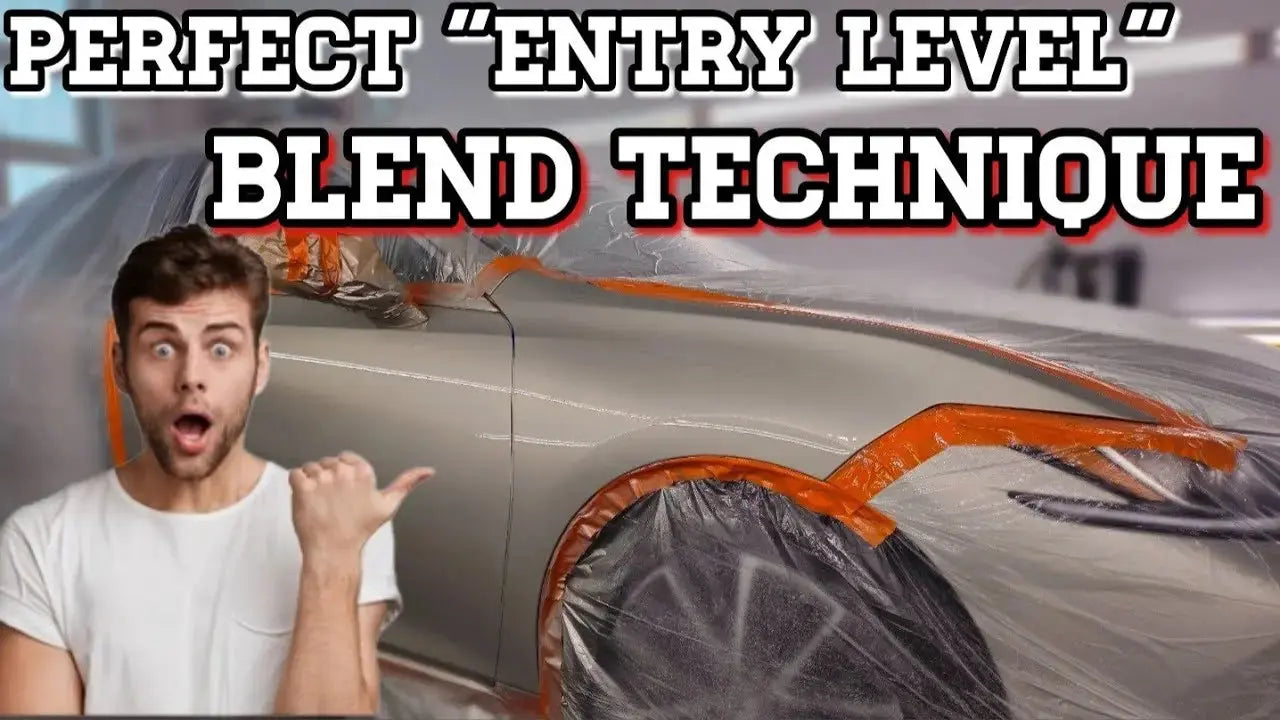
1. Executive Overview and Strategic Intent
In automotive refinishing, managing complex metallic and pearl pigments—such as Code 4X8 (functionally similar to the notoriously difficult Code 4M9)—requires a shift from traditional application methods to high-precision mechanical control.
This Standard Operating Procedure (SOP) addresses the phenomenon of "blend creep," where horizontal spraying patterns cause the transition zone to expand uncontrollably across large panels.
By standardizing vertical reciprocating motion and utilizing PORPHIS PRD Split-Nozzle Technology, technicians can achieve superior flake orientation and localized color transitions for effective pearl coat application.
This approach ensures color match accuracy, significantly reduces material waste, and eliminates the need for full-panel refinishing.
Success is predicated on a foundation of rigorous substrate preparation and precise pneumatic calibration.
2. Substrate Preparation and Pre-Painting Requirements
-
Abrasive Specification:
All blend panels must be finished to 800 grit. This specific level of abrasion provides the necessary surface energy for adhesion while ensuring sand scratches are shallow enough to be completely leveled by the basecoat resin, preventing "mapping" under light-sensitive silvers, champagnes, and pearl coat formulations. -
Technician’s Pre-Paint Checklist:
-
Substrate Verification:
Confirm the repair area (primer/sealer) is blocked and leveled. -
Hardware Strategy:
This SOP prioritizes cycle-time efficiency by utilizing precision masking over mechanical disassembly for mirrors and door handles, provided substrate integrity and masking boundaries are verified. -
Color Anchoring:
Verify the color transition zone on the adjacent fender. To prevent metamerism or "halo" effects, color should be introduced to the fender edge during the basecoat phase to anchor the match, even if sealer application is restricted to the repair area. -
Decontamination:
Execute a high-pressure blow-off followed by a surgical tack-rag wipe to ensure a zero-dust environment.
-
Substrate Verification:
3. Equipment Configuration: The PORPHIS PRD Split Nozzle System
The system focuses on precision pneumatic control rather than high-pressure force. By manipulating the air-to-fluid ratio, the technician can control exactly how the metallic and pearl flakes settle. Proper configuration is essential to transition from the high-solids coverage phase to the delicate "dusting" required for the final blend.
4. Phase I: The Wet Bed Application
-
Application:
Apply a nice, good, heavy coat of wet bed material across the repair and intended transition area. -
Visual Characteristic:
Upon application, the surface may appear mottled or show high solvent content. This is a normal byproduct of the leveling process; technicians must trust the flash-off period. -
Flash-Off Requirement:
Allow for a full matte flash-off. This ensures the solvents have evaporated sufficiently to provide a stable foundation for the vertical coverage coats.
5. Phase II: Vertical Reciprocating Spraying for Coverage
Traditional horizontal spraying often fails on large, flat panels because the natural arc of the human arm causes the blend to "creep" further into the panel with each pass. This SOP mandates a vertical (up and down) motion to mechanically limit the outward expansion of the blend, improving the application of metallic and pearl coats.
The Vertical Sequence:
-
Initiation (Color Anchoring):
Start the vertical stroke on the adjacent panel (e.g., the fender). This ensures the fender and the front of the door share the same metallic and pearl density, preventing "fender-to-door" color shifts. -
Mechanical Constraint:
By restricting the gun's lateral travel to the width of the fan pattern while moving vertically, the technician keeps the repair localized to the primer/sealer zone. -
The "Flip" Technique:
Reverse the vertical direction on the return pass. This "flip" ensures the metallic and pearl flakes are distributed from opposing vertical angles, providing total "hide" over the primer/sealer without increasing the blend's footprint.
Expert Engineering Tip:
Confine the spray pattern to the area under the mirror and away from the hood. By avoiding the upper horizontal surfaces where light hit is most direct, the technician reduces the risk of visible color drift in high-visibility areas.
6. Phase III: Staged Pressure Blending and the "Drop Coat"
Following coverage, the technical objective shifts from opacity to flake refinement. Reducing the atomizing pressure allows the metallic and pearl particles to fall softly, creating a "dusting" effect that dissolves the transition line.
Pressure Reduction and Fan Calibration
|
Phase
|
Pressure Setting (PSI)
|
Action / Technique
|
|---|---|---|
|
Initial Blend Coat
|
20 PSI
|
Small Fan Pattern:
Lightly dust the material over the transition edge to soften the color break. |
|
Final Drop Coat
|
18 PSI |
Final Refinement:
Execute a final vertical pass, ensuring the pattern remains forward of the door handle to maintain localized control. |
Prohibited Technique:
Technicians must strictly avoid "wrist-flicking" or "slinging." These motions create heavy paint build-up at the edge of the fan (centrifugal loading), resulting in visible dark lines or "halos." Maintain a steady, controlled vertical stroke for pearl coat applications.
7. Quality Validation and Post-Application Analysis
-
The Sunlight Test:
Once the basecoat has flashed and clearcoat is applied, move the vehicle into natural light. Inspect the panel from 45-degree and 90-degree angles. -
Flop and Halo Analysis:
Specifically evaluate the "flop"—the color change observed at different angles—to ensure the metallic and pearl orientation matches the factory finish. There should be no visible transition on the fender or the center of the door. -
Solvent Stabilization:
Allow the vehicle to sit in the sun for several hours before mechanical handling. This period is critical to allow for full solvent evaporation and metallic set, ensuring the finish has reached its final stable state.
Frequently Asked Questions
What is a pearl coat?
A pearl coat is a specialized automotive paint layer containing pearl pigments or mica flakes suspended in the basecoat. These pigments reflect light to create a unique iridescent effect that changes color and depth based on the viewing angle and lighting conditions. Pearl coats require precise application techniques to ensure consistent flake orientation and color transitions.
Why did pearl paint go out of business?
This usually refers to the decline of certain paint manufacturers specializing in pearl coat formulations due to market shifts favoring newer paint technologies or consolidation within the industry. However, pearl paints remain widely used in automotive refinishing, and modern advancements in spray gun technology and pressure control have improved their application and durability.
Share:
Professional Standardized Guide: OEM Plastic Bumper Painting & Fender Blending
Professional Standardized Guide: Professional Spot Repair and Clear Coat Blending