
1. Introduction and Equipment Context
In the modern professional refinishing workshop, the "mini" or "spot repair" spray gun has evolved from a niche accessory to a strategic necessity. Selecting the correct tool is a critical factor in material efficiency—directly reducing costly overspray on small repairs—and maintaining the high finish quality expected in localized blending. A high-performing mini-gun allows a technician to maintain a wet edge in tight areas where a full-sized gun would be cumbersome and wasteful.
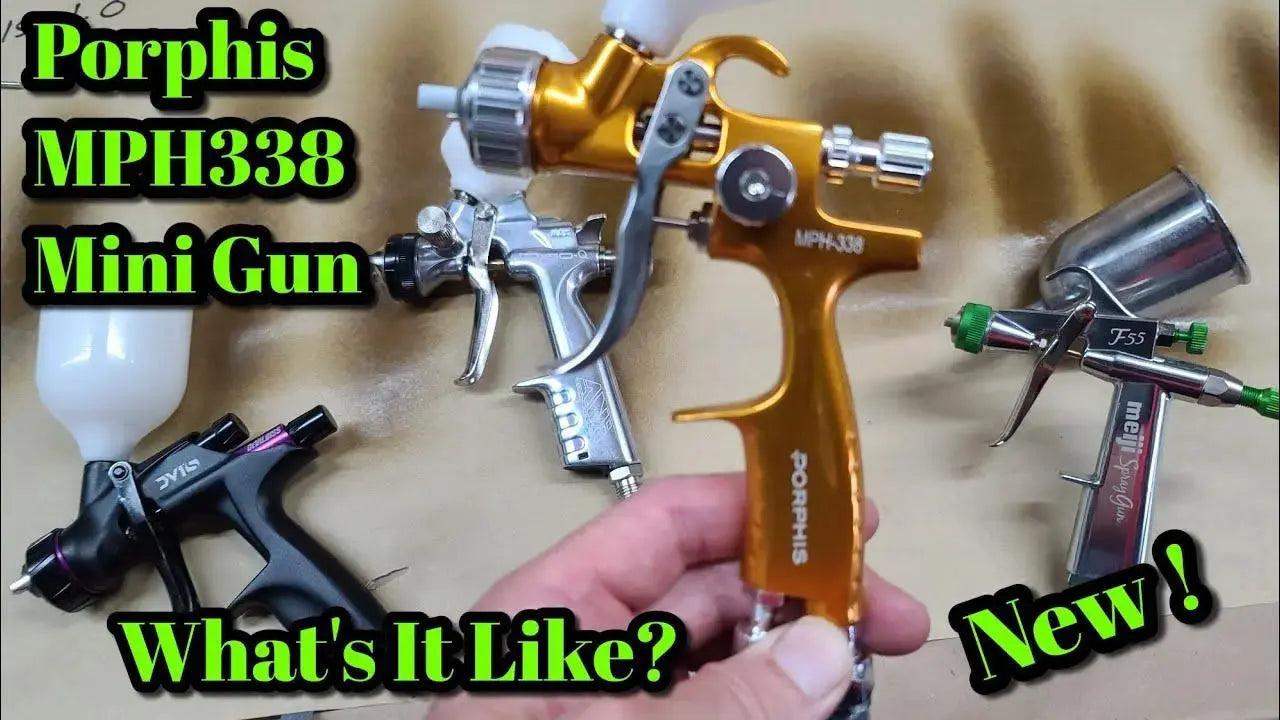
The PORPHIS MPH-338 is a recent entrant into this market, characterized by a "function over form" design philosophy. Eschewing the polished aesthetic flair of premium European models, the MPH-338 features a pragmatic, somewhat old-fashioned industrial aesthetic. Mechanically, it prioritizes reliability through a 10mm hex sealing system and a metal-on-metal taper seal. By eliminating nylon O-rings and soft crush washers, the design suggests a "workhorse" durability intended for rigorous daily use. This robust construction sets the stage for a tool that balances traditional engineering with specific physical dimensions tailored for the modern repair environment.
2. Comparative Physical Architecture and Ergonomics
Tool geometry is a critical factor for maneuverability, particularly when navigating the intricate contours of automotive panels or working within the confined spaces of detail-oriented hobbyist projects. A tool that is too large sacrifices the precision needed for spot repairs, while an undersized "micro" gun may lack the fan stability required for seamless transitions.
In comparative architecture, the PORPHIS MPH-338 occupies a versatile middle ground. When placed alongside the DeVilbiss DV1S and the ANI R160, the PORPHIS is notably more compact, physically "hiding" behind the larger frames of these standard mini-guns. Conversely, it is significantly larger than "micro-guns" like the Meiji F55. Beyond the gun body, the brand includes a "Unis ring" and a badge with every purchase, representing a brand identity focused on corporate social responsibility—specifically a 5% donation from the purchase price to global children's charities.
|
Attribute
|
PORPHIS MPH-338
|
DeVilbiss DV1S
|
ANI R160
|
Meiji F55
|
|---|---|---|---|---|
|
Relative Size
|
Intermediate / Small
|
Large Mini
|
Standard Mini
|
Micro-Gun
|
|
Design Heritage
|
Influenced by Star/Astro 106TFG
|
Premium Modern
|
Italian Industrial
|
Japanese Precision
|
|
Unique Features
|
Lock ring; Dual Allen screws
|
S1 Air Cap; High Ergonomics
|
Twin air-hole horns
|
Low air consumption
|
|
Tactile Controls
|
Metal-on-metal "old-fashioned"
|
High-polish ergonomic
|
High-pressure specific
|
Precision micro-dial
|
 |
 |
 |
 |
The inclusion of a lock ring on the controls and dual Allen screws (reminiscent of the PRD-62 series) provides tactile security and adjustment stability. These architectural choices facilitate a transition from physical form to the technical dynamics of air and fluid management.
3. Technical Specifications and Air Dynamics
-
Recommended Pressure Range:
1.0 bar (14.5 PSI) to 1.5 bar (21 PSI). -
Air Consumption:
Approximately 160 L/min (~5 CFM). -
Nozzle Configurations:
Standard 0.8mm and 1.0mm available (0.5mm by special order). -
Fluid Delivery:
Included 250ml cup uses a preliminary identified M12 x 1.5 coarse thread.
Technical Nuance:
Expert inspection of the 0.8mm and 1.0mm kits reveals that they appear to share the same needle and air cap; the fluid tip remains the primary differentiator between these two setups. Furthermore, technicians should note that while the PORPHIS is physically small, its air demand is higher than "micro" competitors like the Meiji F55. During testing, a noticeable pressure drop occurred upon triggering, indicating that the PORPHIS requires a more robust air supply than its footprint might suggest.
The air cap design—featuring two holes top/bottom and two holes left/right of the exit hole—mirrors high-end Star air cap configurations. This design is instrumental in achieving atomization reliability, ensuring the spray pattern remains stable and consistent. These technical specs translate directly to the practical "spray-out" results observed in the booth.
4. Performance Benchmarking: Fan Width and Material Flow
-
PORPHIS MPH-338 (1.0mm @ 1.5 bar):
Produced a ~7.5-inch fan. It delivers high material volume, resulting in a significantly "wetter" and darker application than the other guns in this class. -
DeVilbiss DV1S (1.0mm @ 1.75 bar):
Produced the largest pattern at ~10.5 inches. The application is visibly "drier," indicating a wider distribution of the material. -
ANI R160 (1.0mm @ 3.5 bar):
Produced a ~6.5 to 7-inch fan. Critically, the PORPHIS achieves a similar (and slightly larger) fan width while requiring less than half the operating pressure of the ANI (1.5 bar vs. 3.5 bar), significantly reducing compressor strain and overspray potential. -
Meiji F55 (0.8mm @ 1.0-1.5 bar):
Produced a precision ~4-inch fan. This remains a micro-scale tool for surgical repairs rather than standard spot repair transitions.
Pattern Integrity Analysis: A standout finding for the PORPHIS MPH-338 is its "forgiving" nature. Even when pushed to 2.0 bar—well above the manufacturer's maximum recommendation—the pattern held together without separating or becoming top/bottom heavy. This suggests a universal utility, allowing technicians to increase pressure for higher-viscosity materials without risking pattern failure.
PORPHIS MPH-338
|
DeVilbiss DV1S
|
ANI R160
|
Meiji F55
|

|
5. Strategic Market Positioning and Procurement Recommendations
Procurement Urgency
-
Base Coat & Clear Coat Spot Repairs:
Optimal for intermediate repairs where a 7.5-inch fan is required to blend over medium-sized panels. -
High-Volume Finish Tasks:
Ideal for technicians who prefer a tool that lays down a heavy, wet coat quickly for faster "fill" on repairs. -
Workshop Versatility:
Due to its metal-on-metal seals and forgiving pressure range, it is an excellent choice for shops seeking a low-maintenance, reliable workhorse.
While the included 250ml cup is functional, the non-standard M12 x 1.5 thread means technicians must exercise caution and wait for confirmed PPS adapter compatibility before integrating the gun into a disposable cup system.
Share:
Spray Gun Comparison: PHS-155 vs. PHS-156
Spray Gun Comparison: PRD-815 vs. DV1